The simple home test that could be 'amazing' for bladder cancer patients

 BBC
BBCTrevor Field knows how uncomfortable tests for bladder cancer can be.
In the 13 years since the 81-year-old was diagnosed, he has had more cystoscopies than he can count.
The procedure involves inserting a camera into the bladder and he has to have these every six to 12 months, to make sure his cancer has not returned.
But he could eventually benefit from a simple urine test at home instead: "That would be tremendous."
The test is currently being offered to new patients in Coventry and Leicester along with parts of Wales and will lead to faster treatment and cut waiting lists, according to the West Midlands Cancer Alliance.
Trevor, from Tipton, said that would be "amazing" and that the procedures he has "aren't the easiest thing" for some people.
"I can understand some people would get embarrassed as most of the staff when I go are female and I can understand some people would find that difficult," he added.

When he got his diagnosis in 2013, he had to wait about six weeks for the test and said being able to carry out a simple test at home should help cut waiting times.
"The sooner they find you have something, the better the outcome," Trevor said.
"Mine was caught early enough; if I had not gone when I did and it had gone through my bladder, it could have spread to other parts of my body."
The idea of the new tests is an exciting one for Altan Omer.
He is a consultant urologist at the University Hospitals Coventry and Warwickshire NHS Trust as well as being chair of the alliance's urology expert advisory group.
"We will stop performing unnecessary tests which can harm patients," he told me.
"It has got a great accuracy. It's got a sensitivity of 92% in detecting bladder cancer and it also has got a high accuracy at ruling out bladder cancer of 99.3%."
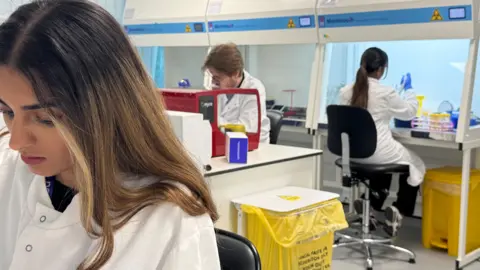
The urine test can provide a result within two weeks. The NHS requirement is for patients to have a diagnosis within 28 days of their referral.
But figures from the West Midlands Cancer Alliance show nearly a third of patients waited more than six weeks for a cystoscopy in West Midlands hospitals in 2025.
That compares to just over a quarter nationally. The waiting list in Coventry was 66%.
The academic research for the test took place over a decade at the University of Birmingham and was then developed over the last two years at Nonacus, a diagnostic company in Quinton, on the outskirts of the city.
"Currently there are about 320,000 people in the UK that have blood in their urine and that's a key risk factor for bladder cancer," the firm's chief executive Jeff Bousfield said.
"When patients come in for an invasive procedure today to see if there is cancer present, only around seven per cent of those tested have cancer.
"It means that in effect you have all of these people in a waiting list that are actually cancer free that are taking up space I suppose from testing those that actually do have cancer and need to be treated more quickly."
Currently the test is for new patients with possible symptoms.
But trials are going on in the hope of rolling it out within the next two years for people like Trevor, who need monitoring.
"If they can, just by simply taking a sample of your urine, tell you that there's nothing to worry about, that would be amazing," he said.
The new test will be available in all West Midlands hospitals by next April after it was commissioned by the West Midlands Cancer Alliance.
Nonacus said it was working towards wider national access and was in discussions with a number of NHS trusts.
The government was determined to make use of new technology to improve cancer treatments in England, a spokesperson for the Department of Health and Social Care spokesperson said.
"While NHS organisations make decisions based on the needs of their local population, we've set up a programme to identify new technologies that have the potential to benefit both NHS patients and services," they added.
Follow BBC Coventry & Warwickshire on BBC Sounds, Facebook, X and Instagram.