'I went for an eye test and was told I had cancer'

 BBC / Gavin Kermack
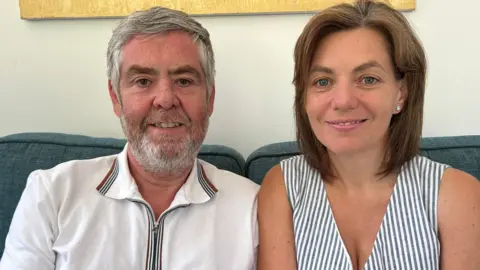
When Jez Bridges visited his optician for a routine eye test, he never expected it would lead to a terminal cancer diagnosis - and a fight to raise £200,000 for private medical treatment.
The 59-year-old father of four from Kinver, Staffordshire, has uveal melanoma, a rare cancer of the eye, which has spread to his liver and is now incurable.
His only option is a procedure not available on the NHS, but which could give him more time with his family.
"You tend to take that time for granted," said Bridges, who is also raising awareness of the importance of regular eye tests. "But when you're with faced with this, you realise how valuable it is."
Bridges had visited his local branch of Specsavers last July to get his eyes tested when he was offered an optical coherence tomography (OCT) scan, which produces a 3D image of the entire eye, rather than just the surface.
The optician found a small mole on his eye, which turned out to be uveal melanoma.
 Family Handout
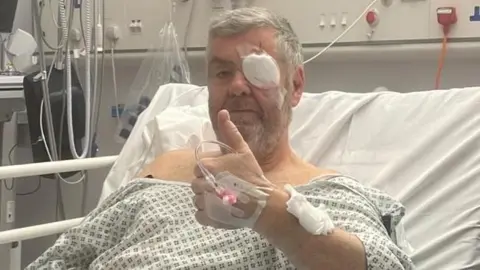
Despite a positive initial prognosis, six months later Bridges was told the cancer had spread to his liver and he was given between one and two years to live.
His only option is chemosaturation, a highly intensive targeted therapy which is not offered on the NHS, but which is available privately at a cost of £40,000-£46,000 a session.
Although it will not save Bridges' life, it could extend it.
Jo Gumbs, the chief executive of the charity Ocular Melanoma UK, said a recent study suggested the treatment could make a difference in nine out of 10 patients.
"Whether people have a complete response, a partial response, or stability, that's classed as a good outcome, because uveal melanoma can be such an aggressive cancer."
A spokesperson for the National Institute for Health and Care Excellence (NICE) said its guidance concluded that chemosaturation could be used, but there were some "uncertainties about its safety and efficacy" and its use was recommended with sufficient oversight.
 BBC / Gavin Kermack
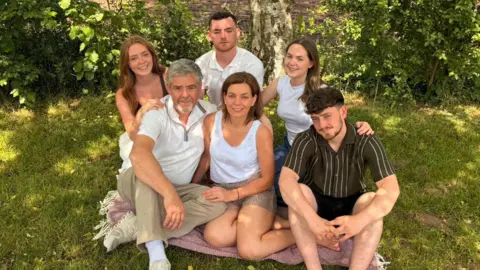
The extra time with his family would mean "everything", Bridges said.
"I can't even begin to think about any of the kids, their futures, them getting married, let alone grandchildren, that I probably won't see anyway."
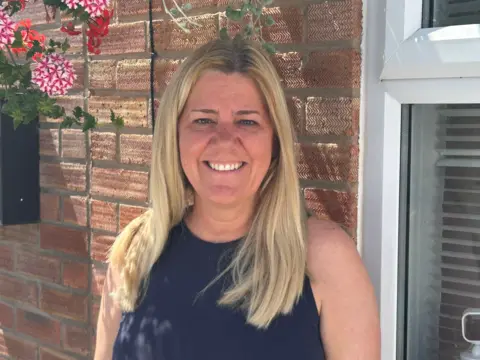
Bridges' sister Justine Owens, from Kempsey, Worcestershire, is leading the fundraising.
"He just wants to be with us, to spend time with us," she said. "He doesn't want to climb a massive mountain or travel to Timbuktu - this is just about spending time with his family, making memories and sharing precious time."
 Family Handout
Bridges and his family are hoping to raise awareness of the importance of regular eye tests.
"It's given us time to put things in place and enjoy the time that we've got," said his wife Kate. "But there are other conditions that are fully treatable that eye tests can pick up and and have a better outcome."
"If I hadn't had that eye test - still to this day, I have no symptoms whatsoever," added Bridges.
"It wouldn't have been until I started having issues, and it's too late then. You're talking about three months, four months.
"You've got no time to prepare or to do the things you want to do or say.
"And that's what it's given us - invaluable time."
Follow BBC Stoke & Staffordshire on BBC Sounds, Facebook, X and Instagram.