London rivers and waterways clean-up plan launched

 EPA
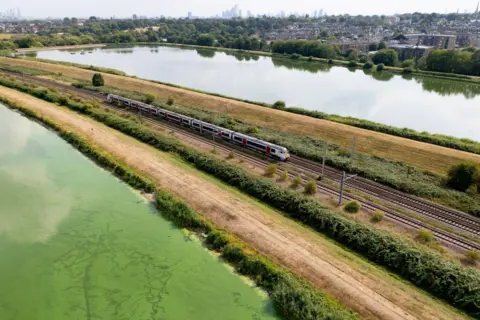
EPAA 10-year plan to clean up some of London's rivers and waterways has been announced by Sir Sadiq Khan, who says they have suffered from "decades of neglect and pollution".
A total of £1.8bn has been pledged by water companies, boroughs and charities, with London's mayor adding £2.7m across three years, on top of £13.6m already promised.
The city's main waterway, the River Thames, has been polluted by at least 72 billion litres of sewage discharges since 2020, BBC News revealed in 2023, although that figure was likely to be much higher.
Sir Sadiq said rivers were "the lifeblood of the city but for too long, they have been neglected, polluted or cut off from the communities around them".
The plan is to stop sewage and pollution flowing into rivers, improve river health with regular testing and enable fish and other wildlife to return to habitats where they can thrive.
It also aims to deliver clean, safe blue spaces to be able to swim.
Last month, Fulham Reach Boat Club in west London recorded levels more than 60 times the Environment Agency's threshold for suitable bathing water.
Thames Water is responsible for supplying water and treating sewage in much of London and some surrounding counties. There were nearly 600 storm overflows into watercourses last year, figures from its own website show.
Ten locations across the city have been earmarked for cash:
- River Brent catchment (Barnet, Brent, Harrow, Ealing, Hounslow)
- Yeading Brook (Harrow, Hillingdon)
- Upper Lea Valley (Enfield, Haringey, Waltham Forest)
- Lower Lea Valley and Royal Docks (Newham, Tower Hamlets)
- Grand Union Canal (Brent, Ealing, Hammersmith & Fulham)
- Salmons Brook and Pymmes Brook (Enfield)
- River Roding (Newham, Barking and Dagenham)
- Ravensbourne catchment (Croydon, Bromley, Lewisham)
- Wandle catchment (Croydon, Wandsworth, Sutton, Merton)
- Lower Crane Valley (Hounslow, Richmond)
Sir Sadiq said: "Habitats that should support otters, kingfishers, water voles, fish and other wildlife have been damaged by sewage, road run-off, litter and decades of underinvestment.
"The impact has been felt by nature and by Londoners, particularly those communities that already experience the greatest environmental inequality.
"I firmly believe access to nature is an issue of social justice."
Listen to the best of BBC Radio London on Sounds and follow BBC London on Facebook, X and Instagram. Send your story ideas to hello.bbclondon@bbc.co.uk