'Mountain climb helped clear storm inside my head'
It was on the popular route to the summit of Pen y Fan in the Brecon Beacons that army veteran Lee Rackham's life changed forever, as the "mental storm" in his head disappeared.
Diagnosed with Post-Traumatic-Stress Disorder (PTSD) in 2013, 40-year-old Rackham, from Swindon, said before then he was "in a dark place" after losing his best friend while serving in the army and later his parents, all while looking after his son who was ill in hospital.
The mental load had taken its toll so much that Rackham, who now works as a scaffolder, even tried to take his own life.
Chloe Mackay, CEO of the charity Combat Stress said the rates of PTSD among the generation of soldiers who went to Afghanistan and Iraq is one in 10, rising to one in five for those in a combat role.
- If you have been affected by any of the issues raised in this story, information and support can be found at the BBC's Action Line.
"People can take a long time to come forward for support, it takes an average of 14 years after discharge before contacting us.
"Treatments are effective, and 70% of veterans can reach recovery, but often people don't know they have mental health problems.
"You can have difficulty sleeping and experience anxiety and it's not always obvious you have a mental health problem," she added.

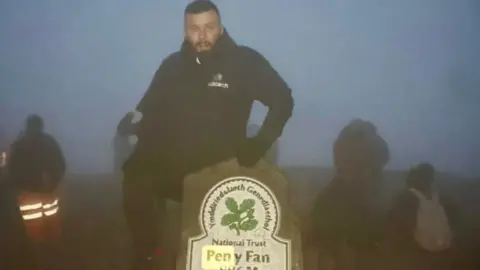 Lee Rackham
Based in Bulford, Rackham served in the army between 2007 and 2012, which included a tour of Afghanistan in 2011.
He told BBC Radio Bristol while he had a few counselling sessions after leaving the military, he struggled with his mental health and later tried to take his own life.
Describing his head as "spinning", Rackham said at the time he was "struggling".
"No one knew what was going on inside my head," he said.
According to the Office for National Statistics, there were 6,190 suicides registered in England and Wales in 2024, around three quarters of them were men.
Andy Barton, from Andy's Man Club, a male anti-suicide charity, said there continues to be a "stigma" when it comes to men talking about low moods.
"Men say they are showing weakness if they do talk to people outside the groups, and lots of people think they are a burden on somebody if they do," he said.
Rackham said opening up to people was something he had struggled with, especially as he wanted "to be that hard man".
"When you're a scaffolder you don't want to bother anyone...in reality you need to actually talk to people," he said.
"My mate rang me up after he found out [that he tried to take his own life] and said he'd rather I cried on his shoulder than him cry at my funeral," he added.
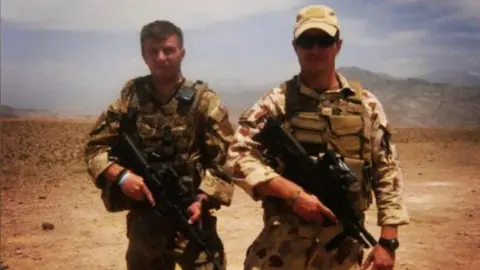 Lee Rackham
Rackham said it was only after a chance decision to climb the Welsh peak alone in November, that he found a way of helping himself out of the mental "storm" in his head.
"It was dark as anything [the climb] and I thought, 'I've got to do this', but as I got half way up I kept on thinking, 'I can't do this, you're weak'.
"I got to the top and that's when my whole life turned around, so many other people were up there as the sun came up - they were laughing and hugging."
"If you're in a dark place at the moment what have you got to lose. Take yourself out of that comfort zone and do it," he said.
"When a storm comes it's always going to pass and something better will come out of it," he added.
Follow BBC Bristol on Facebook, X and Instagram. Send your story ideas to us on email or via WhatsApp on 0800 313 4630.