New endometriosis tests welcomed but 'do not solve all problems'

 Geet Athwal
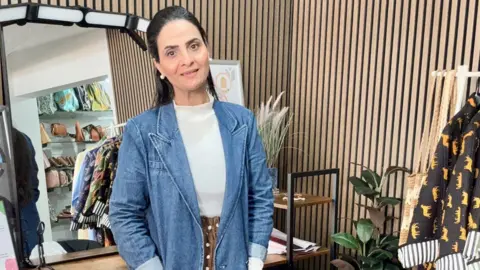
Geet Athwal first started experiencing pain when she was 22 and living in India.
Initially told that she had PMOS - or polyendocrine metabolic ovarian syndrome - she said she was left to get on with her life and was told the pain would settle in time.
Moving to the UK in 2009, she had learnt to manage the pain. But when she was rushed to hospital in 2012, surgery revealed that she had stage four endometriosis.
Athwal, who now lives in Shifnal, said she was left without support - she knew the word endometriosis, but had no idea what it was.
Life after the diagnosis with little support was tough - Athwal had five painful and distressing failed rounds of IVF before her daughter was born.
"From 2012 to 2026 I've had seven surgeries in total. Finally in December 2025, I had full hysterectomy."
She now hopes that two new non-invasive tests being offered via the NHS to detect the condition could help women in a way she was not.
 Geet Athwal
The two new tests are being recommended under new draft guidance for the NHS in England and Wales, alongside regular checks.
The new draft recommendation means GPs will be able to start offering either or both to some patients, if available.
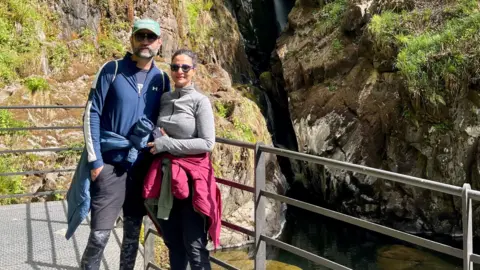
"From the point of view that I have a daughter, I've got nieces... it's a good start so that women, girls, young women don't have to wait for a surgery to actually really prod inside you to know that you've got endometriosis," said Athwal.
She added that the tests could help bring down the average wait for a diagnosis of nine years and four months, according to a new report on diagnosis wait time by the charity Endometriosis UK.
However, she said: "Diagnosis speed matters, but it doesn't mean that better treatment options are there."
"If I go to my GP now, I have more documents and research work for my own self than they have.
"It's not problem solved and it also needs to find faster access to a specialist gynaecologist and better treatment pathways. Train the GPs, train the health specialists."
 Bethany Lewis
For 19 year-old Bethany Lewis, her diagnosis of endometriosis four weeks ago was a massive relief.
In April 2025 she was diagnosed with PMOS, but still felt there was something not quite right.
She struggles with pain she likens to barbed wire around her stomach, which travels to her legs and often means she cannot stand or walk.
In September 2025, inspired by her struggles, she set up The Cysters Circle, a support group for women living with PMOS, endometriosis and other conditions.
It now has more than 300 members who chat online and meet in person.
'My doctor didn't know what endo was'
She said the news of the new tests are a step in the right direction.
"I think it's a good development in the sense that a lot of women and girls who are waiting will be able to get a quicker diagnosis," she said.
"It'll take pressure off hospital waiting lists as well, so a lot of extensive or more complex cases can be moved up."
She believes that if these tests could replace the invasive diagnosis process, it would help women get back to normal life, instead of having to worry about having time off work to recover from surgery.
"I think just more awareness overall needs to be done throughout GP services. My routine doctor didn't even know the symptoms for endometriosis, let alone what endometriosis was," she added.
 Worcestershire Acute Hospitals NHS Trust
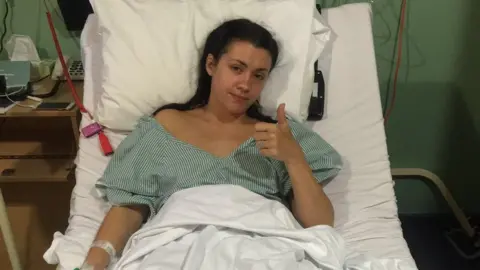
Harriet Windows, 34, from Worcester, has had debilitating symptoms since she was 13, and was eventually diagnosed with stage four endometriosis when she was 25.
She has had five laparoscopies and lost one of her ovaries as a result, and has since been diagnosed with adenomyosis.
A laparoscopy is keyhole surgery, and in cases like this, involves the removal of endometriosis with electrosurgical heat treatment or incisions.
"I'm never below a six out of 10 on a pain scale," she said.
"Other days it's so bad I can't get out of bed, which is tricky when you have two kids."
She added that she is sceptical over the new tests.
"I'm so thrilled if it works and if it's genuine... I would quite like to just watch and wait and see if it genuinely works.
"If it means that women can avoid having these horrible invasive laparoscopies just to diagnose it, or not, in some cases, then yeah, that's brilliant."
Follow BBC Shropshire on BBC Sounds, Facebook, X and Instagram.