Farmers reveal impact of hot and dry summer

 BBC
BBCFarmers across Gloucestershire have shared how the hot and dry weather has been impacting their livelihoods.
As drought has been declared across more than half of England, the BBC is shining a spotlight on farming as part of its Farmwatch series.
Farmers have said the lack of grass during the hot weather is making it harder to feed livestock, and dairy farmers are having to deal with hot and bothered cows producing less milk.
Others have said that while crop yields are down, the rising cost of fuel and fertiliser is hitting them hardest.
Professor Nicola Cannon from the Royal Agricultural University (RAU) in Cirencester said: "Gloucestershire and Wiltshire have gone through multiple heatwaves, there's people quoting 38-39 days without rainfall now."
She said the extreme heat has cut milk production by up to 20%.
"Cows feel stressed just as humans feel stressed when it's really hot, and as a response to that, their milk productivity goes down," she said.
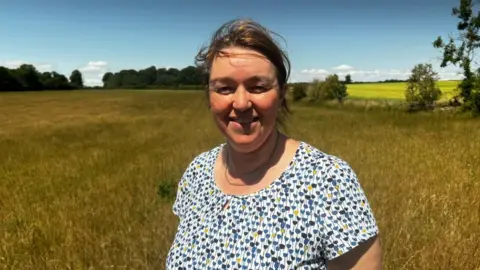
Cannon said that drought-hit grassland is also forcing many farmers to use winter feed earlier than planned.
"Soils are parched, and grass can't rebound after cutting for hay and silage," she said.
This comes as one farmer in neighbouring Somerset said this summer had been "the worst drought in 50 years", while another said he had lost half of his field crops planted in July.
Meanwhile, dairy farmers in Wiltshire have been installing "cow showers" and giant cooling fans to help their animals cope with the seemingly never-ending hot weather.
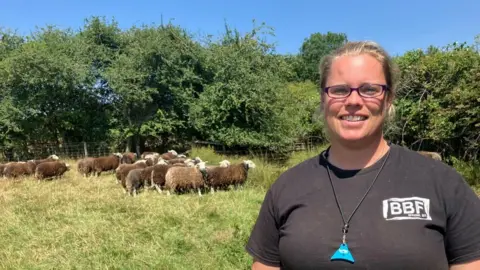
Abby Cook, a shepherdess from the Cotswolds, said: "Where we had grass, it's all burnt off really quickly, so it's making it a lot more challenging because our grass is disappearing really, really fast."
She said that her sheep need extra water while their lambs are still nursing, which is harder during such a dry summer.
While she said selling her wool, which is used for carpets and insulation, no longer covers the cost of shearing the animals.
"Whilst we'd always do [shearing] for animal welfare, now that is our sole reason," she said.
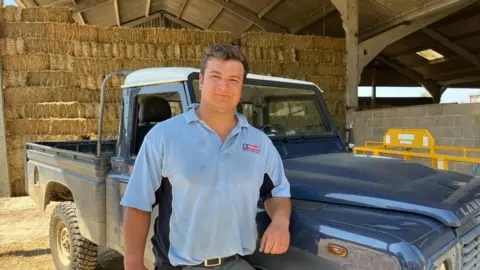
Arable farmer Jack Harvey, of Rudgeway Farm in Treddington near Tewkesbury, said he had found the weather kinder than last year.
"At least we have had a few drops of rain through the spring to get the crops growing well," he said.
However, he said a lot of arable farmers are "really struggling to pay the bills" due to higher prices for fuel, fertiliser and other chemicals they need.
"The price of wheat then hasn't risen to match it, and it's made the margins extremely tight," he said.
Potato farmer Graham Nicholls from Kingscote, Tetbury, has also seen positives from the warm weather, despite relying on Mother Nature to water his crops instead of irrigation.
"The yields will be down a little bit, but what we'll find is that the potato is actually a lot better quality because if potatoes are sat in wet, cold ground, some of them can rot," he said.
"We don't get any rotting when it's really dry, and also you don't get so many "greens"."
He said the extreme heat is a cause for concern, but potatoes will ultimately adapt to the shifting climate.
"Plant breeding will change, and they will develop potatoes that can actually stand this heat better," he said.
Follow BBC Gloucestershire on Facebook, X and Instagram. Send your story ideas to us on email or via WhatsApp on 0800 313 4630.