The rise and fall of Winchester's royal mint

 Getty Images
The Royal Mint has been making British coins for more than 1,000 years, located first within the Tower of London before moving to its current site in Wales in 1968.
But for 350 years, a cathedral city in Hampshire, had its own mint - striking coins under royal control.
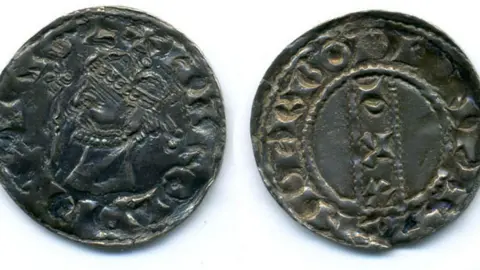
During the 890s, King Alfred the Great significantly reformed his kingdom's currency, issuing new uniform pennies and establishing royal mints - including one in his capital of Winchester.
The coins were made by moneyers and stamped with the words "win" or "winch". Severe penalties were imposed on those who dared to tamper with them.
"If you were caught coin clipping or mixing up your silver with other metals - your hand would actually be cut off and hung over the mint," explained Winchester tour guide Erica Wheeler.
In about 928, Athelstan, the first King of England, issued a decree laying down the laws governing the operation of mints and penalties for moneyers who broke them.
"Kings had to make sure that the money was good money - it wasn't mixed with any other lighter metals," Wheeler explained.
"The worth of the coin was literally in the weight of silver that was in the coin.
"It was a certain exact weight, so, if you were trying to debase the coin, to take a little bit of silver for yourself, you might clip off tiny, tiny bits of that coin.
"The user wouldn't really notice that but, eventually, that coin becomes really debased and, of course, the kings don't want their economy undermined by that."
 Winchester Council Collections/Hampshire Cultural Trust
Being granted a royal mint was a coup for the city, as it sought to cement its status as a centre for royal administration, said Dr Catherine Weikert, head of humanities at the University of Winchester.
"Winchester was really a significant royal city from as early as the 10th Century," she said.
"It was really significant for Winchester to have the royal mint alongside the royal palaces that were here."
But over time, the quality of the coins deteriorated and in 1124, King Henry I took drastic action, summoning a trial in the city, known as the Assize of Moneyers, resulting in dishonest moneyers from across the country being punished.
"The idea was that some of the moneyers had been actually stealing," said Weikert.
"They were either clipping coins or shaving coins, so taking - almost literally - a little bit off the top of the silver coinage, or they were underweighing it and keeping the change for themselves.
"You can't have dishonest moneyers... and your moneyers are also a direct employ of the royal power.
"So Henry I essentially assizes all of the moneyers, he checks all of the coins, he brings them together in Winchester and anyone who is found to be using underweights or clipping or shaving coins is severely punished.
"Some of them were even mutilated to make the point."

By 1279, the minting process had moved to a more secure location within the Tower of London and there is little visible evidence of the Winchester mint today.
"It's underneath the current buildings or it's actually enclosed or encased within the current buildings," said Weikert.
"The Royal Mint would have been located probably on a ground or a cellar floor within the area of the Pentice and St Maurice's Covert, just off of High Street."
Excavations in and around the historic city have unearthed some original silver pennies but the largest collection out of an estimated 24 million silver pennies that were struck in Winchester is housed at the Hermitage Museum in St Petersburg.