From lamp-post gatherings to iconic building: Centre for the deaf celebrates century

 Sally Fairfax / BBC
Its origins can be traced to the 1800s when a group of deaf people regularly gathered under a lamp-post in Hull's old town. Now, Hull and East Yorkshire Centre for the Deaf's building on Spring Bank is celebrating its centenary.
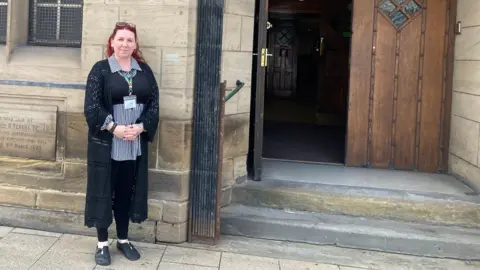
If you have ever walked down Spring Bank in Hull, you can't miss Hull and East Yorkshire Centre for the Deaf – a handsome brick building on the right as you head into town.
Centre manager Sarah Regan has been telling the Hidden East Yorkshire podcast how it came into being.
Having been silent all day at work, a group of deaf people would gather under a lamp-post on High Street in Hull at the end of a working day, with others from the deaf community.
After a while, a room in a local pub was rented to them and the charity began to take form.
They rented their first base in High Street in 1853, and the charity grew in size and popularity.
One of the members was an apprentice in Haller's shoe factory.
"Haller recognised that these people were all meeting after work to chat and to have that sense of community," says Sarah.
"Community is really important to deaf people. It's important to everybody."
What began as an informal gathering grew bigger and, at a time before education was standard for all, Haller set up a school for children and young adults who were deaf.
The residential school on Dock Street had about 10 to 15 students and the centre moved to Spring Bank, renting rooms in a terraced house.
"The community saved enough money to buy this land off a stonemason", says Sarah, as she takes me through the grand entrance of the centre that has housed the charity since 1926.
 Sally Fairfax / BBC
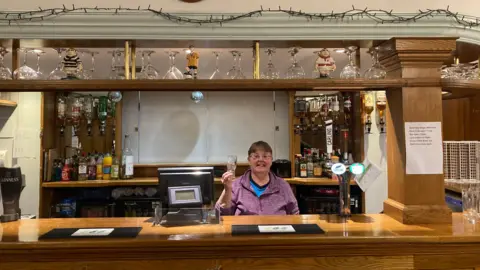
Inside, the building is built around a horseshoe shape, with the room in the centre a cosy pub.
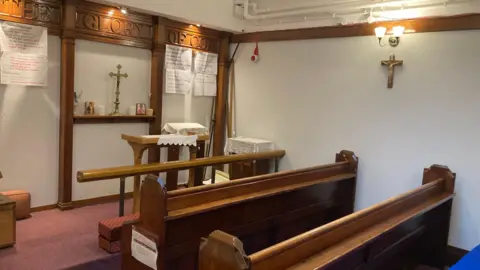
It was once the chapel, which has since moved to a different room where monthly services are held.
The intimate little pub, with a bar at the back where the vicar used to stand, has booths around the sides and is well-lit so users can see each other sign.
Next, Sarah takes me to a professional-looking billiards room with several large tables and wooden racks for cues around the sides. Matches are played every week.
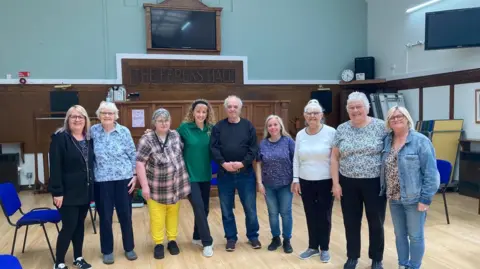
The largest room in the building is the sports hall, where members are gathering for a keep fit session.
 Sally Fairfax
Regularly used for badminton, parties, bingo and weddings, it was also the venue for a recent red carpet event to celebrate the centenary and to show a documentary about the centre, made by the members.
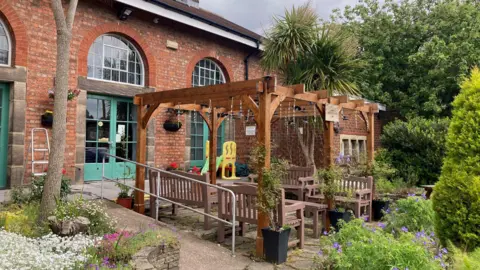
A secluded garden at the back offers an area for calm reflection, where users can have a drink and where plaques and benches commemorate past members who have passed away.
Members over 16 pay just £1 to visit the centre. Sarah tells me they do not want anyone's financial situation to be a barrier to them seeking community or support.
"It's a very isolating condition," she says. "A lot of these ladies live alone, so they don't speak to anybody in between coming here."
Sarah introduces me to two members. She signs my questions to them and interprets their responses back to me.
Sheila, who is in her 80s, has been coming to the centre since she turned 16. She says the people here are like brothers and sisters to her.
"If I'm outside I feel incredibly lonely and everyone leaves me out," she says. "I can't be involved in anything. But here, straight away I'm one of the team. We laugh all the time. This is my second home."
 Sally Fairfax / BBC
Mary, also in her 80s, is chairwoman of the centre's Centenary Committee.
She says she went to a deaf school but, when she left at 16 and went into the hearing world, she felt completely isolated.
"At school I'd heard that some of the older ones came to the deaf club and I was like, where is it?" she said.
"I had to ask my mum, please bring me to the deaf centre, please come with me, have a look round and make sure I'll be fine, make sure the building's nice and everything's OK."
Mary has been coming to the centre ever since.
 Sally Fairfax / BBC
The charity owns the building, meaning "we only have upkeep to worry about", Sarah adds. It relies on donations to help meet those costs.
"We are looking at £300 per day, with staffing and everything else, and it's got to come from somewhere," she says.
I leave the centre through the large wooden doors and step on to the street outside, where a lamp-post references how it all began many years ago.
Listen to highlights from Hull and East Yorkshire on BBC Sounds, watch the latest episode of Look North.
Download the BBC News app from the App Store for iPhone and iPad or Google Play for Android devices