Police commissioner defends force after Widdecombe investigation 'commentary'

 BBC
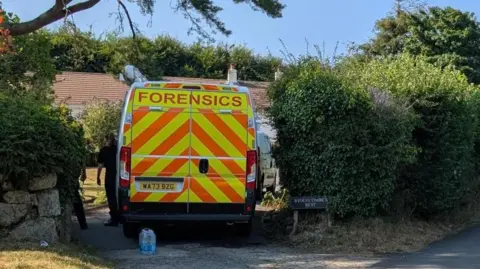
BBCDevon and Cornwall's police and crime commissioner has defended the force after the investigation into Ann Widdecombe's death was handed over to counter-terror officers.
Alison Hernandez acknowledged "commentary" about the way police communicated during the early stages of the case, but described the force's response as "substantial and professional" and said it was "not unusual" for counter-terror police to become involved later.
On Sunday, the force said there was "nothing to suggest" the attack on the former minister at her home in Haytor, Devon, was politically motivated.
The following day, a 28-year-old suspect was re-arrested on suspicion of terror offences.
The body of Widdecombe, a former Conservative minister and later Reform UK spokeswoman was discovered on Thursday 9 July. She sustained serious injuries.
A white British man, 28, from Rotherham, South Yorkshire, was initially arrested on suspicion of murder on Saturday.
Assistant Chief Constable Matt Longman said at the time officers remained "open-minded" about a potential motive and there was not thought to be any threat to the wider public.
After the suspect was re-arrested on suspicion of commission, preparation or instigation of acts of terrorism, Counter Terrorism Policing South East (CTPSE) said new information had "come to light during what has been a dynamic and complex investigation".
National Counter Terrorism Policing head Laurence Taylor said the investigation had built on "progress made by our colleagues in Devon and Cornwall Police".
On Tuesday, Taylor said his officers were "working to understand the extent of any planning or preparation and the motivation" behind the attack, which he described as "targeted".
Taylor added the killing had not, at this stage, "been declared a terrorist incident" and police had been given more time to question the suspect.
The Devon and Cornwall police and crime commissioner said she had spoken personally to Taylor, and thanked him "for the resources he offered early on" as well as to "seek reassurance that there has been a smooth handover of the investigation".
Hernandez accepted there had been "commentary" about the way her force had communicated during the case's early stages.
She also referenced comments from Home Secretary Shabana Mahmood, noting she had said "it is not unusual that in a fast-paced investigation, more information comes to light that changes the nature or the character of what the police are dealing with".
After Devon and Cornwall Police announced it was treating Widdecombe's death as murder, the force urged the public against sharing speculation about the case online, in particular with regard to any motive.
But speaking after counter-terror police had confirmed their involvement, Reform UK's deputy leader Richard Tice said it would be "wise, when considering motivation" for police to keep an open mind "as opposed to ruling things out too quickly that may then end up being ruled back in".
The party's leader Nigel Farage had earlier suggested the killing was likely to have been a premeditated act.
Speaking to Radio 4's PM programme on Monday, Jonathan Hall KC, the government's independent reviewer of terrorism legislation, said he was "slightly surprised" the force had guided the public away from the idea of there being a potential political element in the first place.
Hall acknowledged that, although this was a live investigation, police needed to be "really thoughtful" in releasing information in the social media era, and that police communications can improve.
"It's much better to be simply open-minded and say to the public something that's, you know, true - 'we don't know what's going on' - rather than appearing to rule something out and then having to reverse their position when new facts emerge," he said.
Asked about the level of speculation surrounding the case, Downing Street said it was important to protect the "integrity" of the investigation.