How woman who nearly lost home over hoarding finally reached out for help

 BBC
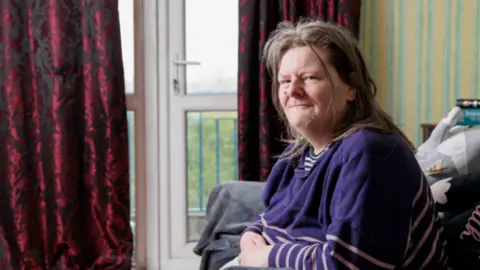
BBCRuth Cookson had always struggled to let go of things.
But as she grew up, the compulsion to hang on to objects – from the valuable to the worthless – became more and more of a problem.
And by the coronavirus lockdown, it had put her at risk of losing her home.
"Colouring books, kitchen utensils, clothes, coats, anything you could think of, I was hoarding it," Ruth told the BBC.
"And I didn't get one - it was two, three, four."
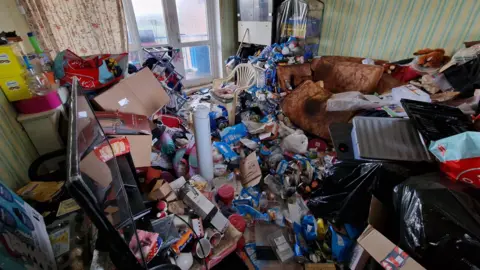
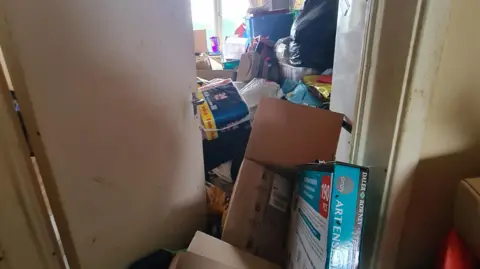
Her one-bedroom flat in Leasowe on Merseyside had become unlivable.
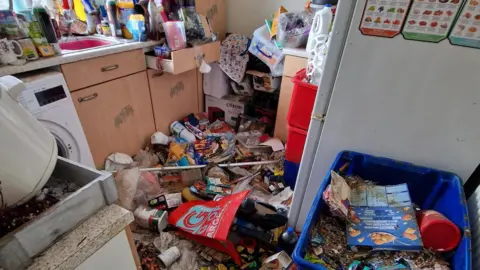
She found herself literally having to climb over piles of rubbish to get through her hallway or into her kitchen, bathroom or bedroom.
Her living room floor was virtually invisible under the mounds of boxes, carrier bags and containers, and replacements for things she'd lost in the mess.
Ruth, 53, said: "With the amount of stuff that I had, when I couldn't find it, I'd go out and buy something else. Then, when I couldn't find that, I'd go out again and bought another one. And then you could guarantee I'd have three, four, five of the same item.
"But then, when it comes to getting it all cleared, the difficulty is letting it all go."
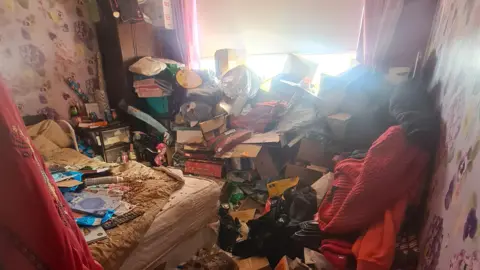
And Ruth was not just doing what experts call "dry hoarding" – where people build up things like cardboard, stationery, old bills and newspapers – but what is known as "wet hoarding" as well, where food waste is not thrown away and is left to fester and attract vermin.
Ruth does not know exactly why she started to hoard, but there is ample research that suggests trauma and loss can be triggers for hoarding - which is recognised by the World Health Organisation as a mental health condition.
And Ruth said there had been a number of traumatic events in her life that could have sparked her hoarding.
When she was five, a house fire killed two young, close relatives. She said later in life she experienced what she called a "really toxic relationship".
And Ruth said in some ways, the hoarding became a defence mechanism, a way of shutting out the world.
But that in itself started to become a serious problem.
"It was embarrassing. If someone needed to come to read the meter, I wouldn't let them in because of the state of the flat.
"I just felt so embarrassed and ashamed."
Ruth is one of an estimated 1.4m to 3m people in the UK believed to be hoarders.
But experts suggest that the true figure may be higher, because so many people will become isolated and not seek help.
Housing associations like Prima, which manages the block Ruth lives in, are now joining forces to work together on a national level to help and support tenants who hoard.
Jenny Devon, from Prima, said helping people to manage or overcome their hoarding was important if they were to be able to stay in their homes.
"There is now so much compliance that's required now, like gas servicing and electric checks,"she said.
She said if workmen could not get access to homes, the in the worst case scenario tenants could be forced to leave.
Prima has now set up a Housing and Hoarding Innovation Group, which is calling on other housing providers and local authorities around the UK to commit to adopting a standardised model of support for tenants.
She said Prima had been running groups for tenants who hoard, so they could come together and support one another.
And, she said, it had given a valuable insight into why some people find it impossible to throw things away.
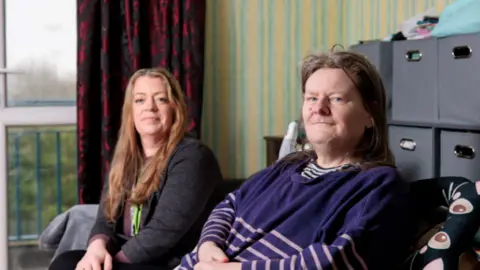
She added: "We have a lady that is in one of our peer groups and she holds on to paperwork. But it's a way to prove that she's right, because she spent a lifetime as a child being told by her mother not to say anything, not to question anything.
"And so the trauma behind that has become obviously something that she now is dealing with as a 70-year-old woman trying to understand her in hoarding."
Ruth's breakthrough came when her housing officer helped her put together a plan for how to take small steps to address the bigger problem.
"I said, 'I need help, I'm a hoarder, I need help. I'm sick to the back teeth of living in a tip'.
"And she said, 'OK then, we'll put a plan together. I'll come every week and we'll challenge you every week to do a small job'."
After clearing out the mess and going through her possessions, Ruth was able to work out what she needed and what she did not.
And now, she said, if something does not have a home within her home, it goes.
She said she would advise anyone who found themselves hoarding to seek help.
"You've got to admit that you've got a problem," she said. "It's the best thing I have ever done, saying I needed help.
"I'm a hoarder. I know what the problem is, why I hoard, and because now I know why I hoard, I can challenge it head on and try and keep on top of what I'm doing."
- If you are affected by any of the issues raised in this story, you can find help and support through the BBC Action Line.
Listen to the best of BBC Radio Merseyside on Sounds and follow BBC Merseyside on Facebook, X, and Instagram. You can also send story ideas via Whatsapp to 0808 100 2230.