Your guide to winter flu concerns in the East Midlands

 Reuters
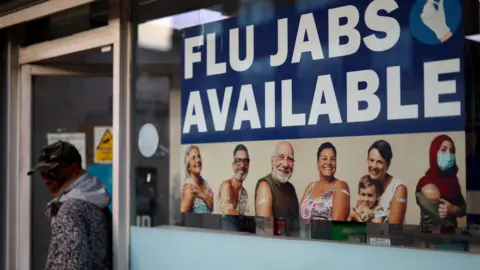
A surge in flu cases across the country has led to fears that health services could come under major strain this winter.
Health Secretary Wes Streeting has predicted a wave of "super flu" cases will present the NHS with a challenge "unlike any it has seen since the pandemic".
The fear is that increased social mixing over the festive season could exacerbate the situation over the coming weeks.
But what is the situation here in the East Midlands, and how bad could it get?
What is behind the surge?
 Reuters
Flu has arrived several weeks early this winter, and experts predict it could be a particularly nasty season because of a new mutated version of the virus that is circulating.
The version circulating this winter is H3N2 "subclade K", a type of seasonal influenza A virus. Some have been calling it "super flu".
People have not encountered much of it in recent years, which means there is less built-up immunity against it in the community.
The NHS has already sent out a "flu jab SOS", encouraging vulnerable people to get their free vaccination.
How does the local picture compare to the national trend?
Nationally, the number of patients in hospital with flu is at its highest level at this time of year since records began - although these records only date back to 2021 and do not capture the two worst flu seasons of the past 15 years, which were seen in 2014-15 and 2017-18.
The number of patients in hospital with influenza has risen more than 50% over the past week, with officials warning there is still no sign of "super flu" peaking yet.
Here in the East Midlands, experts at both Nottingham University Hospitals (NUH) NHS Trust and Sherwood Forest Hospitals (SFH), have reported significant increases in flu cases over the past eight weeks, replicating trends seen across the country.
Since the beginning of October, as of Thursday 11 December, there had been 1,115 patients testing positive for flu in both NUH and SFH - a 56% increase on the same period last year (up from 715).

In the most recently released set of figures, University Hospitals of Derby and Burton NHS Trust reported there were 44 beds occupied by flu patients on Sunday 7 December - a 38% rise on the previous week.
Meanwhile, University Hospitals of Leicester NHS Trust said there were 41 beds taken up by patients with flu on Sunday 7 December - a 17% increase on the previous week.
However most people with flu do not require hospital treatment and can safely recover at home.
How can people stay healthy and avoid infection?
A lot of advice around how to avoid getting flu is similar to the guidance repeated verbatim during the coronavirus pandemic. This includes:
- If you're meeting people indoors, open a window for fresh air
- Practise good hygiene
- Cough into your bent elbow, or use a tissue and dispose of it afterwards in the nearest bin
- Wash your hands frequently with warm water and soap
- Clean your surroundings often, especially areas that are touched frequently such as door handles
- If you are unwell but must go out, consider wearing a face mask
What have hospitals in our area said?
Harry Pick, a respiratory consultant in Nottingham, said: "In the last eight weeks cases of flu have soared in our hospitals, with the overall number of inpatients with flu being significantly higher than what they were during this same period last year.
"With cases still rising, it is likely that we are still yet to see the peak of this winter's flu admissions.
"Flu can make you feel very unwell and, in some cases, can be very serious. This is why it is so important to get a flu vaccination, as soon as possible if you can, to protect you from developing severe infection, especially in the run-up to the Christmas period.
"Such a large increase in flu places incredible pressure on our hospitals. Fortunately, many patients in hospital with flu have already had their vaccination and this has prevented them from developing severe infection, helped them to get home sooner and has freed up bed space for other patients in need."

Prof Damian Roland, a paediatric emergency medicine consultant at Leicester Royal Infirmary, said the early arrival of flu had led to the hospital being busier than usual at this time of year - but added the public could play its part in preventing services from becoming overwhelmed.
"We're hoping if patients who are susceptible to flu get the vaccine then we can make sure it doesn't grow into December and January - but that is a possibility," he said.
"We have a lot of services, both in GP practices and pharmacists around Leicester, Leicestershire and Rutland that can meet patients' needs and we think it's best they go to those services and we keep the emergency department for emergencies."
Meanwhile Dr Greg Fletcher, a consultant in anaesthesia and intensive care at the Royal Derby Hospital, said while cases number might be higher this year, he remained confident he and his colleagues could continue to provide a good service.
"We've seen bad winters before, and we have always coped," he added.
What is the difference between flu and a cold?
There are lots of coughs and colds doing the rounds. So how do you know if you have flu rather than something else? Your symptoms can give a clue.
Colds
- Symptoms appear gradually
- Mostly affect nose and throat
- Early sign is pressure in your ears
- Chestier, mucus cough
Flu
- Comes on suddenly
- You feel wiped out
- Fever, muscle aches, exhaustion
- Need bed rest
- Dry cough
Covid
- Typical flu symptoms
- Loss of taste or smell
- Diarrhoea or tummy upset
How can you treat yourself at home?
The NHS has these tips for anyone self-treating in the comfort of their own home:
- Get lots of rest and sleep
- Keep warm
- Take paracetamol or ibuprofen to lower your temperature and treat aches and pains
- Give paracetamol or ibuprofen to your child if they're distressed or uncomfortable - but check the packaging or leaflet to make sure the medicine is suitable for your child and speak to a pharmacist or GP if you're not sure
- Drink plenty of water to avoid dehydration (your pee should be light yellow or clear)
In addition, the NHS advises people to call 111 or ask for an urgent GP if you have flu symptoms and are pregnant, 65 or over, have a long-term medical condition, a weakened immune system or you do not feel better after seven days.
And anyone experiencing sudden chest pain, difficulty breathing or coughing up a lot of blood should call 999 or go to A&E. More information is available here.
Follow BBC Derby on Facebook, on X, or on Instagram. Send your story ideas to eastmidsnews@bbc.co.uk or via WhatsApp on 0808 100 2210.