Are Dartmoor's beloved hill ponies under threat?

 BBC
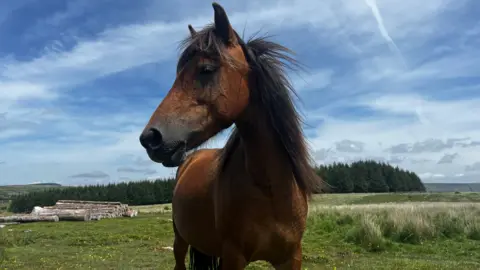
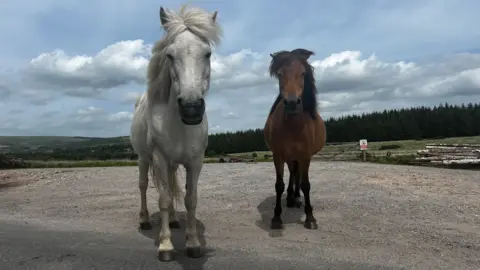
BBCDartmoor's semi-wild hill ponies, which have roamed the moor for more than 4,000 years, are at risk of extinction under new grazing rules, campaigners claim. The regulations are aimed at improving the moor's ecological condition but critics say the changes will put ponies in competition with more commercially viable sheep and cattle, forcing farmers to choose between the ponies and their livelihoods.
The rules have been put forward by Natural England which denies it is proposing a cull.
It says decisions about which animals are grazed on the moor rest with landowners and commoners, and that ponies will always be part of the mix.
However, critics say that ignores what they see as the inevitable outcome of the policy change - a cull of up to 90% of the remaining ponies on the moor.
For George Abel, Dartmoor's hill ponies are not a business.
His family has farmed on the moor for five generations, running a mix of sheep, cattle and ponies.
But unlike the others, he says, the ponies barely pay their way - "just about" covering the cost of the annual drift, when commoners gather the herds to check their health and remove foals from the moor to keep the population stable.
"It's more just the heritage and the culture is why we've maintained them," he says.
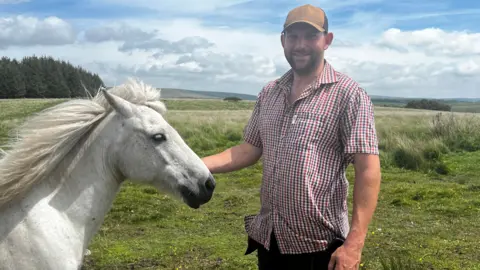
Abel says the ponies are not just a symbol of Dartmoor's past. They are, he says, rather than a part of the problem, "a large part of the ecological puzzle" on the moor and without them biodiversity "would suffer greatly".
Their place in Dartmoor's identity runs deep: so much so the pony was chosen as the logo of the national park when it was designated in 1951.
Nick Bruce-White, chief executive of Devon Wildlife Trust, says the ponies are "absolutely iconic, loved" and "critical for the management and restoration of Dartmoor's habitats", adding: "We cannot restore nature as we desperately need to on Dartmoor without hill ponies."
But he says Dartmoor's grazing picture is "really complicated" and "very dangerous to oversimplify", with some parts of the moor overgrazed, others undergrazed, and different solutions needed in different places.
'Catastrophic'
Jo Lovemore, a volunteer with charity Friends of the Dartmoor Hill Pony, says the animals have roamed Dartmoor since "at least the Bronze Age", living on the moorland landscape for millennia.
"Essentially they live a wild life and are just overseen for welfare issues and to maintain the current population level," she says, which until now has stood at just under 1,000 ponies.
Dartmoor hill ponies, which are included on the Rare Breed Survival Trust's watchlist are genetically distinct from other ponies and have evolved to survive the moor's harsh conditions.
If the predicted cull goes ahead, "it would be the end of the line for this population", she says.
A 20% loss would be "catastrophic", while a 90% loss would leave a population that could not simply be replaced later, she adds.
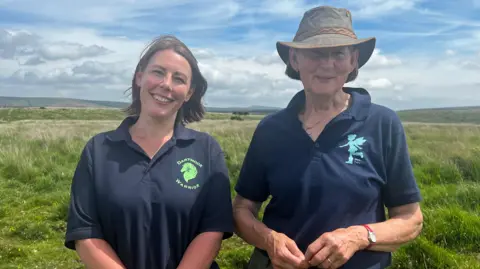
The Friends launched a petition calling for Natural England to remove ponies from the new grazing agreements.
More than 148,000 people have signed so far and the charity plans to deliver the petition to Number 10 on 2 September, accompanied by six of the ponies.
Supporters say the threat is not only to the ponies themselves, but to the landscape they help maintain.
Abel says ponies, cattle and sheep "play a vital role in the biodiversity and maintaining Dartmoor".
That claim is echoed by the 2023 independent review of protected site management on Dartmoor, which described the moor's pony population as "invaluable for conservation grazing and genetically important".
The argument is especially intense around the spread of Molinia, or purple moor grass - a native species that has become invasive.
The 2023 review said Molinia was "out-competing other vegetation and creating a tussocky, bleached, landscape where few animals will graze" but studies have shown ponies will eat Molinia.
Joss Hibbs, secretary of the Dartmoor Hill Pony Association (DHPA), the breeders' association for ponies, lives near Two Bridges on the moor.
Having witnessed the spread of the grass, she describes it "an ecological disaster" and says ponies are an "essential tool" in correcting it.
"We are going to need sufficient numbers of them to have a proper impact and the last thing we need to do is decrease their number if we're going to deal with this monoculture of Molinia," she adds.
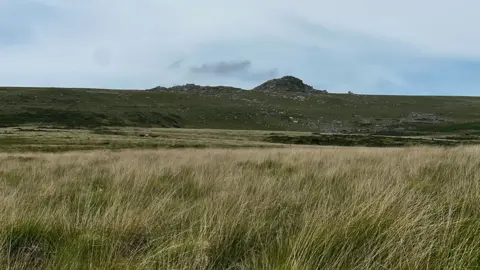
About 10 minutes away on a stretch of open moorland, the Molinia is not quite as tall and there are gaps between the tussocks, small white and yellow flowers peeping through.
The sounds of insects can be heard.
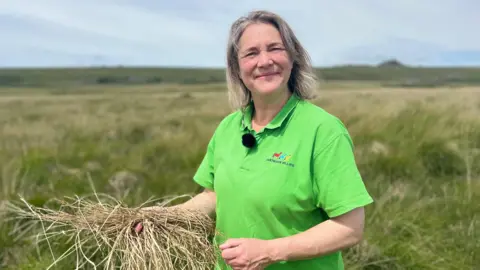
Friends of the Hill Pony volunteer and pony tamer Sheila Robson, points to the difference ponies have made on a conservation grazing site.
"Instead of the blanket Molinia where the horses graze, it opens up the sward so that other plants have actually got the chance to get some light and get the seeds to the earth," she says, adding she is watching flora like heather, bilberry and meadowsweet start to make a come back.
"[The ponies] just munch as they go, doing their job and it gives the other plants a chance," she says.
One of the recommendations in the 2023 review, which was chaired by David Fursdon, the Lord-Lieutenant of Devon, said ponies should not be included with cattle in stocking rates and Natural England should not take actions likely to result in a decline in pony numbers.
Natural England says it is "aligned" with the Fursdon review but campaigners including Hibbs point to a mismatch between the body's words and its actions in including the ponies in livestock counts under its new moorland agri-environmental schemes that provide payments for farmers for grazing upland in ways that benefit nature.
Campaigners warn the new schemes would cut livestock, including hill ponies, by 56% to 89%, adding previous cuts have not increased biodiversity on the moor and claiming the spread of Molinia is down to under- rather than overgrazing.
Abel says under the new agreements farmers will be forced into the "horrible position" of having to "choose between keeping the ponies or… paying the bills".
The issue became political earlier this week when Conservative leader Kemi Badenoch described the plan as "total madness".
Downing Street responded by saying the Labour government would not allow a cull, insisting the animals were safe.
But Hibbs queries if this means the government has directed Natural England to change its policy and adds the DHPA would be happy to provide input into designing a new approach.
'Not recommending a cull'
The Department for Environment, Food & Rural Affairs (Defra) says ponies must be included in the stocking density calculations linked to the moorland actions, as they contribute to grazing pressure on the moorland.
It says the impact of Environmental Land Management (ELM) schemes on pony populations "will be continually monitored for any adverse effects and mitigations will be explored to ensure no further reduction in population numbers".
Defra says it is working with partners including the DHPA "to help ensure that we maintain numbers of semi-wild ponies on the moor for generations to come", adding Natural England is "not recommending a cull".
David Slater, south west director for Natural England, added: "Our role is to advise farmers who wish to enter the publicly-funded schemes available for grazing regimes.
"These schemes have been designed by government to contribute to nature recovery - some of these require less grazing and some more dependent on local conditions but ponies are and always will be part of that mix."
Hibbs says Defra and Natural England are not working with the DHPA, despite both being asked for a meeting.
She says any monitoring of the pony population would come too late after the "irreversible" removal of the majority of the animals from the moors.
But Bruce-White said he did not think it was "inevitable" that pony numbers would fall "catastrophically" even in places where grazing levels were reduced, adding that there were "certainly many other parts of the moor that desperately need more grazing, and in particular, more cattle and pony grazing".
Lovemore adds: "If Natural England decide in two years' time, 'Oh, that was a mistake, we want ponies back on the moor', they can't simply be replaced with any old pony.
"They just won't survive out here... they literally are irreplaceable and... part of Dartmoor's identity."
Follow BBC Devon on X, Facebook and Instagram. Send your story ideas to spotlight@bbc.co.uk.