Father's Day launch for male mental health campaign

 BBC
BBCA charity campaign aiming to "significantly reduce" the number of suicides among men has been launched on Father's Day.
ManDown's 383 campaign, which it said was named after the average number of male suicides every month in the UK, has been set up to help raise funds for the Cornwall-based charity.
It said it wanted to open more groups across the country for men to meet and discuss any mental health issues they have.
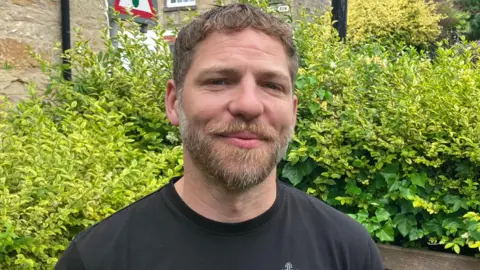
Ross Jackson-Hicks, founder of ManDown, said the number of men who take their own lives is a "horrific statistic" and wanted the campaign to highlight the "mental health crisis" within society.
Group meetings organised by ManDown are based in several locations across England and Scotland including Truro, Plymouth, Exeter, Cheltenham, Inverness and Greenwich in south-east London.
The charity said the meetings are "a safe, confidential and non-judgmental space" for men to talk about their mental health experiences and support each other.
Jackson-Hicks said the charity had chosen to launch the campaign on Father's Day as it was a day when men are celebrated and lots of people had lost fathers to suicide.
"The number of male suicides in the UK every month is a horrific statistic and it's one we're trying to reduce significantly," he said.
- If you have been affected by any of the issues raised in this story, information and support can be found at the BBC's Action Line.
Jackson-Hicks added the charity wanted the campaign to help those "struggling in the shadows" and tackle a stigma around men's mental health.
"Generational stuff like 'man up' and 'boys don't cry' are the sort of unhelpful messages which have been portrayed over time," Jackson-Hicks said.
"That stays with people and men don't want to seem to be vulnerable, weak or have people see them cry.
"If we can give them that space to cry, to talk, to share to really just share what is actually happening there then they won't put that mask on and have it manifest into something much deeper and darker."