South West highest risk for tick bites and disease

 Getty Images
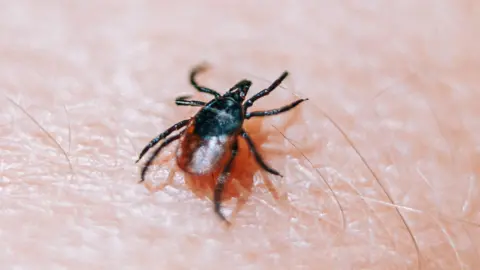
The South West is one of the highest-risk regions in England for tick bites and tick-borne diseases, a report has found.
People in the region are being advised to "take precautions" by the UK Health Security Agency (UKHSA) South West following the release of the One Health Vector-Borne Disease Surveillance Report.
The report, published with the Department for Environment, Food and Rural Affairs (Defra) and the Animal and Plant Health Agency (APHA), recorded 281 laboratory-confirmed acute Lyme disease cases in 2025 for the region.
Jennifer Taylor, consultant in health protection at UKHSA South West, said the region had "the highest rates of tick bites and tick-borne disease in England".
The UKHSA's South West region includes; Bristol, Cornwall, Devon, Dorset, Gloucestershire, Somerset and Wiltshire.
Simple precautions
Taylor said: "Our beautiful landscapes are part of what makes this region special, but they are also habitats where ticks thrive.
"We want people to continue enjoying the outdoors this summer, but to take simple precautions: cover up where you can, check yourself and your children for ticks after being outside, and remove any ticks promptly.
"If you develop symptoms after a tick bite, please seek medical advice."
The UKHSA said anyone who had been bitten by a tick must "remove it as soon as possible using a tick removal device or fine-tipped tweezers"
They should also be aware of symptoms including: a spreading rash, flu-like illness or fatigue in the weeks that followed.
The agency said tick bites were most common when spending time outdoors in wooded areas, grassland and heathland.