Buffalo Bill's right-hand man and his proud Welsh ancestry

 Buffalo Bill Centre of the West
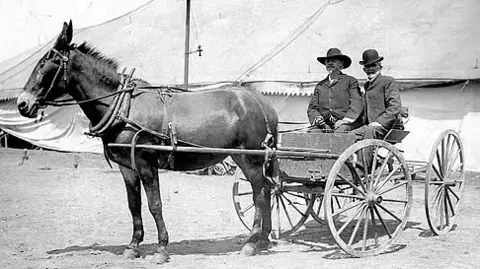
Buffalo Bill is perhaps the greatest showman and Wild West gunslinger to have ever lived.
But the man behind his success can trace his heritage back to Wales and persuaded him to perform his Wild West show there on 21 occasions.
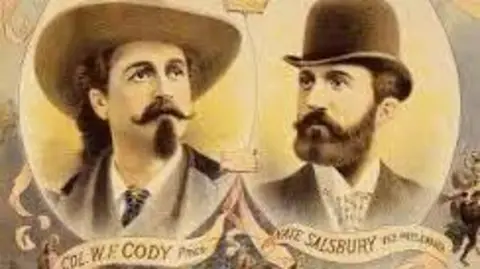
Nathan "Nate" Salsbury was a theatre impresario, businessman and gambler who amassed a $20,000 fortune before the age of 20, enabling him to set up his own company of actors.
In 1884 he met William "Buffalo Bill" Cody and their joint legend was born.
Stephen McVeigh, professor of American cultural history at Swansea University, described their relationship as something similar to that of Top Gear front man Jeremy Clarkson and producer Andy Wilman.
 Buffalo Billy Centre of the West
"Salsbury was a very accomplished performer in his own right, but he had much more of a business brain, which enabled him to put Cody's visions into practice," he said.
"Buffalo Bill wanted to reenact the exploits of his youth with hundreds of Native Americans, buffalo, horse-stunts and theatrical battle depictions, but had absolutely no idea of how he could make that endeavour profitable.
"Nate Salsbury was the man who made the numbers work."
 Denbighshire Historical Society/America Comes Alive
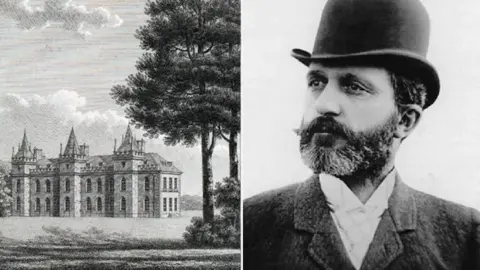
Prof McVeigh said, although already distant, Salsbury liked to boast of his Welsh lineage at a time when many immigrants to the United States preferred to distance themselves from their British ancestry.
"Nate traced his patrilineal Welsh ancestry to the 'Salusbury' family of north Wales, specifically the family seat of Lleweni Hall in the Vale of Clwyd, located near the market town of Denbigh."
He added that Salsbury's great-great-great-grandfather William, born in Denbighshire about 1622, emigrated to New England in the 1630s and eventually settled in Massachusetts - for a time in a town called Swansea.
"He died in June 1675, slain by what were then referred to as Indians."
Prof McVeigh said Salsbury's deep desire to emphasise his natural father's family tree, who died while Nate was a child, may stem from his loathing of his step-father, from whose cruelty he fled to join the Unionist army as a teenager.
Whatever the motivation, it is thought Salsbury leaned heavily on Cody in order to bring their show to Wales across two tours in 1891 and 1902-03.
The two had similar upbringings in their teens, when the American Civil War broke out.
By age 20, amid the American Civil War, Bill was a scout for General Phil Sheridan's Unionist army in Kansas.
Three years later he was a buffalo hunter for the Kansas Pacific Railroad, providing the workers with meat to fuel them as they built the transcontinental route across North America.
Similarly - but less glamorously - Salsbury volunteered for the 15th Illinois Regiment.
Taken prisoner and held at the Andersonville Prisoner of War Wamp in Georgia, where 13,000 men died of starvation and disease, Salsbury whiled away his time fleecing fellow Unionist inmates at poker, accumulating the money that would later set him up in business.
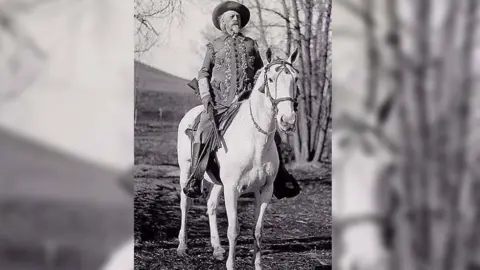
While Bill loved to boast of his career as a Pony Express postal rider, buffalo hunter, gold prospector and soldier in wars against the Confederacy and Native Americans, Salsbury kept a lower profile.
 Buffalo Bill Center of the West
"Salsbury preferred to play his cards closer to his chest, whereas Cody was the showman who picked up on the nostalgic desire for entertainment which depicted a rural frontier life when nearly all the west coast of the USA had been conquered and agricultural life was rapidly giving way to industries like Henry Ford's car factories."
Buffalo Bill's Wild West played to about 200,000 spectators in 21 open air venues across Wales, from Pembroke Dock to Ruthin.
Invited by opera sensation Adelina Patti, 28,000 people crowded into Swansea's Victoria Park to witness the show in 1903 where buffalo were chased around the arena by highly-skilled Native American horsemen, before a staged "Cowboys and Indians" battle.
Their shows sold-out in front of dignitaries including Queen Victoria and the Royal family, Kaiser Wilhelm II and Pope Leo XIII.
 Getty Images
"Salsbury knocked off the rough edges from Cody. Buffalo Bill was a contradiction of a man.
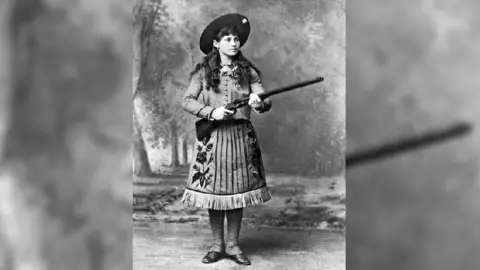
"On the one hand he was a fervent supporter of women's suffrage and placed females such as Annie Oakley and Calamity Jane at the heart of his shows, but on the other he treated his own wife appallingly.
"Similarly, he boasted of having scalped Native Americans during the 'Indian Wars', but treated them incredibly well in his theatrical troop, paying them the same as white performers - far more than they could ever have hoped to earn in the US."
However, by the turn of the century, Salsbury and Cody had fallen out, partly over money, but mostly because of Cody's rampant ego, which saw him claim more and more credit for The Wild West's success, to the detriment of Salsbury.
Salsbury died during the 1902-03 European tour, though Cody soldiered on with it for another decade.
Prof McVeigh concluded: "I think Wales saw the best of Buffalo Bill's Wild West, not only the shows themselves, but the spectacle of Indian teepees and buffalo grazing in parks like Cardiff's Sophia Gardens. However, as Cody neared 70 he was often too infirm and drunk to mount his horse for the main scenes of the show." Prof McVeigh added that, in modern terms, the only comparable longevity of "Buffalo Bill's Wild West", (1883-1913), are Les Miserables and The Mousetrap.
A measure of Cody's international fame was that, upon his death in 1917, the warring nations' leaders, King George V and Kaiser Wilhelm II - along with US President Woodrow Wilson - all took time out from hostilities in order to pay tribute to his phenomenal life.