Humanoid robots the 'next stage' in farming

 Harper Adams University
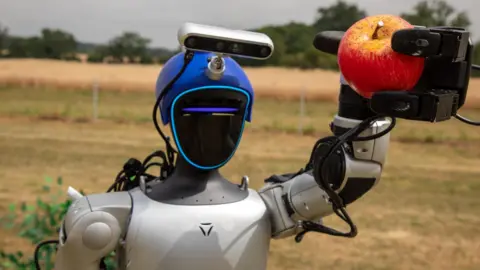
Humanoid robots could be the "next stage" in farming automation, a university professor has said.
A project at Harper Adams University in Shropshire is looking into how the robots could shape farming in the future.
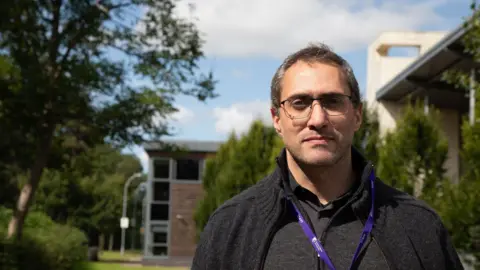
Robotics specialist Prof Fernando Auat Cheein, who is at the forefront of the new technology, said the robot shared "similar capabilities" to humans and could be deployed to do the same work alongside them.
"A humanoid has the same degree of freedom, the same ability as the human body, so we can programme the robot not to solve one problem, but to solve many of them," he said.
Cheein, who is professor of engineering at the university, explained the human-shaped robots could carry out existing tasks that people do, such as harvesting, planting or pruning.
The robots could also be adapted to be automated and to complete the work in a faster way.
 Harper Adams University
Using robotics in farming is nothing new at Harper Adams, but they each tend to be designed to complete a specific task.
"Each one of the robots that you have now, has a solution, it's basically an adhoc solution," he said.
"So you have the problem, and you have a robot to solve that specific problem. And the robot cannot be used elsewhere, or to solve a different problem."
Another benefit, he said, was that once perfected, programming could be replicated across 1,000 or more more robots.
Cheein said the future was not about replacing people in farming, but was instead about working alongside the technology.
The humanoid would be sharing the workspace or tasks with people, he said.
"The robot and ourselves in the same environment should co-exist in some sense and for that we need the robot to have social skills," he explained.
"So we can deploy the humanoid to do the work that we can do."
Follow BBC Shropshire on BBC Sounds, Facebook, X and Instagram.