Ministers to issue guidance on children's screen use

 Getty Images
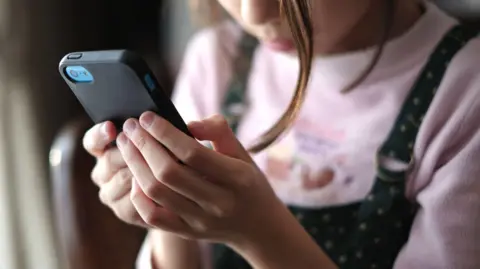
Ministers are to issue guidance for the first time on screen use for children five to 16.
The government has launched a three-week call for evidence to inform guidance - which will be published in the autumn - to give parents advice on healthy screen use.
It is expected to include practical tips on how much screen time children should have, when they should get their first smart phone, and how technology is used in schools.
Education Secretary Bridget Phillipson said parents deserve "clear, practical support they can trust."
"Some will argue the answer is to turn back the clock and return to a world of only pens and paper. I disagree. Used well, technology can open up opportunities for children with SEND [special educational needs and disabilities], personalise support and help more children succeed," she said.
Writing in the Telegraph, Phillipson warned while today's children are growing up with more opportunities than previous generations, there has been "a loss of childhood" and "a national crisis" with children sleeping less, finding it harder to concentrate, and spending less time outdoors.
Children's Commissioner for England Dame Rachel de Souza said young people benefit from technology, but that children, parents, and carers struggle to find where the right balance, saying it is "the bane of our life".
Dame Rachel, a co-chair of the call to evidence, told BBC Radio 4 Today programme that she gets questions from teenagers asking how to cut down on screen time, and they often say they want adults to intervene.
She said the consultation would also include gaming in its look at screen time and she was optimistic because there is cross-party consensus on the harms of too much screen-time for children.
The government will also seek views on screen use in schools and understand where technology can best support learning.
The guidance is intended to help parents in England, but will also be of interest to those in the rest of the country where education and public health policy is devolved.
Appearing on BBC Breakfast, Minister for Skills Jacqui Smith stressed that this consultation on screen time in general was different to the issue of social media and its impacts on young people, and that technology use for educational purposes can be helpful.
"There's a lot of things that happen on screens that aren't social media, but nevertheless, parents worry about how much it's appropriate for their children to be using screens and in what process," she said.
This call to evidence is different to a consultation that closed last month on whether to ban social media for under-16s, restrictions on addictive design features and better support for parents.
More than 110,000 people responded and the government said it is aiming to set out its response as soon as possible.
 PA Media
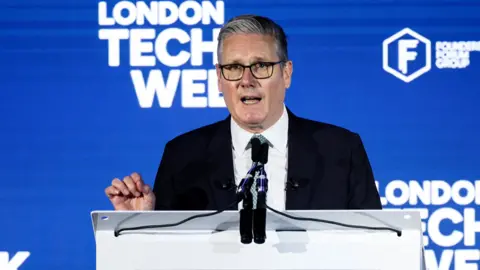
On Monday Sir Keir Starmer called for tech companies to block children from sending, receiving or seeing explicit images online, warning that the government will introduce new legislation to force them if firms do not intervene.
In a speech at London Tech Week, the prime minister said: "For too long, people have been told that is simply the price of modern tech, that nothing can be done, that government is powerless, that parents just have to accept it.
"I reject that completely, because tech should adapt to the needs of society, not the other way around."
He added: "These are some of the most innovative companies in the world and I believe they can solve it."
Starmer is also expected to announce restrictions on children's social media access over the coming days.
In recent weeks, government ministers have examined a variety of options for restrictions, including an Australia-style blanket ban on under-16s having social media accounts.
In March, the government released guidance saying children under the age of five should be limited to one hour of screen time per day, while under-twos should not be watching screens alone.
Ministers will also introduce a legal ban on smartphones in schools in England.


Sign up for our Politics Essential newsletter to keep up with the inner workings of Westminster and beyond.