Anthony Fauci refuses to answer questions during US Senate hearing about Covid origins
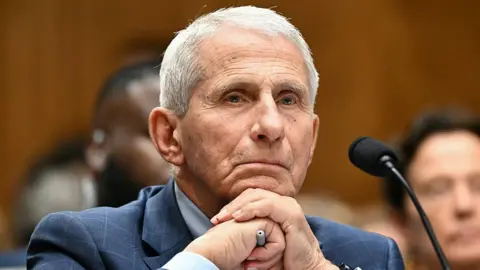
Former top US health official Anthony Fauci refused to answer questions at a US Senate hearing about the origins of the Covid-19 pandemic, saying he feared Republican lawmakers would seek to trip him up and use his testimony to prosecute him for perjury.
He invoked the amendment to the US Constitution, which states that no individual can be "compelled in any criminal case to be a witness against himself".
Days before the hearing, Republican Senator Rand Paul released more than 1,000 pages of Fauci's pandemic-era writings, in which he mused about fame and the origins of Covid.
Fauci said Paul has a grudge against him. He said he previously testified about Covid under oath at several congressional hearings.
"Although it pains me to do so because of the respect I have for the legislative branch of government ... under the advice of my attorneys, I will invoke my right under the Fifth Amendment of the constitution to refrain from answering your questions," said, Fauci, the former leader of the National Institute of Allergy and Infectious Diseases (NIAID).
Taking the Fifth is not an admission of guilt - it is designed to protect individuals against coercion, mistakes, and unfair burden-shifting.
Fauci said Paul's "obvious obsession" with pushing for Fauci to be prosecuted had led him not to answer questions this time.
"The only conclusion I can reach is that the sole reason he is calling me before this committee is to get me to say something - anything - that could vindicate his repeated public pledges that I end up, in his words, 'behind bars,'" Fauci said.
Paul continued questioning Fauci despite his refusal to answer. The hearing grew tense at times, including when one of Fauci's lawyers who was seated next to him repeatedly tried to interject during Paul's questioning. Paul directed a security guard to remove him from the room.
During opening remarks, Paul claimed Fauci's diary entries contradicted what he told the American people about the origins of the virus.
Paul suggested that while Fauci said publicly that Covid originated naturally, he privately believed the virus originated in a medical lab. The senator has repeatedly promoted the lab-leak theory that Covid came from China's Wuhan Institute of Virology.
Many scientists favour a theory of "animal spillover", meaning the virus began when an animal carrying the virus infected a human. However, scientists and evidence have not definitively coalesced around either theory.
Fauci's diary entries reflect openness at the start of the pandemic to two possible theories about Covid's origins - including natural origins and a lab leak - before he appears to become more convinced it had a natural origin.

 Getty Images
For instance, in one entry from February 2020 discussing a conference call between Covid scientists, Fauci says the doctors did not have "total agreement" about where the virus came from.
Later, the NIAID leader writes, he "is almost certain that the virus evolved naturally from a species jump, even though… I keep an open mind about the possibility of a lab leak".
"[J]ust because two alternatives are possible that does not mean that they are equally probable," Fauci wrote.
At Wednesday's hearing, several Democrats came to Fauci's defense, including Senator Maggie Hassan, who said the hearing was "designed to entrap" Fauci. They raised concerns about rising cases of measles and cyclosporiasis - a parasitic infection that causes diarrhoea - under current US Health Secretary Robert F Kennedy Jr's leadership.
Kennedy, a critic of Fauci, told Fox News over the weekend that officials had spent eight months to "dig" Fauci's diary entries out of 11 separate servers from government computers.
As the former head of NIAID, Fauci, who retired in 2022, faced death threats during and after the coronavirus pandemic, as well as vociferous criticism from Republicans over mask mandates and other Covid restrictions.
Fauci and Trump frequently sparred over the handling of the pandemic, including when Trump suggested unproven treatments.
Before he left office, former President Joe Biden issued a pre-emptive pardon for Fauci, his chief medical officer.
"The issuance of these pardons should not be mistaken as an acknowledgment that any individual engaged in any wrongdoing, nor should acceptance be misconstrued as an admission of guilt for any offense," Biden said at the time. "Our nation owes these public servants a debt of gratitude for their tireless commitment to our country."