We're absolutely not prepared for extreme heat and it's frightening, scientist says

 Getty Image / Met Office
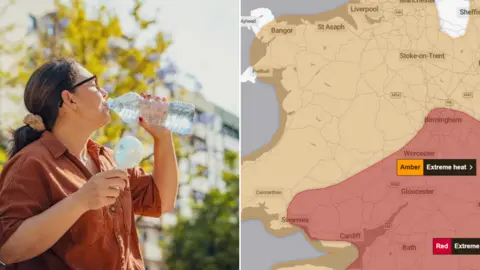
Wales is "absolutely not prepared" for the consequences of the extreme heat sweeping the country, a climate scientist has said.
Mary Gagen from Swansea University called the red heat warning issued for Wednesday and Thursday "frightening".
Temperatures are expected to hit 37C, and more than 700 schools have been fully or partially closed across Wales.
The Met Office has extended its current red extreme heat warning, with it now set to end on 23:59 on Thursday evening
Gagen said while we have always had heatwaves, it is nothing like the intensity and frequency we are seeing.
"Our infrastructure is absolutely not prepared for this," she said.
Welsh government's deputy minister for public and preventative health, Nerys Evans, called it a "heat emergency".
Referring to Wales' heatwave in May, Gagen said it was "really unusual to have two in a row".
"Actually, for me on a personal level, as I'm walking around, it feels like the first time in my life that I can physically feel climate change.
"And it's quite frightening, actually. It's an uncomfortable experience."
Mary said the country would experience "tropical nights" caused by a "heat dome" effect.
"Each one of those events, whilst, sure, it's a feature of a heatwave and we do get heatwaves in this country, each of them has a climate change element behind it that's making it more intense," she said.
"It's preparedness, it's having cool spaces in our cities. It's having buildings that can cope with the heat.
"And we are really learning in this heat event that we are absolutely not prepared. We're seeing school closures. If you are trying to manage ill people on a ward in our hospitals that doesn't have air conditioning, you're going to find this very uncomfortable.
"So, we really have a long way to go. Our infrastructure is absolutely not prepared for this."
 Nadezna / BBC Weather Watchers
Similarly, experts from Swansea University warn that "extreme heat is now a reality for schools in Wales, not something that happens elsewhere in the world", and say urgent action is needed.
Three professors who focus on health impacts for those learning outdoors called for "long-term investment" in school buildings, including improved ventilation, as well as "evidence-based" guidance on daily routines, hydration, sun protection and policy responses to hot weather.
"We must especially support children in deprived areas and those with additional learning needs, who face the greatest risks, both from heat exposure itself and from the disruption caused by school closures," they added.
School closures and cancelled trains
School closures are confirmed in Cardiff, Blaenau Gwent, Bridgend, Caerphilly, Ceredigion, Carmarthenshire, Denbighshire, Gwynedd, Merthyr Tydfil, Monmouthshire, Neath Port Talbot, Newport, Powys, Rhondda Cynon Taf, Swansea, Torfaen and Vale of the Glamorgan.
Carmarthenshire council is urging residents to take extra care around rivers, lakes, reservoirs and beaches, warning that cold water shock and hidden hazards can be fatal even in hot weather.
It is also reminding people to follow "simple" water safety advice, including never swimming alone, avoiding jumps into open water, supervising children, choosing lifeguarded locations, avoiding alcohol, and remembering to "Float to Live" if they fall into cold water.
Speaking on Radio Wales Breakfast, chief medical officer for Wales Isabel Oliver said in these periods of heatwave, there can be "significant pressure on the NHS".
"But the health effects of heat are largely predictable and preventable so it is really important that we are all aware of what we need to do to keep safe and in good health," she said.
The Cure will play Cardiff's Blackweir Fields on Wednesday, and McFly will play Cardiff Castle on Thursday.
Oliver asked people to look out for each other, and avoid alcohol.
"If people are feeling the effects of heat exhaustion which is tiredness, dizziness, headaches, feeling sick it is really important that they move to a cool place, remove unnecessary clothing such as jackets or socks," she said.
Meanwhile, Transport for Wales (TfW) has cancelled services across Wales due to extreme heat and a shortage of trains.
These include services from Manchester to Cardiff, Ebbw Vale to Cardiff, Bridgend to Maesteg, Chester to Wrexham, Llandudno Junction to Blaenau Ffestiniog, and Pontypridd to Cardiff Bay.
Some lines were also operating using bus replacement services, with customers urged to check the TfW website before they travel.
TfW advised passengers to only travel if absolutely necessary on Wednesday, Thursday or Friday.
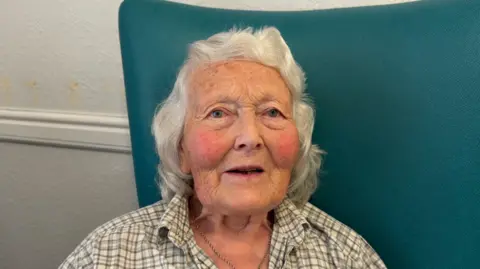
Beverley Holt, deputy manager of Cartref Dyfi care home in Machynlleth, said they had changed the menu and activities in preparation for the heat.
"It's a struggle, we're just trying to keep everyone cool, hydrated and keeping the curtains closed," she said.
Lois Burke, 90, said it was more like Caribbean weather, but added: "I wouldn't want it to get any hotter and at my age I'm not particularly active, so it's just lying around a bit."
Sally, 86, was still managing to exercise, but kept cool by lying down on her bed with the window open and by drinking as much as she can. "It's extreme, climate change is starting to rule our lives I think".

Speaking on BBC Radio Wales Drive on Tuesday, Nerys Evans described the red warning as serious.
"This is a heat emergency that we've got over the next couple of days, and we will see extra demand on our health service," she said.
"That's why it's so important that people follow the basic rules of keeping themselves hydrated, out of the sun and more importantly looking after vulnerable people who can't regulate their own body temperatures like we do."
Claire Beynon, executive director of public health at Cardiff and Vale University Health Board, said they had made changes including telling staff they can switch to shorts and polo shirts.
"We're trying to move the people who need air conditioning the most into areas that have air conditioning to keep them cool.
"We've also sent a message out around the whole organisation to see if anyone can come in and help with hydration within the wards, giving people extra rounds of water," she said.
 Weather Watchers/ Nadezna
Public Health Wales has urged people across Wales to stay safe and check on family and friends.
It also warned people who worked outdoors, lived in top-floor flats, or were exposed to the heat for long periods could also be particularly vulnerable.
Ashella Lewis, from Skylight for Crisis South Wales, said extreme heat poses serious risks for people experiencing homelessness, including dehydration and sunburn, adding that heat exhaustion can be life-threatening.
She said the charity was providing water, suncream, hats and umbrellas, after seeing high numbers of sunburn cases last year.
Lewis also encouraged people to help by offering water or suncream, or by contacting StreetLink Wales to support someone who is sleeping rough.
The red weather warning for extreme heat begins at 09:00 BST on Wednesday and lasts until 23:59 on Thursday. It covers Blaenau Gwent, Bridgend, Caerphilly, Cardiff, Carmarthenshire, Merthyr Tydfil, Monmouthshire, Neath Port Talbot, Newport, Powys, Rhondda Cynon Taf, Swansea, Torfaen and Vale of Glamorgan, as well as parts of England.
A separate amber warning is in place for all of Wednesday and Thursday and covers the whole of Wales.
The hot weather has already caused disruption across parts of Wales, with a historic bridge closed and public services also affected.
Steffan Messenger, Wales environment correspondent
Heat-related records have been tumbling for a while now in Wales, sounding an alarm about our changing climate.
This month's scorching weather comes hot on the heels of our warmest May day on record a few weeks ago.
Last summer was our hottest on record - and 10 of the warmest years yet documented in Wales have all happened since the early 2000s.
Climate scientists warn hotter summers are to become "the new normal" in decades to come with heatwaves that are more frequent and intense.
Modelling from the Met Office - released to coincide with the 50th anniversary of the famous 1976 heatwave - suggests a similar event in 2056 could see temperatures reaching 41C in Wales.