How Brexit hurt and helped one small port

 Getty Images
"Going through Brexit was a nightmare, but we got there in the end," said Dave Collins-Williams.
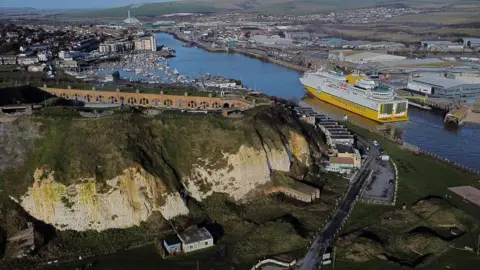
He manages Newhaven Port in East Sussex, which had to make significant changes after the UK voted to leave the European Union in the 2016 referendum.
Among other things, infrastructure costing millions needed to be built in just a few years to cope with the return of customs and food standards checks.
Collins-Williams said one challenge was the timescale by which the port had to be ready, alongside the fact that the government reduced its funding for the changes.
"We had to cut back on the projects that we would have liked to have done," he told the BBC.
"It was down to the bare essentials."
Although ready by 2023, Brexit delays meant the new infrastructure was not needed for another year, Collins-Williams said.
"The EU is our largest trading partner," said a government spokesperson.
"It is time we focus on building a closer, forward-looking relationship with Europe that works for the British people.
"At the upcoming UK-EU Summit on 22 July, we will deliver an ambitious package of deals to boost trade, cut red tape and create opportunities for young people."
'No new jobs created'
Collins-Williams said overall Brexit benefited the port as it led to its facilities being improved.
He said more Border Force areas were built, besides additional warehousing and freight parking spaces.
A £4.5m control post for inspecting animal and plant products was also constructed as leaving the EU meant they now had to be checked.
But Collins-Williams said no new jobs were created.
He explained it had been estimated the port would need to inspect 12 trucks a day, although in reality it did an average of three checks per week.
"I'm glad I didn't employ those extra staff because I would have been letting them go soon after," Collins-Williams told the BBC.
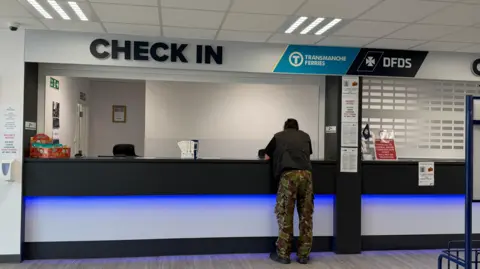
Collins-Williams said the multi-million-pound control post - which the port had to partially fund with its own money - could become redundant next year.
This is because the government is negotiating a new sanitary and phytosanitary agreement with the EU, which is set to scrap most routine border checks on food and agricultural products moving between the UK and EU.
Collins-Williams said he hoped the building could be repurposed, although added he had "doubts".
He said Newhaven Port - along with many others across the UK - was pushing for government compensation as it would likely "need to strip everything out of the building and start again".
What is the impact on trade at the port?
Andy Wells, who owns the haulage company Cargo Flow Agency, said Brexit had caused increased costs for importers and exporters as now two customs clearances for the EU and UK had to be organised.
Goods could flow freely between the two beforehand.
He added getting the paperwork could also cause costly delays, though 90% of vehicles could pass through Newhaven Port "seamlessly".
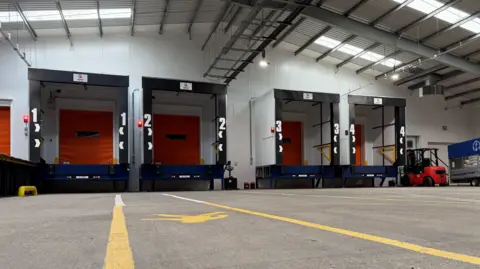
According to Wells, Brexit's "broad impact" was that demand for transport between the UK and EU "reduced significantly".
He said his company was carrying 45% less cargo than before, which Wells attributed to small businesses not exporting to the EU.
"It really demonstrates how dependent we were on the European trade routes, which now can't be exploited because of the additional costs and the general reluctancy of traders to [get] involved," Wells told the BBC.
But he said he had compensated for this lost revenue by making a secondary business out of doing the customs clearances for others.
"The financial result is about equal to what we were earning previously," he added.
The Bank of England said in June that Brexit cost the UK economy 6%, although some critics said the study did not fully account for the outperformance of the US investment and tech industries or the European energy shock four years ago.
Looking to the future
Newhaven Port manager Collins-Williams told the BBC the site would ultimately like to "attract more customers - both tourism and freight".
"Keeping Newhaven as a thriving port is important for the economy," he said.
Collins-Williams estimated it currently employed around 100 people and indirectly supported an estimated 500-600 jobs.
He urged more people to take the Newhaven to Dieppe ferry crossing, which celebrated its 200th anniversary in 2025.
"Dieppe is a relaxed place to go through," he said. "There's not the hustle and bustle.
"There's more time to do everything."
Follow BBC Sussex on Facebook, X, and Instagram and listen to BBC Radio Sussex on Sounds. Send your story ideas to southeasttoday@bbc.co.uk or WhatsApp us on 08081 002250.