AI 'filling in gaps' in lung cancer diagnoses

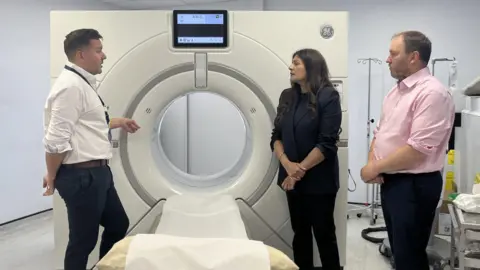 Julia Gregory/BBC
Artificial intelligence (AI) will help with "filling in those gaps" when it comes to lung cancer diagnoses in England, a hospital trust manager says.
AI is being rolled out in Surrey to help speed up cancer diagnoses as part of a national £20m government investment.
"Time is really important, the quicker you pick up these subtle cancers the better the prognosis for the patient," Mike Jones, AI and digital manager at the Royal Surrey NHS Foundation Trust, says.
"There's no way a human can look at 800 X-rays every day to tell you which ones are the most critical. To have the AI there filling in those gaps is what you can't replace."
AI-powered X-ray tools that act as a virtual "second pair of eyes" for radiologists will be rolled out to all NHS trusts in England by 2029, the government says.
This technology, currently available in half of England's NHS trusts, is already helping more than 4m people receive a faster diagnosis or an all-clear for lung cancer.
Jones says the AI package has two core functions - prioritisation and clinical decision support.
He explained that previously X-rays were reported in a chronological order, but this had been changed so AI pre-read scans and could move people to the top of the queue.
'Best of both worlds'
The technology also reads scans and gives highlights of its findings to hospital staff.
"The patient gets the best of both worlds," Jones told BBC Radio Surrey.
"They get the AI read, but then if the human disagrees with the AI they've got full autonomy to overwrite that report or combine the two and write the best report for that examination."
The government says chest X-rays are one of the most important tools in diagnosing lung cancer, England's biggest cancer killer, with more than 7m performed across the NHS each year.
Jones said: "There'll be more patients that survive lung cancer because we're picking these cancers up earlier."
Ian Murray, the minister for digital data and modernising government, says AI "isn't replacing the clinicians, it's not replacing the human, it's actually supplementing that".
"We've just seen an example of where someone came in and could be diagnosed as having a stroke within three minutes rather than within 60 minutes, and that 57-minute difference makes a huge issue to both their survival and their recovery, and their treatment pathways," he added.
Early data shows the technology helps radiologists analyse scans in an average of just four days, compared to eight days for the most complex cases previously, the government says.
By cutting the time it takes to analyse chest X-rays, the tools are expected to help more patients begin treatment within 62 days of a GP referral, which is in line with cancer waiting time standards.
"So there'll be a situation whereby AI will pick something up that the human eye couldn't, there'll be something that the human eye can pick up that the AI doesn't, mash them together, you get a much better result," Murray said.
Preet Kaur Gill, Parliamentary Under Secretary of State in the Department of Health and Social Care, said: "Adoption is going to be really key in terms of how we [can] be transformative, making sure that NHS trusts are able to support their staff to adopt the technology that is coming."