'My uncle didn't build walls to split rich from poor'

 Oxfordshire History Centre
The nephew of a man behind infamous walls constructed to separate a private housing development from council homes has said the theory that they existed to make the houses more appealing to buyers is "untrue".
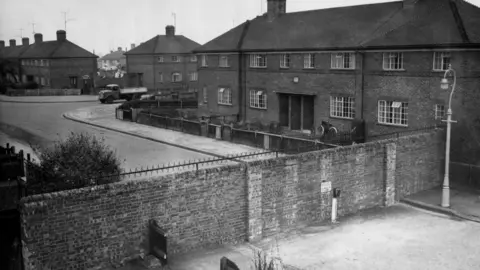
For 25 years two eight-foot-high walls stood in Cutteslowe, dividing the north Oxford area into two.
On one side was an estate of white rendered semi-detached homes built by the private developer, Clive Saxton, whilst the other was a red brick council estate.
A recent BBC Radio 4 series, The Shadow of the Cutteslowe Walls, heard from people who thought the walls had been built to keep the council estate residents out.
They suggested that Saxton felt his homes wouldn't sell if residents had to have so-called "slum dwellers" as neighbours.
But Saxton's nephew Roger Needle said that was "untrue", and that his uncle did not want to construct the walls but it was "the only thing he could do in the circumstances".
 Oxfordshire History Centre
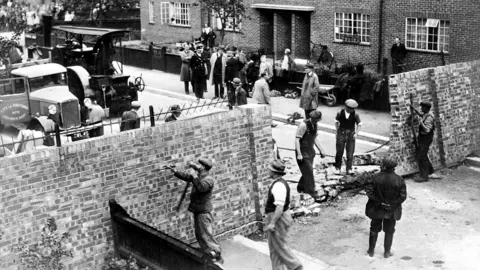
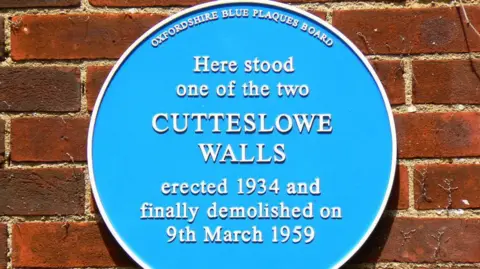
The Cutteslowe Walls in Oxford were built in 1934 and were topped with lethal spikes.
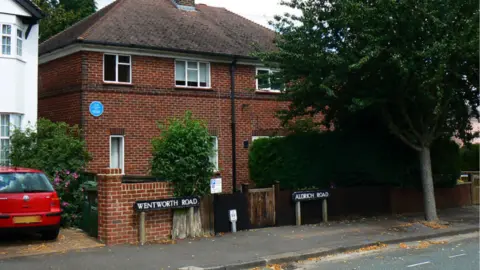
They divided the City Council's Cutteslowe estate from private housing to the west which was developed by Saxton, of the Urban Housing Company.
Explaining his uncle's backstory, Needle said Saxton had been a "well-educated person" who relocated to Oxford from his birthplace in Yorkshire.
"The City Council had previously built a Cutteslowe estate with the first phase, and then they actually offered another 22 acres for a builder to buy and build houses," he said.
The Urban Housing Company bought the site, but Needle says the firm was told by the council that the homes constructed must be valued at £650.
This was in contrast to the homes on the City Council estate, which were going to be worth about £200 less.
"The build started and Uncle Ashley went back to the council and said: 'I think that at the end of the day, there's going to be a mixture of problems with the different group of social groups'," Needle said.
'Greater value'
Needle said his uncle urged the authority to dispel the difference in price, and allow him to build cheaper homes to match those already built on the adjacent estate.
"He [Saxton] wanted to match it. That unfortunately didn't happen," he said.
"All in all, it started off with the Urban Housing [Company] estate being built at much greater value of houses on the Cutteslowe estate."
He added that his uncle also had a plan to purchase the whole site, including the council-built homes, from the authority. This was rejected.
Following this rejection Needle said developers started encountering a problem with building the new estate so close to the existing council homes.
"People were just trampling across what was a building site," Needle explained.
"He [Saxton] decided that the best thing would be to put a close-boarded fence, something like a double the height of a field fence."
 Brian Robert Marshall
But the fence was soon broken down, Needle said, at which point "it was decided that the fence was no good".
"So they built a wall."
That story goes against the popularly adopted tale, of a wall built to divide two social classes.
Needle said that story was true in that there "was a wall there that divided people and there were people of different characters", but that the previous class implications were "totally untrue".
"He didn't want that, but it was the only thing he could do it in the circumstances."
 Brian Robert Marshall
But current city councillor Linda Smith, who grew up on the Cutteslowe estate, disagreed with Needle's assessment.
"The walls were not a temporary measure to safeguard a building site," she said.
"They existed for 25 years and served the clear purpose of preventing the residents of the expensive private houses having to encounter the tenants of the neighbouring council estate, forcing those on the other side of the wall to make long detours to get anywhere."
She said the walls had remained in place for "so long" not because of Saxton, but "because of the rampant snobbery and prejudice against council tenants".
"I'm proud of the role the City Council played in finally bringing down the walls in 1959, through the use of a compulsory purchase order of the land they stood on," Smith added.