What it's like to chase solar eclipses around the world

 under_the_lights
On Wednesday, parts of Europe will be plunged into daytime darkness as the moon passes in front of the sun, temporarily blocking its light and casting a shadow across the continent.
For many of us, it will be a once-in-a-lifetime experience. But for some, following eclipses has become something of an addiction.
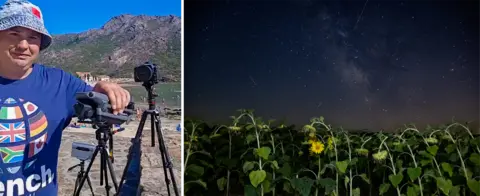
Armed with two high-spec cameras, a specialist telescope and a drone, Mark Griffiths has spent two days driving from Cheshire to Galicia - one of the best places to view the eclipse - to record the event.
It's a hobby that started six years ago, when he went to Shetland to see the northern lights - though the weather was so dreary he "didn't see anything".
But it didn't put him off and he soon found he couldn't stop. He loved the thrill of witnessing and capturing the sky's most spectacular events.
 under_the_lights
He's since filmed the northern lights numerous times - he goes to Iceland once a month and leads tour groups there - and has photographed various auroras, eclipses and bioluminescence.
But this is his first total solar eclipse.
"I kept wanting more," he says, and Europe's first total solar eclipse for more than 25 years is "like what the World Cup is to football" for enthusiasts like him.
"I'll be honest, it's like an addiction now," he tells me.
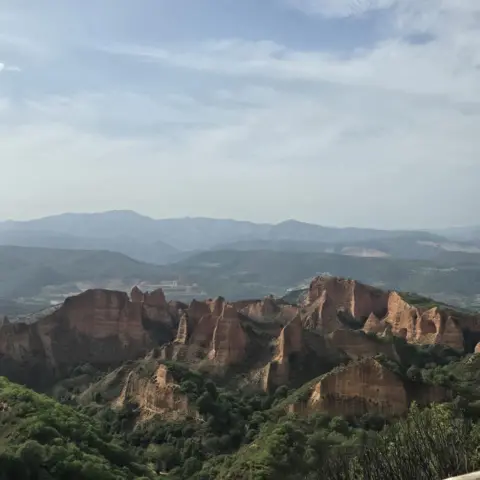
I'm speaking to him the day after he's finished his marathon drive from England, across France and into Spain. He only paused to take photos of the night sky and rest for a few hours in Bordeaux. "I'm quite sleep deprived."
The path of total eclipse begins at the tip of Siberia before curving round the Arctic Ocean and crossing parts of Greenland and Iceland.
It then proceeds across a stretch of the northern Atlantic Ocean before reaching northern Spain and finishing in the Mediterranean. Other parts of Europe will see a partial eclipse.
The total eclipse is only expected to last a couple of minutes for people who watch it, but that doesn't deter eclipse hunters from crossing continents to witness it.
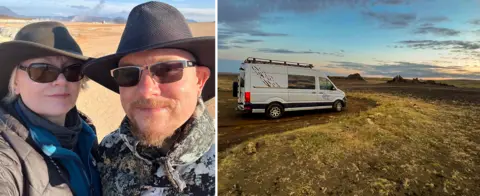
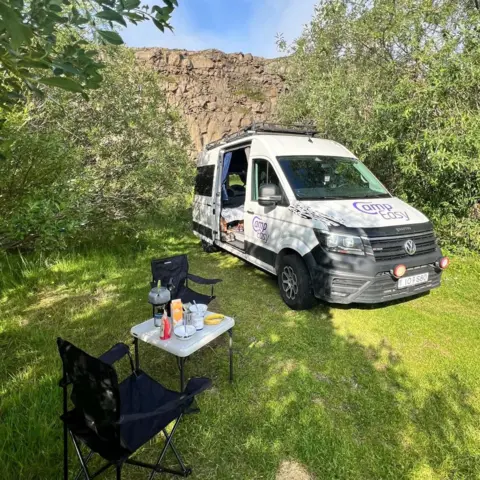
Samantha Phillips-Brown and her husband Gregory have flown to Iceland and hired a camper van so they can drive to a remote area to see it.
 Samantha Phillips-Brown
This will be the second solar eclipse they've witnessed.
It was the awe-inspiring power of the first one they saw, near their home in upstate New York in 2023, that convinced them to travel for this one. They booked their flights and van more than a year ago.
"It was such a phenomenal experience to see the Sun start going dark and hear, suddenly, the birds stop chirping," recalls Samantha. "It's just a very strange experience."
Gregory thinks of how Iceland's first settlers must have felt witnessing such a phenomena more than a millennium ago, a time of mythological rather than scientific explanation.
"They really didn't know what was happening, didn't know how long it was going to last... it must have been quite terrifying for them, in a way."
They are spending the days before the eclipse driving round eastern parts of Iceland to go hiking and camping.
 Samantha Phillips-Brown
The path of totality crosses the western part of Iceland and they hope to find a spot in the Westfjords peninsula to witness it.
Although they've heard rumours of roads being closed to stop too many people overwhelming the area, so are keen to get there a couple of days before the spectacle.
Samantha, who her husband describes as an "obsessive travel planner", is all over the Facebook groups and social media pages being used by eclipse hunters to share information and advice.
She's expecting a good turnout given the number of eclipse glasses she's seen people with in Iceland. "They're really trying to prepare everybody," she says.
"What I expect, as we start inching westward, is we're going to see more and more of them."
Andrew Wills is also going to an island to see the eclipse, albeit a much warmer one: Majorca.
He's travelling with his wife and his dad, who is 90. Father and son witnessed Europe's last total solar eclipse together in 1999 while stood atop St Agnes Beacon in Cornwall.
The landmark, believed by some to be a Bronze Age bowl barrow, offers panoramic views across the Cornish countryside and out to the Atlantic. It was a cloudy day, remembers Andrew.
"We didn't see the shadow rushing across the sea towards us, though we did see the dawn appearing and it getting closer very quickly," he says. "It was awe-inspiring."
 Andrew Wills
He has high hopes for a clearer day in Majorca where he has booked a villa near the town of Andraitx, located in the west of the island.
Andrew has earmarked a spot nearby he hopes will give a good view across the sea. Their location in the path of totality means the eclipse will likely happen low on the horizon.
"We're going to take a couple of camping chairs with us, so Dad can sit if we can get there an hour or so before."
The islands of Majorca and Menorca will be the last places on land to view the eclipse before the Sun sets and the shadow disappears.
Eclipses have fascinated Andrew ever since he saw his first in St Agnes all those years ago.
"We live on a planet where we have this amazing coincidence. Where the Sun is 400 times bigger than the moon but the moon is 400 times closer.
"And so when the moon passes in front of the Sun and between Earth, it casts this perfect shadow."
It made him appreciate the delicacy of life on our planet in the way astronomer Carl Sagan once did when speaking of the Pale Blue Dot photograph.
"We are tiny little specks in a huge vast area of nothingness," says Andrew. "We're amazingly lucky to be alive."