The textile firm that 'invented' replica sports kits

 Getty Images
When England take on Panama in New Jersey this evening, the MetLife Stadium will be packed with fans wearing replica shirts with names such as Bellingham, Kane and Anderson on the back.
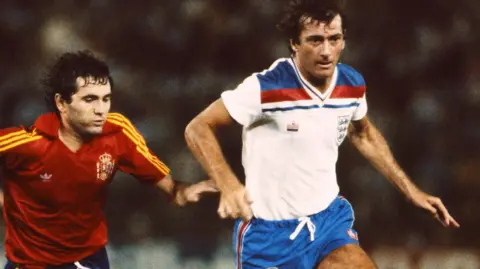
But at one point replica football shirts for adults had yet to be introduced to the public, that was until a Wigston-based textile firm, Admiral, changed that with the 1982 England World Cup shirt.
To celebrate the company that initially began its life making underwear, a free exhibition is being held this summer explaining its connection to the World Cup tournaments of years past.
"Admiral actually started the replica kit market, we say they invented it," exhibition curator Emma Buckler said.
 Getty Images
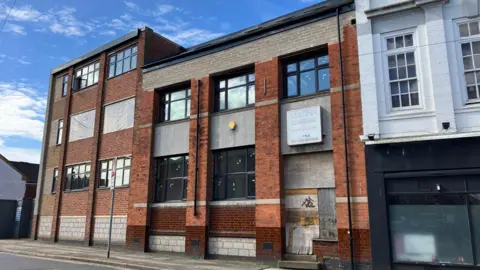
Founded as Cook & Hurst Ltd in 1908, the company made woollen underwear before starting to produce exercise clothing for the Royal Navy under the Admiral brand name in 1914.
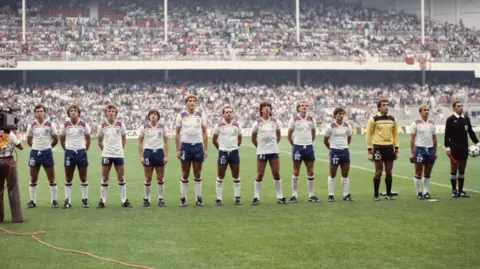
The firm, which was based in Long Street, Wigston, for more than 80 years, manufactured kits for clubs in the UK and for the England team throughout the 1970s and early 1980s - including for the Three Lions' trip to Spain in the 1982 World Cup.
The exhibition, being held at Wigston Library until 7 July, explains the firm's unexpected issues with the 1982 World Cup strip.
In the heat and humidity the polyester fabric caused the players to sweat "very heavily" and numbers also fell away from their kit, Buckler said.
Admiral was as a result forced to source a more "breathable" fabric for England's second game of the tournament against Czechoslovakia.
 Bettmann Archive/Getty Images
Buckler, also an events and communications officer at Oadby and Wigston Borough Council, said: "Before that [1982] there was no opportunity for fans to buy their own version of the kit.
"It started out for children and then for the 1982 World Cup kit that was the first adult replica kit that was available on the market.
"Bert Patrick [Admiral's owner at the time] was really good at seeing trends also with the development of the colour television that made the kit much more visible to people, and they wanted to look like the people they saw on the television."
 Oadby & Wigston Borough Council
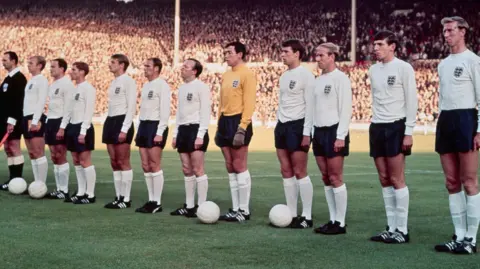
Prior to this, Gordon Banks chose to wear an Admiral-manufactured shirt during the 1966 World Cup after he was impressed with a new lightweight fabric the company had designed a year prior.
Buckler said a visit to the factory swayed him, she added: "Just before the World Cup they designed a really powerful and new type of fabric which was ideal for playing sports and football in and he was personally impressed with it.
"He was aware of Admiral when he was playing at Leicester City, he really thought the kit was really high quality, really practical as well and cutting edge."
Local historian, Bill Boulter, said that much of the expertise and skills needed to create these products could be found in Wigston.
"Right from framework knitting in the 1800s all the way through, the skills were here to make different things when men's trousers got longer, socks got shorter.
"Making underwear the skills were there, making up, overlocking, lock stitching, cutters, so the skills were there to produce the goods and introduce fashionwear into it moving forward," he said.
Mark Atton, an apprentice knitting machine mechanic at Admiral between 1976 and 1979, said: "They were ground-breaking in everything they were doing at that time, they had got their fingers in a lot of pies.
"They worked hard and Bert Patrick went to sort the Leeds [United] contract, and the England contract and things sort of flourished from there.
"The kit they produced was very good and the design, the styles were different and led the way to where we are now.
"It was a great place to work, it had a real sort of good atmosphere... [with] my mum working there making the kit for the teams I was fortunate to get some samples as well."
Admiral closed in the mid-1980s and the Leicestershire workforce were made redundant but after a number of ownership changes, Admiral Sportswear Ltd was set up in 2011.
The exhibition moves to Parklands Leisure Centre in Oadby from 11 to 30 July.
Listen to BBC Radio Leicester on Sounds and follow BBC Leicester on Facebook, on X, or on Instagram. Send your story ideas to eastmidsnews@bbc.co.uk or via WhatsApp on 0808 100 2210.