Mum fears deaf son is missing out at school

 Anastasia Jobson/Sense
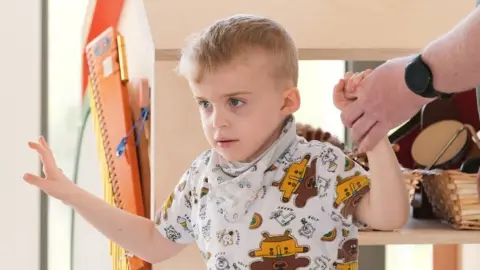
The mother of a 10-year-old boy who is profoundly deaf fears her son is missing out on his education due to a lack of teaching staff with British Sign Language (BSL).
Caroline, from Blackley in Manchester, believes the current situation is leaving her son Thomas - who is also visually impaired - isolated and she is concerned he is "not learning anything meaningful".
"Many people assume all special schools can meet every disabled child's needs, but really when your child has a multi-sensory impairment (MSI) it's like a postcode lottery," she said.
A statement from Manchester City Council, on behalf of the school, said it worked to ensure the "best offer and outcomes for all of our children".
A Freedom of Information request by the charity Sense found 65% of local authorities in the north-west of England did not employ a single specialist teacher to support deafblind children.
There are 832 deafblind children across 25 local authorities in the north-west region, according to the most recent statistics from the Department for Education.
Deafblindness is defined by the Deadfblind UK charity as "the loss of sight and hearing to the point where your communication, mobility and ability to access information are impacted".
Caroline said: "For most of his time at school, there are no signers with Thomas who could teach him using BSL.
"He's in a special school and the teachers there are all amazing, but I fear that they can't meet his needs."
The government announced on Tuesday it would increase the number of specialist interpreters more than eightfold - to support 12,000 Deafblind people with communication needs nationally.
 Anastasia Jobson/Sense
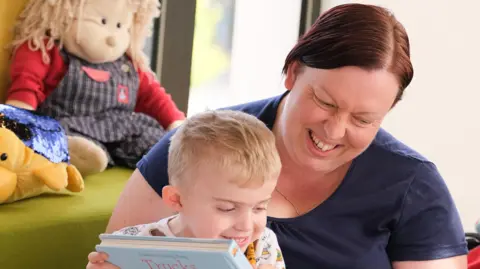
While Thomas, who was born with a rare genetic condition called CHARGE syndrome, has a designated MSI teacher, she covers several schools and only has a responsibility to monitor him at least once a term.
Thomas also has a specialist teaching assistant with BSL, but they only teach him one-to-one for an hour each week.
"Thomas is happy at primary school and has fun playing in the sand," said Caroline.
"But I worry he's not really learning anything meaningful."
After learning BSL themselves, his parents have been trying to teach more of it to Thomas at home.
Caroline said her son was now signing to tell them he was off to school, that he was hungry or wanted a cuddle.
She believes Thomas's communication would progress faster were he to be given full-time one-to-one support at school from a qualified BSL user with deafblind awareness training.
"The problem is the existing system is completely flawed," said Caroline.
"When Thomas is assessed, he qualifies for the maximum level of sensory service and MSI support within his local authority and that sounds like 'Wow - phenomenal' but in reality, the maximum level of support is almost nothing."
'Critical shortage'
There is no requirement for a specialist school teacher to complete MSI training, learn BSL or undertake vision impairment training.
James Watson-O'Neill, chief executive of Sense, said the government needed to tackle the critical shortage of specialist staff in the specialist education and health workforce.
"Without access to MSI teachers, or with only limited support from overstretched schools and teachers, deafblind children are being denied their basic right to learn and get the best start in life," he said.
"Too many are falling through the cracks."
Sir Stephen Timms MP, minister of state for social security and disability, said the government was addressing the shortage, adding that too many Deafblind people had "faced barriers" simply because specialist support had not been available.
He said grant funding of £15,000, to assess specialist interpreters, would start to address that.
"Effective communication should not be a privilege and by increasing the number of interpreters, we are delivering real change for the Deafblind Community," he said.
Thomas' school said: "We work in close collaboration within existing budgets with a range of external partners including the sensory service, occupational therapists, speech language therapists, and the local authority, to offer a range of specialist resources to help ensure the best offer and outcomes for all of our children."
The Department for Education added that SEND reforms were "transforming the system so that every child receives the right support in their local school" and it was investing "£1.8bn to widen access to advice, guidance and support from specialists in every community up and down the country."
Read more stories from Cheshire, Lancashire, Greater Manchester and Merseyside on the BBC, watch BBC North West Tonight on BBC iPlayer and follow BBC North West on X.