'Migrants risk hypothermia on longer boat crossings'

 Getty Images
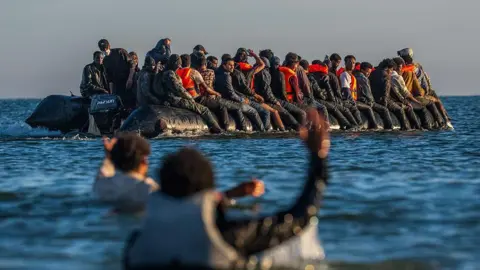
Attempts by migrants to reach the UK in small boats this year have spanned more than 100-mile (160km) of coastline stretching from Dieppe in France to the beaches of Belgium.
In spring smugglers adapted their tactics by launching an increasing number of taxi-boats from the Belgian coastline.
But in recent days the focus has shifted as a number of boats have launched much further south and authorities in Dieppe say the fight against irregular migration is being stepped up in response.
A retired Dover coastguard is warning launches that far from the usual shorter routes near Calais and Dunkirk are risking exhaustion and hypothermia for those packed into the boats.
Twenty hours at sea
On 14 June, around 60 migrants on three small boats set off from near Dieppe, according to SNSM, the French sea rescue society.
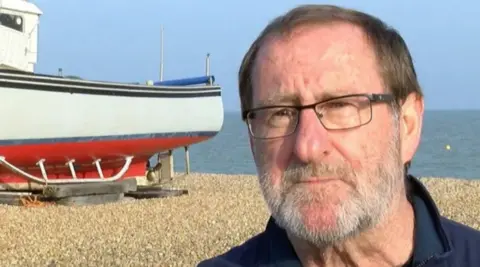
It's a journey to the UK that's approximately 80 miles (128km) and could take at least 20 hours, according to Andy Roberts, a retired coastguard from Kent.
"They're crossing the busiest thoroughfare for shipping in the world, with over 500 commercial shipping movements a day," he said, adding that the boats could be "overcrowded" and migrants could be "soaking wet".
Last year BBC South East first reported on a number of rescues from small boats much further south around Dieppe.
The authorities have now confirmed to the BBC that increased surveillance is being introduced along that stretch of the French coast.
Until now, only members of the National Gendarmerie were responsible for monitoring the coastline, according to local government officials in Seine-Maritime.
Now, they say that in addition to the gendarmes, officers from the National Police will also patrol the area.
In 2024, 11 attempted departures were recorded from the Dieppe area, with seven successful.
In 2025, there were 31 attempts, with 10 proving successful.
Before the activity on 14 June there had been 13 attempted departures, with six proving successful.
Changing tactics
It's a similar trend that the Belgian authorities have grappled with at their end of the coastline this year.
In March, Westkust Police said it hadn't seen any migrant boat activity in 2025, but had suddenly seen a rise in activity off West Flanders earlier this year.
Police suggested the increase was due to an increase in pressure on smugglers in France.
Dr Peter Walsh, senior researcher at the Migration Observatory at the University of Oxford, said: "Arguably this is the strongest indicator that French and British enforcement efforts on the French coastline are having an impact because they are changing smuggler behaviour.
"That does suggest departing from the usual places in Northern France is becoming less viable, but it also means the boats and migrants are taking potentially longer and more dangerous journeys."
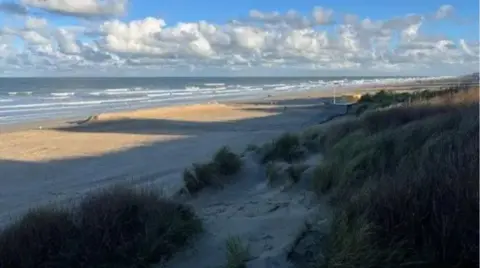
The bulk of the crossings are still centered around the beaches of Northern France.
Over the weekend a woman died on a small boat attempting to reach the UK.
She was found unresponsive on a boat which had entered UK waters in the English Channel on Saturday, and died despite receiving medical help, the Home Office said.
On Monday more than 700 people crossed the Channel on 11 small boats - the highest number in a single day so far this year.
More than 10,000 people have made the crossing this year, but the numbers between January and June are lower than during the same period last year.
"Organised crime are adapting their tactics to stretch greater attempts by law enforcement particularly in France, in particular by launching from the Belgian coast," said John Vine, the former Independent Chief Inspector of Borders and Immigration.
"Although the figures for crossings are down on last year , the fact remains that this trade will continue unless and until there is a credible deterrent to tackle the demand.
"Enforcement alone will not end illegal small boat crossings."
In April, the UK and France confirmed a new £662m deal to stop migrants from crossing the Channel.
It will involve France deploying millions of pounds worth of drones, two helicopters and a camera system to intercept people smugglers and illegal migrants.
Riot-trained police will also be sent to French beaches as part of the deal.
A Home Office spokesperson said: "This Government is bearing down on small boat crossings, with removals of small boat migrants at record levels and asylum claims down by 12%.
"The Home Secretary has signed a landmark new deal with France to boost enforcement action on beaches and put people smugglers behind bars.
"This builds on joint work that has stopped over 42,000 illegal migrants attempting to cross the Channel since the election."
Follow BBC Kent on Facebook, on X, and on Instagram. Send your story ideas to southeasttoday@bbc.co.uk or WhatsApp us on 08081 002250.