'I was one of 85 pilots who flew a US spy plane'

 John Fairhall/BBC
"I didn't wear a sign that said, 'This guy flew the SR-71' - but it really changed your life, it changed your opportunities," says former US Air Force pilot Buz Carpenter.
He was attending an event to mark 50 years since the SR-71 Blackbird spy plane set world speed and altitude records in July 1976 which are still unbroken, according to manufacturer Lockheed.
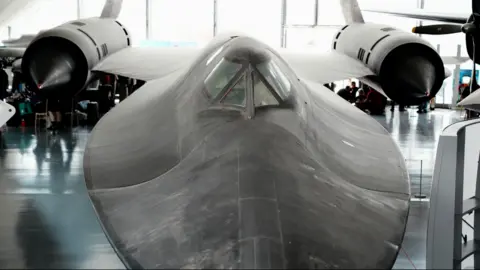
It was hosted by the Imperial War Museum (IWM) in Duxford, Cambridgeshire, which houses the only example of the reconnaissance aircraft outside the United States.
Carpenter said: "Only 85 pilots in 25 years ever flew this aeroplane operationally, so we were a small group of people, [with] 85 navigators."
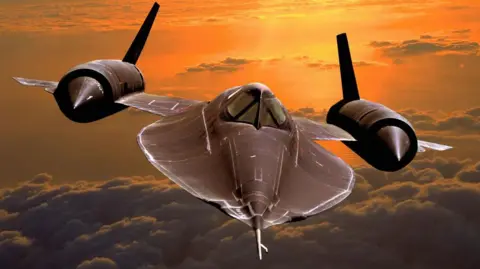
The Lockheed SR-71 Blackbird was the fastest manned operational jet-powered aircraft ever built, capable of reaching a record-breaking speed of over Mach 3.2.
On 28 July 1976, it set a speed record of 2,193.2 mph (3,529.6 km/h) and another hit an "absolute altitude record" of 85,069 feet (25,929 metres).
 Getty Images
Carpenter, who was in the US Air Force between 1967 and 1994, was an SR-71 instructor pilot from 1975 to 1981.
He said: "I was flying out of RAF Mildenhall in Suffolk and we would take off and go subsonically across Great Britain."
This was at the height of the Cold War tensions between the United States and the Soviet Union.
The Blackbird's mission was strategic reconnaissance: photographing military installations and troop movements deep inside enemy territory.
Carpenter said: "We were able to do a lot, not only for the leadership in the United States, but for all the leaders in NATO, because we shared all the information with all of them."
 Getty Images
Only 32 SR-71s were built, with the first entering service in 1966.
Steve Justice worked at Skunk Works, Lockheed Martin's research and development base, having held key roles in engineering, management and advanced design.
"The thing that makes the Blackbird so unique and special is the fact that it flies at a place where no other aeroplane flies," he said.
"It's flying at 2,200 miles per hour (3,540km) at two and a half times the altitude that a commercial airliner flies."
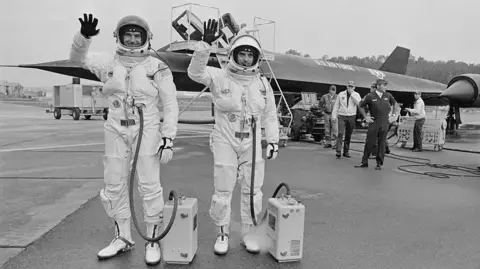
To fly in such thin air, the pilot and navigator had to wear pressure suits, very much like space suits.
 John Fairhall/BBC
He added: "I had the incredible privilege of working around the men and women that designed this aeroplane.
"The technology that they had to develop just to make it a stealth aeroplane, how to measure stealth, what stealth was, the materials, the design techniques, all contributed to the amazing shape that you see."
 John Fairhall/BBC
Brandon Gregory, executive director of the IWM's American Air Museum in Britain, described its Blackbird as "the crown jewel of the collection".
"It's just a cool aircraft: I think people resonate not only with the looks of the aircraft but beyond that what it stood for and what it did," he said.
"To have the pilots, the crew members and to be here with folks who flew in this very aeroplane, is just phenomenal."
Do you have a story suggestion for Cambridgeshire? Contact us below.
Follow Cambridgeshire news on BBC Sounds, Facebook, Instagram and X.