Were Havering voters misled on Hexit?

 BBC
BBCYou've probably heard of Brexit - but what about Hexit?
That's the idea of the borough of Havering exiting the Greater London Authority (GLA) and going it alone.
It is an issue that some in Reform UK talked up during the local elections in May.
But the new council leader, who was never much of a fan of the idea, has kicked it into the long grass, prompting accusations from opposition parties that Reform UK may have misled local voters on the issue - a charge the party has denied.
A change in the political weather saw Reform UK win control of its first London borough in May, as it seized power from the Havering Residents Association, which had been running it.
'I feel more Essex'
The modern London Borough of Havering was created in 1965 after the reorganisation and creation of the 32 London boroughs.
Formerly part of Essex, it was formed from the old borough of Romford and the urban district of Hornchurch.
One of the borough's local MPs, Andrew Rosindell, who defected from the Conservatives to Reform UK earlier this year, has long made the case for Havering to leave the GLA, which he claims would give the borough more power to decide how its money is spent on things such as transport and policing.
During the local election campaign he and his new party leader, Nigel Farage, expressed support for the idea of giving local people a vote on it.
For example on election results day, Farage said there were many in Havering who had felt "their association is with Essex and ever since 1965 have slightly resented being part of Greater London".
"All I would say is people ought to have the choice to make a decision on that," he said.
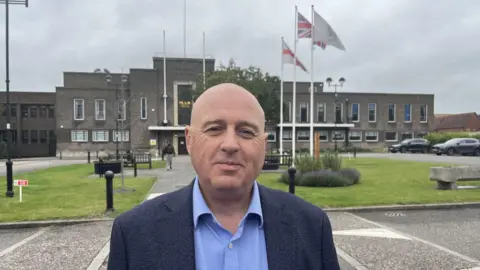
But the party's new council leader in Havering, Keith Prince - who says he never campaigned for that change - dismissed the idea in his first meeting of the council just over a fortnight later, saying he wouldn't be "wasting our time pursuing Hexit".
Prince, who also sits on the London Assembly, told the BBC that he and the Havering Council Reform UK group had not misled anyone as they were never on the same page on this issue as the Romford MP because of the potential cost to things like older people's travel, and he said it was something a council could not deliver anyway.
He said: "If people want a referendum they can have one. I've got no problem with that. My issue is that I just don't think that the case has been made financially. As I see it, many of our residents will be much worse off.
"It's really not something that the council can deal with and we've got an awful lot of problems. We've got a £70m black hole so we're going to focus on that."
Could Havering even quit London?
The sight of Reform UK politicians taking different perspectives on this has led some of their political opponents to accuse them of trying to mislead voters.
The former council leader, Ray Morgon of the Havering Residents Association, explained: "It's not the council which determines whether Havering is in the GLA.
"The motivation for Reform, was they wanted to win Havering Council and obviously it was one of their key priority areas in London and they made promises to people that are not deliverable... such as Hexit".
Havering is one of London's 32 boroughs, which are responsible for managing day-to-day services such as refuse collection and social care.
The GLA, currently led by London's mayor Sir Sadiq Khan, delivers strategic services across the boroughs, like transport and policing.
A London borough does not have the power to split from the GLA. That would require legislation from central government.

At Café Bueno in Romford I met 21-year-old car fitter, Joshua Stile, who said he had sympathy with the idea that Havering has more in common with Essex.
"I feel more Essex, I don't feel included as part of London, because there's such a massive gap difference, with money, with jobs, with housing, all of it," he said.
Pensioner June Fitzgerald told BBC London the idea of Havering exiting current London local government arrangements was "ridiculous".
"The cost of actually changing everything," she said. "Would Essex want us back?"
Cafe manager, Arif Rana, said Hexit could be bad for business.
"Leaving the GLA means that we no longer have the free transport for the pensioners, and if you look around, most of the customers here are pensioners.
"Every morning they come for a coffee or a breakfast. If you start charging them for public transport they won't come."

Rosindell claims Havering would be able to negotiate its own public transport arrangements outside of the GLA and insists voters understood that the idea of leaving the GLA that he talked about during the campaign could only be delivered if Reform UK won a general election.
He said if that happened, he would like to see the GLA abolished altogether.
He said: "Get rid of it all, it's all a waste of money. It's an unnecessary layer of government.
"The outer Greater London boroughs don't get a fair deal, we put a lot of money into this and we don't get a fair share of the resources."
A spokesperson for City Hall said the mayor had "a strong track record of protecting jobs and growth in Havering, as well as delivering affordable housing and vital transport improvements".
Listen to the best of BBC Radio London on Sounds and follow BBC London on Facebook, X and Instagram. Send your story ideas to hello.bbclondon@bbc.co.uk