Land-based salmon farm to go ahead

 BBC
BBCA land-based salmon farm is set to go ahead after planning permission for a building to cover the fish tanks was approved.
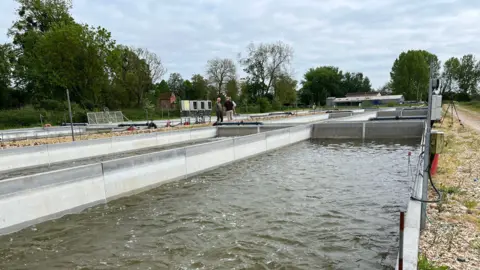
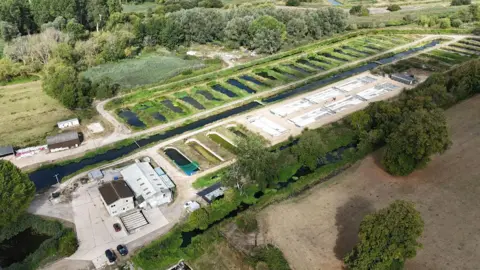
The site, near Downton in Wiltshire, used to be a huge trout farm which drained into the local river, but as a salmon farm, concrete tanks will be used with specialised filters.
Coldwater Salmon Ltd lease the site and said it needs a canopy to stop water from becoming contaminated by things like bird poo.
The planning application received more than 1,000 comments, with many objections due to concerns about factory farming and the environment.
The new building is classed as temporary and can remain in place for five years.
The tanks the salmon will use are next to the empty trout ponds and were created soon before the trout farm closed, as it had planned to use them.
How would it work?
Manager Alistair Watret also ran the trout farm and said: "We used to abstract approx 1,800 litres a second from the Hampshire Avon. The discharge went back into the main river."
He said the salmon farm's Recirculating Aquaculture System (RAS) will use groundwater from a borehole that will be treated and reused like "one large aquarium".
Filters will remove "suspended solids" - like fish poo - which will be collected and stored in lagoons to be used for biogas or as fertiliser. There will also be a biofilter with bacteria which clean, UV filters and protein skimmers.
Watret said salmon are more "delicate" than trout and need "pristine" water, and covering the tanks is a biosecurity measure.
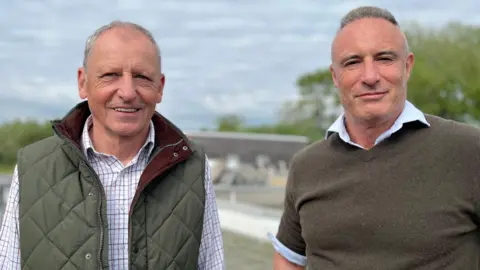
Company owner Julian Connor said the RAS is better for the environment.
"Our pollutants are basically negligible," he said.
He added that, unlike with sea-farmed fish, they cannot use certain chemicals and antibiotics, because they would destroy the biofilters.
The plans also include solar panels on the roof of the building, which Connor said would provide between 24-40% of their energy.
 Julian Connor
What are the concerns?
Many of the objections to the planning application came from national organisations, including the Green Britain Foundation.
Trustee Dale Vince said he was surprised that a fish farm so close to a rare chalk stream river would be allowed.
He said it was "in effect, a town of several thousand people, 20m from the chalk stream, without a sewage system" and that there is still a risk of mass deaths in an indoor environment, like those that happen in sea-based salmon farming.
Connor feels they are being mixed up with sea-based farming too much, where fish can be attacked by lice, jellyfish and disease.
He added that his venture in Switzerland, which uses the same technology, was given green status for fish welfare, following a visit from the WWF in 2017.
Follow BBC Wiltshire on Facebook, X and Instagram. Send your story ideas to us on email or via WhatsApp on 0800 313 4630.