What would a huge offshore wind farm mean for Norfolk?

 Martin Giles/BBC
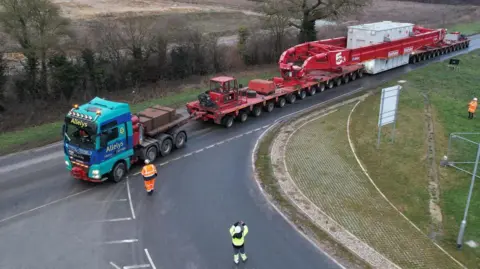
If you regularly drive through Norfolk, you might be used to getting stuck behind an agricultural or heavy goods vehicle. For motorists travelling from King's Lynn towards Norwich, there is now the added slow-moving traffic of a series of transformers being transported across the county for a substation serving what could become one of the largest offshore wind farms in the world. How will the transformers be used and what part will Norfolk play in it?
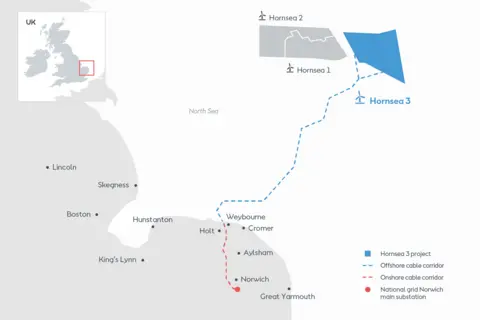
With the possibility of producing 2.9 gigawatts of energy, the Orsted Hornsea Three offshore wind farm is expected to be the largest in the world.
In December 2021 the then Secretary of State for Business, Energy and Industrial Strategy, Alok Sharma granted permission for the £8.5bn project, due to be completed in 2027.
The offshore wind farm is to be located 75 miles (120km) off the Norfolk coast, so why has it taken over a rural Norfolk village?
What is being built?
 Martin Giles/BBC
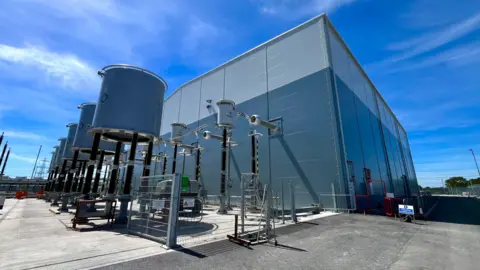
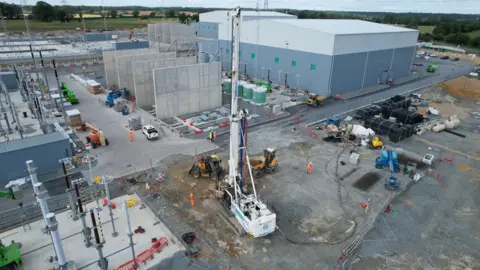
Nestled in the Swardeston countryside four miles (6km) from Norwich, a 49-acre site home to a converter substation is preparing to take offshore wind energy to the National Grid for millions of homes.
On the site, link 1 and link 2, which are both valve halls, converts energy and connects it to the grid.
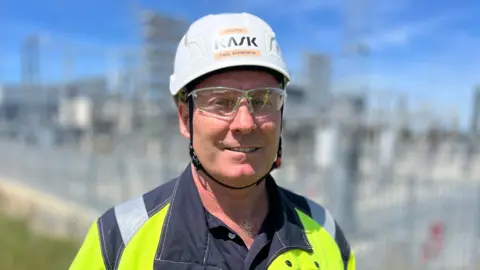
Paul Ashworth, onshore construction manager for Hornsea Three has worked for the company for 11 years and lives in Eaton. He said it was a "blessing" to only live 10 minutes from the site.
He said: "Substations are very common around the world. This is a converter substation, not your standard alternating current substation."
 Orsted
Work on the site started in 2023 with soil stripping, before concrete foundations were laid, steel frames put in place and equipment landed a year later.
He said: "When I look at the scale of this whole project from January 2024 when we started the civil engineering on link 1, to be substantially complete from a building point of view within 18 months was absolutely amazing to see."
A battery energy storage system (BESS) has also been built on the site to minimise disruption to those living nearby.
The facility will store excess electricity to be used at a later time to help balance the grid.
How has it affected roads?
 Orsted
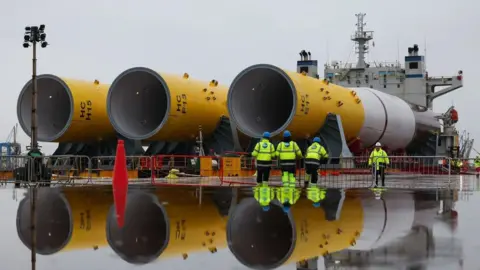
Transformers are a key part of a converter substation changing the voltage produced from the turbines into what can efficiently be used by the National Grid.
Since December, eight transformers for the substation have been transported from the Port of King's Lynn to Swardeston, with a ninth still to come.
Travelling at 12mph (19km/h), it can take up to nine hours to transport the transformers 46.5 miles (75km) across the county, scheduled on a Sunday to reduce disruption.
While a lot of planning is involved to put police orders in place and give out flyers to residents along the route, Ashworth said it was a "necessary evil".
He said: "To go from King's Lynn Port to here is a huge undertaking, especially with the size of the vehicle they need.
"We only have two transformers left to deliver. The last one will be here mid-July but we have to look at it in a very positive way.
"We are coming here, bringing transformers in, we can then get them connected and commissioned and then this project is to power 3.3 million homes - that's a great energy mix the whole country needs, not just Norfolk."
When will work be complete?
 Orsted
At the converter substation, link 1 of the project will go live at the end of the year with link 2 going live early next year.
In the North Sea, construction has seen the installation of 197 monopiles which will be the foundations of each wind turbine.
The first monopile was installed in May with their installation due to be completed next year.
Ashworth said the project will be winding down towards the end of 2027 however, he will remain on site until about February 2028.
What are the safety concerns?
 Paul Ashworth
When proposals were raised for placing industrial batteries at Swardeston to store up energy from wind turbines at the offshore wind farm, a number of safety concerns were raised.
Swardeston Parish Council said it had "grave concerns" about the use of lithium ion batteries and the surrounding technology posing a possible fire risk.
However, Norfolk Fire and Rescue Service had no concerns or objections to the development.
At the time, Orsted said safety was its highest priority.
Among concerns, in 2021, the RSPB criticised the government's decision to permit the offshore wind farm for the potential harm to wildlife including kittiwake birds.
It said kittiwakes would have to dodge turbines to reach feeding grounds and could potentially lead to the death of 73 of these species of birds each year.
What do campaigners think?
 John Fairhall/BBC
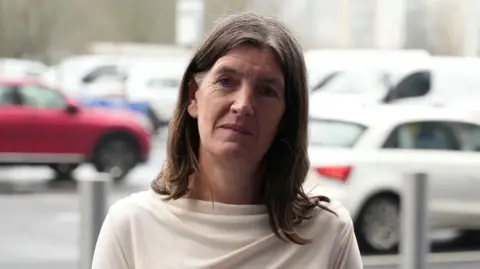
Rosie Pearson is the founder of the Essex, Suffolk, Norfolk Pylons Action Group, which has been campaigning against a 114-mile (185km) network of pylons and cables stretching from Norwich to Tilbury in Essex.
She believed there were other ways to carry out energy infrastructure.
She said: "The obvious thing which should have happened years ago is to connect all the power offshore into a connected grid and then bring it onshore near to London where it is needed ideally at a brownfield site, not way inland in the countryside such as near Norwich because that's hugely damaging for communities, nature and it's a more expensive way of doing things."
She believed it would be cheaper to coordinate wind farms and bring them together to create "energy islands" so there is less infrastructure overall.
She said: "Firstly, government needs to step up and coordinate offshore. We know it's better for the environment, we know it's cheaper, so there's no reason not to do it.
"Secondly, the energy companies should be pushing back for the sake of the environment and consumers and doing what's best for us, not what they find easiest."
Do you have a story suggestion for Norfolk? Contact us below.
Follow Norfolk news on BBC Sounds, Facebook, Instagram and X.