Crews make 'significant progress' in tackling Cairngorms wildfire

 RSPB Scotland
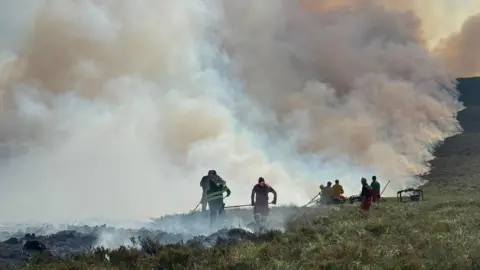
Fire crews are continuing to tackle a large-scale wildfire in the Cairngorms after making "significant progress" in battling the blaze.
More than 100 firefighters have been involved in the operation to control and extinguish the fire, which started near Ryvoan Bothy, south of Nethy Bridge, on Wednesday.
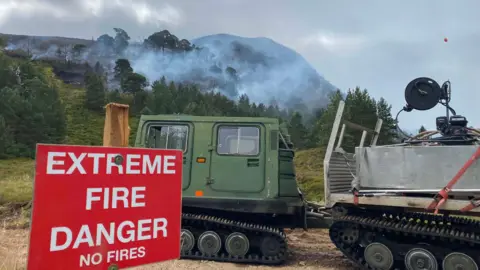
Six appliances and specialist resources including all-terrain vehicles remained on the scene on Sunday morning.
The Scottish Fire and Rescue Service (SFRS) said the response was still "influenced by changing weather conditions," despite rainfall on Saturday evening.
The public has been asked to avoid Glenmore, Abernethy, Loch Morlich and the surrounding areas.
Homes and businesses, including campsites and a ski resort in the Glenmore Forest Park area, have been evacuated as a safety precaution.
On Saturday evening, Police Scotland said those residents and other members of the public who have been displaced by the fire and want to return to the exclusion zone should report to the reception of the Macdonald Aviemore Resort between 10:00 and 12:00 on Sunday.
They will then be contacted when it is safe to return.
The SFRS said "marked improvements" in tackling the fire had been made on its western flank, while progress had also been made in the Strathnethy area.
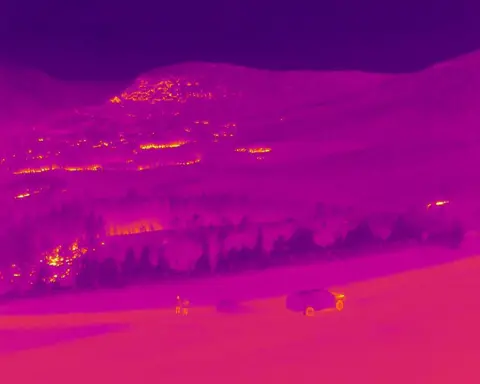
Forestry Scotland allowed crews the use of drones to get an aerial view of the fire area on Sunday, before crews were rotated.
A high-volume pump has been used to draw water from Loch Morlich to support firefighting efforts.
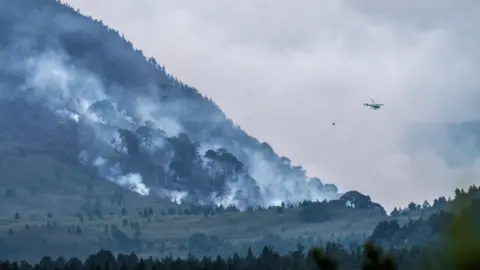
Videos from the response on Saturday show helicopters scooping up large quantities of water before dropping it on affected areas.
The fire was covering an area of about six square kilometres.
Jon Henderson, SFRS assistant chief officer, said the response had been a "protracted effort" in difficult conditions.
He said: "The conditions have been very, very favourable, which has allowed us to really start to attack the fire in earnest and continue to contain it.
"The terrain is treacherous, it's inaccessible at times, and it's very, very difficult and very dangerous.
"We're very positive about where we are now, but those things can't change very quickly, and we need to remember that we're dealing with a fire in a mountain range."
 Ronan Dugan
The SFRS said firefighting conditions were at their most challenging between 15:00 and 18:30 due to "warmer temperatures and changing wind conditions".
Henderson said teams had benefitted from low wind and light rain early on Saturday.
Wildfire risks across parts of Scotland will remain at a very high level until at least Monday.
Gavin Miles, director of planning and place at the Cairngorms National Park Authority, praised the efforts to tackle the wildfire.
Despite restrictions being in place, he said visitors and locals were "welcome to come and enjoy the park" while being aware of the high risk of wildfires and the parks fire bylaw.
He said that while this is the first year of the by law which bans open flame and barbecues in the park, early indications were positive with rangers reporting a reduction in the number of reported incidents.
 Cairngorms National Park Authority
The RSPB said about 300 hectares of its Loch Garten reserve at Abernethy had been burned, while concerns had been raised over the wellbeing of capercaillie, a critically endangered woodland grouse thought to have been nesting nearby.
The SFRS said they were working with Forestry Scotland and Land and Estates Scotland to plan their response around the area's "difficult and inaccessible" geography.
In some areas, trenches have been dug to act as fire breaks.
 RSPB Scotland
Sandy McCook, chairman of Nethy Bridge community council, criticised justice secretary Neil Gray after he said the fire had been "contained" on Thursday – only for the response to be scaled up a day later.
Henderson said that "contained did not mean the same as extinguished" and that the response had been strategically planned around controlling its spread.
He said: "Contained means that effectively that we understand the behaviour of the fire and the fire isn't out to control.
"We work harder to contain it in certain areas and allow it to travel into other areas where we know that we're able to tackle it.
"Even when the fire is extinguished, there will still be hotspots of the fire and we'll probably still be there for a protracted period of days, just making sure that we keep on top of that."