How afraid should we be of Scotland's jellyfish?

 R.S. McLaren Photography
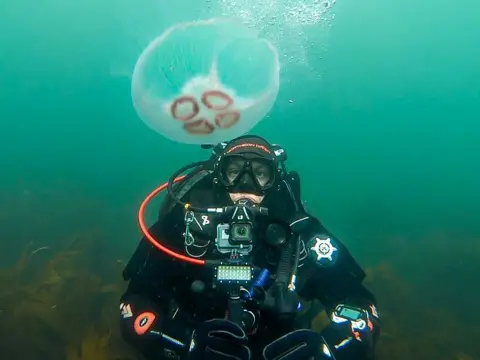
When scuba diver and underwater photographer Ross McLaren encountered a jellyfish for the first time, he said all he felt was "sheer terror".
"I was diving in the Clyde and one of the instructors had to pull me out of the way of the tentacles as it was wafting above me," he said.
McLaren ended up with a sting across his upper lip but said it did not stop him from wanting to dive.
Many people are scared of jellyfish due to the fear of painful stings and the creature's unpredictable nature in the water.
 R.S. McLaren Photography
But McLaren, who lives near the coast in North Ayrshire, believes there is more to the brainless, heartless and boneless invertebrates than people might think.
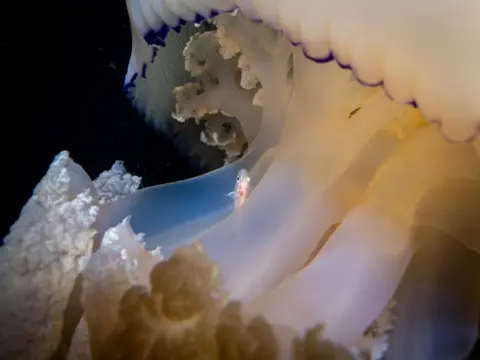
"Jellyfish have such a bad reputation but they are one of the most mesmerising and beautiful creatures underwater," he said, having completed almost 600 dives.
As we reach peak jellyfish season in Scotland, should we see them as a sight to behold or a reason to run?
When do you see the most jellyfish in Scotland?
July and August are peak months for jellyfish sightings in Scotland.
"The number and distribution of jellyfish are impacted by many different factors," said Anna Bunney of the Marine Conservation Society, which runs a nationwide survey of jellyfish.
"This includes sea temperatures, the availability of plankton for feeding, which peaks during the summer months when it is warmer, and ocean currents."
Sea temperatures tend to lag behind air temperatures, Bunney says.
The maximum air temperatures in Scotland usually occur in July and August, whereas sea temperatures are at the warmest in August and September.
When the sea starts to get warmer, it means a return of the jellyfish.
 James Lynott
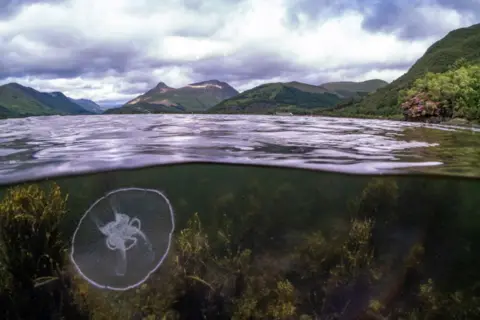
Bunney described jellyfish as weak swimmers or "passive drifters" which rely on ocean currents to carry them.
Calmer ocean conditions around the UK in the summer months help to push jellyfish gently towards the shore, meaning there are often more sightings of the creatures.
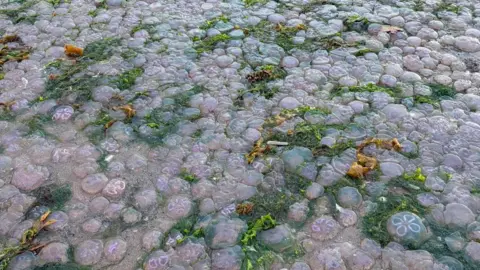
Breeding speed also increases with warmer conditions, allowing adult jellyfish to reproduce in large numbers, creating so-called blooms.
These blooms can look like a thick soup or pulsing cloud in the water and have been known to block boat engines.
In 2011, Torness nuclear power station in East Lothian was even shut down as a precautionary measure due to huge numbers of jellyfish found in sea water entering the plant.
 Marc Kilpatrick
McLaren added that while jellyfish season is normally April to October, the creatures can still be seen in Scotland's waters all year round.
"You see them in the winter months but they are far more prevalent and common during the summer," he said.
What happens if a jellyfish stings you?
Jellyfish stings in Scotland are not usually life-threatening but can be very painful.
Depending on the type of jellyfish, the stingers may not be sharp enough or long enough to pierce the skin.
Bunney said most jellyfish have stinging cells but the severity and detectability of the sting varies widely between species.
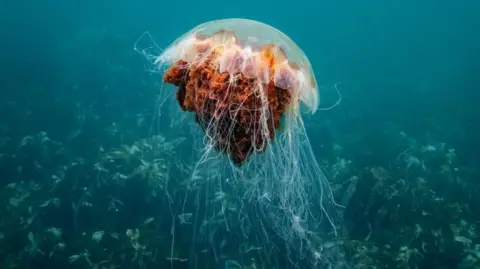
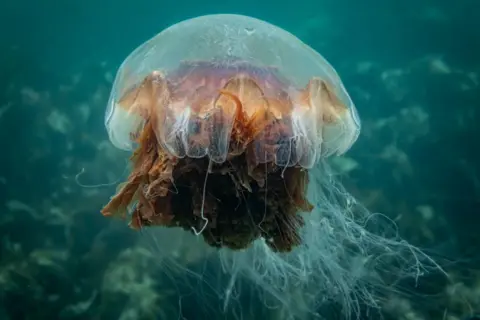
Swimmers should be aware of the Lion's Mane, which is a brownish orange colour, and prevalent around Scotland's coastline in the warmer summer months.
They have long tentacles which can give a sore but not lethal sting.
The tentacles can break off and float around in the sea or become attached to chains on a boat, for example, but the stinging cells will stay alive even when not attached to the main body.
 R.S. McLaren Photography
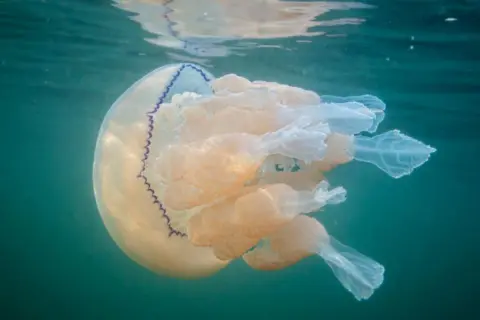
Bunney, who said she has been stung a lot by jellyfish, compared a mild sting to that of a nettle.
"There was one point when every time over a period of two years I was stung by a jellyfish when I was out in the sea," she said.
"But thankfully, it hasn't impacted how I feel about the ocean.
"In fact, what I often think is the most frustrating is when you are stung but you cannot see what you have been stung by."
 R.S. McLaren Photography
McLaren said he has never been put off scuba diving by the prospect of a jellyfish sting but he can understand why swimmers might be nervous.
"When you're diving, as long as the visibility is good, you can negotiate your way around a jellyfish relatively easily, if you know what way the current is flowing and you pay attention," he said.
"Swimming, on the other hand, I totally get it - if I was taking my kids down to the beach and there were a lot of jellyfish I would probably stop them from getting in the water.
"When you're swimming you tend to have your head out of the water more so you can't always see what is underneath or know where the tentacles are going."
Both Bunney and McLaren added that it is important not to touch a jellyfish when it is washed up on a beach as it can still sting, even when presumed dead.
 R.S. McLaren Photography
Bunney said to follow NHS guidance after a jellyfish sting.
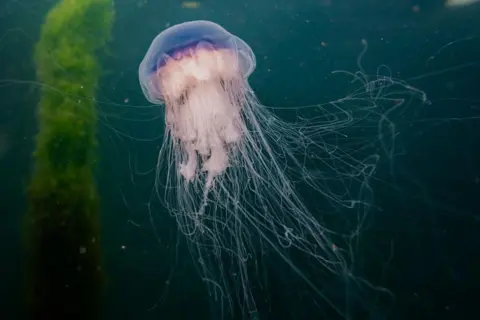
It suggests using tweezers or the edge of a bank card to remove the tentacles as soon as possible as they can continue to sting while attached to the body.
A heat pack or immersion in hot water can reduce pain and swelling, and painkillers such as paracetamol can also help.
If symptoms because more severe or a sensitive part of body has been stung, seek medical help.
Why do jellyfish sting?
 R.S. McLaren Photography
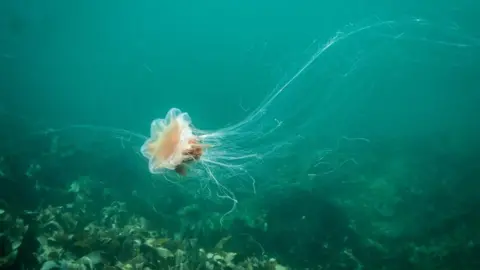
Unlike bees or wasps, which sting as a defence mechanism to protect themselves, a jellyfish sting is an automatic reflex, not a deliberate attack.
"A common misconception is jellyfish go after people but contact with a jellyfish is actually merely incidental and humans are not on their menu," Bunney said.
"They are not actively stinging, it is just when anything touches their tentacles as they are moving through the water, regardless of what it is."
 R.S. McLaren Photography
Jellyfish tentacles are lined with thousands of venom-filled stinging cells.
When touched, these cells fire toxic harpoon-like tubes designed to paralyse prey, such as plankton and small fish.
Should jellyfish stop you from swimming in the sea?
"Do not be afraid but be cautious" is the advice from Bunney, who generally recommends swimming calmly away from jellyfish.
"Most of the species found in Scotland have very mild stings, which only cause minor irritation, and some are completely harmless," she said.
Bunney says it is important for people to learn about the different species of jellyfish and report sightings to the Marine Conservation Society.
"People think jellyfish are ugly," she said. "But they are really beautiful creatures that come in all different colours and sizes."
 R.S. McLaren Photography
McLaren echoed the love for the marine invertebrate.
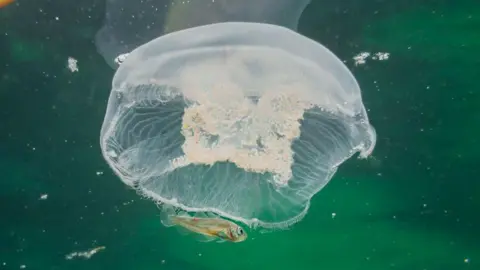
"People hate jellyfish but I always do my best to take a photo of one when I see it because they are impressive to see in the water," he said.
"It's almost like stars in the night sky when you are on the sea floor and looking up at the jellyfish above you.
"It's magical."