Glass centre shut as protesters persuaded to leave

 Jim Scott/BBC
A glass centre has shut for the final time after placard-waving protesters were persuaded to leave.
The nearly 30-year-old facility shut at midday after Sunderland University said it needed significant remedial work at a cost of between £14m and £45m.
Campaigners and its architect Andy Gollifer disputed the accuracy of the figures, but the university said it had been transparent during the process.
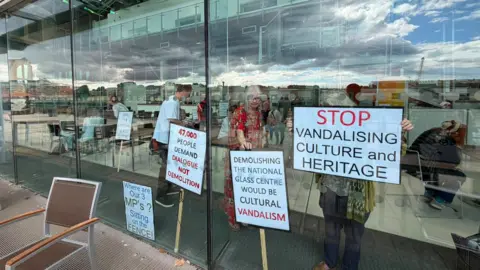
Artists had already cleared their workshops of equipment, material and artwork, however, a number of campaigners remained in the facility's cafe as the doors were locked, but have now left the building.
Carolyn Basing, who was one of the artists and chairs the Save the National Centre Campaign group, reflected on the closure.
"This has been such an amazing place, and it's such an amazing community to work within, lovely people, and that's all come to an end," she said.
"And there doesn't appear to be justification for it."
The NGC was opened by the then Prince Charles in 1998, and was largely funded by Arts Council England, to preserve the area's 1,350 year glassmaking heritage.
It had operated galleries and demonstrations for the public, workshops for artists, and was home to the university's glass and ceramics courses which have since ended.
 BBC/Jim Scott
Artist Joanna Manousis relocated from Ohio in the United States, along with her husband and two young children, to Sunderland to use the NGC as a base for her business after studying a PhD there.
However, unable to continue in the city, she has since sold her family home in Roker, while she looks at locations elsewhere so she can continue to produce and sell art.
"We just thought we are in the best facility in the country, we can carry on making once finished with the [PhD] programme, but obviously that was not the case."
She also said "to tear it down" would be a travesty.
 Jim Scott/BBC
The NGC was developed by the now defunct Tyne and Wear Development Corporation, and run by the council, before being transferred to the university in 2010.
Roger Clubley, who was the project's executive director, said the building and land was always meant to be used for the benefit of the public, and there had been "excitement" around the "innovative" development at the time.
He said he now felt "immense sadness".
"It was equipped and able to run properly, earning money, looking after itself and this should not have happened."
Campaigners are now working to oppose the demolition of the building, which includes continuing to appeal that a council direction which could halt the plans to raze the building is carried out.
 Handout by Roger Clubley
A spokesperson for Sunderland University said "sincere thanks" was owed to the staff who had worked at the centre over many years.
They said that "despite a range of conversations with individuals and organisations" no "feasible plan emerged to meet the significant financial requirement" for the remedial works, and the £800,000 annual subsidy funded by the organisation.
They also said that almost 90% of the university's income came from student tuition fees, and in a period of "significant financial challenge" across the sector, the priority was to "protect teaching, research and knowledge exchange activities".
"The university has remained committed to transparency in its decision-making and this will continue as we move forward, following all planning requirements in relation to the planned demolition of the building," the spokeperson said.
The university is gifting specialist equipment from the NGC for use in the planned Glassworks site in Sunniside, or to establish "interim" glassmaking facilities.