Air conditioning debate heats up in the South

 BBC
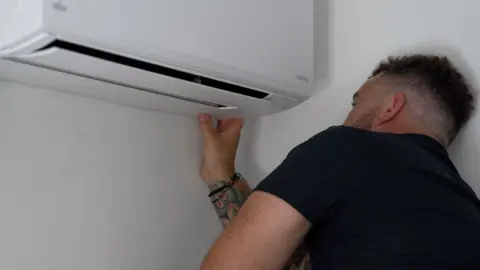
BBC"As you can see it's 27C, mid-morning in the bedroom at the moment. It's quite unbearable."
Oliver Sanders, from Didcot, is among those in the South who recently decided it was time to install air conditioning.
And who can blame them - records have been broken, hospitals have declared critical incidents, and infrastructure has buckled under the intensity of the extreme heat.
Tristan Spence, who owns an Oxfordshire-based installation company, says there has been a significant rise in demand, leaving him fully booked until January.
But as calls grow for all new-build homes to have built-in air conditioning, climate experts are warning they may not provide a long-term solution to keeping us cool.

Oliver bought his home in 2020, one year after it was built, and said he had heard it had been well insulated.
"There wasn't really any concern about the summers being too hot," he says.
"I think that's really what pushed us over the edge is how often and how hot it has been recently."
Tristan echoes this point and says his company, TRS Cooling, has seen a particular rise in owners of new-build homes requesting the need for air conditioning.
"New builds are really well-insulated. Which is great in the winter but as soon as summer comes and you have prolonged periods of heat you can't get the heat out of the property," he said.
Retained warmth in brick and concrete can push night‑time temperatures in urban centres up to 7C higher than the surrounding countryside.
This is the urban heat island effect, and it is at its most dangerous in the early hours, when bodies need cooler air and cannot find it.
Tristan said that was where air-conditioning is a "great solution to removing heat from a property".
But some experts point out that air conditioning does not destroy heat, it moves it - out of buildings and into the street.
And there, as some studies suggest, it can warm the air your neighbours breathe and drive up the demand for still more cooling.
Nethmi Kariyawasam, from the Smith School of Enterprise and the Environment at Oxford University, says passive methods of cooling like shading, shutters and even the orientation of the building when constructing new homes, should be explored first.
When it comes to homes that are already hot, she says air-con should be a last resort.
"Mechanical ceiling fans and fans produce much less carbon emissions and they are cost-effective as well," she says.
But Nethmi also says when it comes to critical infrastructure like schools and hospitals, air-con "can't be avoided".