'Thank you, David Hockney, for transforming my life'

 Bradford Culture Company
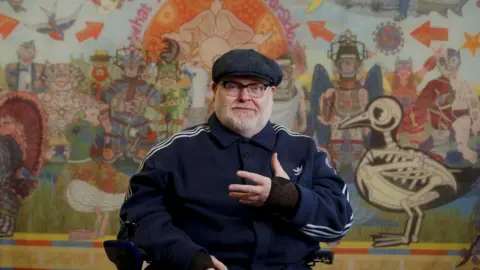
When Bradford artist Jason Wilsher-Mills was asked to reflect on the death of one of the city's most famous creative sons, David Hockney, his answer was simple and deeply personal - "He transformed my life."
After disability made it impossible for him to continue creating large-scale paintings, Wilsher-Mills saw Hockney experimenting with drawing on an iPad.
Inspired by the artist's willingness to embrace new technology he bought one himself, and was creatively rejuvenated.
"So thank you, David Hockney, for changing my life, from one Yorkshireman to another," he said.
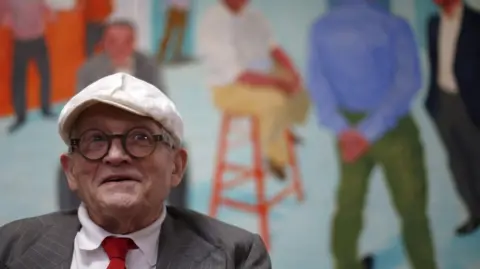
The death of the Bradford-born artist last week has led to an outpouring of warm tributes, not least from his home city.
For Jason and other artists involved in Bradford 2025's Draw! project, Hockney's legacy extends far beyond the artists he inspired directly, and it remains firmly rooted in Bradford.
 Reuters
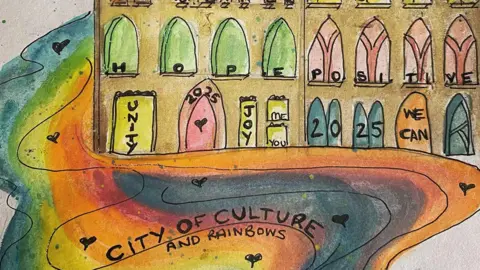
Draw! was one of Bradford 2025's flagship community arts projects, and was supported by Hockney.
It invited people across the district to pick up a pencil, respond to creative prompts and engage with the world around them in new ways.
More than 6,000 people submitted drawings at community arts sessions and online throughout the year.
Beginning with a simple prompt from Hockney himself to "draw something you think is beautiful", the project became a celebration of the values that shaped his work: curiosity, observation, playfulness and the belief that creativity belongs to everyone.
Wilsher-Mills was among the artists who contributed to the project, encouraging participants to "draw your favourite thing".
"My favourite things are Beano annuals from the 1970s, Doctor Who, The Beatles. Sometimes it's Ian Curtis or a drawing that my kids did for me," he said.
"All those objects of desire that we have in our lives are so personal and so powerful. If you absolutely love the object, it's like a little pilgrimage when you're drawing."
If Hockney's invitation was to draw something beautiful, Wilsher-Mills encouraged participants to look more closely at the things they loved.
Other artists on the project, all providing their own creative prompts, included comedians Harry Hill and Johnny Vegas, and fashion icon Zandra Rhodes.
 Submitted/Bradford Culture Company
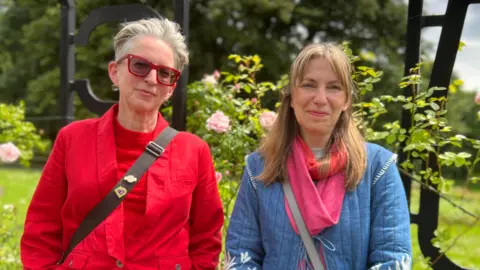
Illustrator and workshop facilitator Nicola Storr saw first-hand how strongly Hockney's message resonated with participants.
"One of Hockney's mantras was 'look, look and look again'," she said. "He was really encouraging everyone to get out and see."
As families returned month after month to take part in workshops, she noticed something striking.
"There were so many conversations that started with, 'well, I can't draw. I got told I can't draw. But this is by Hockney, so I'm going to turn up and do something.'"
For many people, it was Hockney's name that gave them the confidence to take part.
"A lot of the conversations always ended up back around Hockney," said Storr. "There were so many warm conversations that all started with Hockney."
Participants spoke not only about his work, but about his connection to Bradford and the way he carried the city with him throughout his career.
"It was like having an art teacher watching over you," she said. "He was almost like the grandfather watching over the project."
Storr believes people connected deeply with Hockney because of his pride in his roots.
"I think Hockney was the absolute northern king of that," she said. "He was proud of Bradford."
 BBC/Aisha Iqbal
Artist, curator and creative producer Alison McIntyre, who runs the Art Doctors project, says improving accessibility was one of Hockney's defining qualities, and reflected a wider career spent challenging assumptions about what art could be and who it was for.
"He was really passionate about drawing being something that should be part of everybody's life," she said.
"It didn't matter whether it was a perfect piece of work or not. The process of drawing was more important than the end product."
For many participants on the Draw! sessions, says McIntyre, that simple message proved liberating, as the spirit of Hockney infused every session across the year.
She is not surprised by the affection people still feel for Hockney and the enduring connection between the artist and the city that shaped him.
"He was the people's artist, I think," she says.
"That's why people in Bradford still have such an affinity and love for him."
Listen to highlights from West Yorkshire on BBC Sounds, catch up with the latest episode of Look North.