Who is the Somali referee barred from entering the US for the World Cup?

 Getty Images
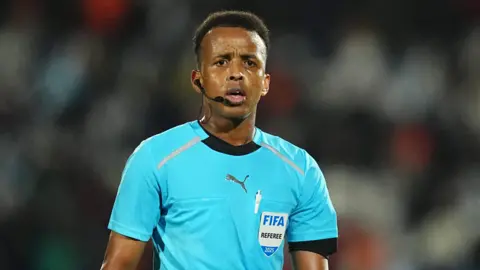
Refereeing at the 2026 Fifa World Cup was set to be the highlight of Omar Artan's career, but the Somali will miss out on the opportunity to take charge of matches on the game's biggest stage after being denied entry to the United States.
The 34-year-old, who was set to become the first man from his country to play an on-pitch role at the finals, was turned away by border officials in Miami despite holding a diplomatic passport and a single-entry US visa.
"Every referee's ambition is to go to the World Cup," Artan told BBC Somali in an interview last week before leaving home.
"When you are selected, you feel that all your hard work was worth it. It was a moment where everything came into focus.
"Years of effort finally made sense."
Artan, who was named the best male referee in Africa last year and took charge of two matches at the recent Africa Cup of Nations (Afcon), had been hailed as "a symbol of inspiration for the new generation of Somalis" by the country's President Hassan Mohamud after being included in the list of Fifa match officials.
The Somali government is mounting diplomatic efforts in a bid to resolve the issue, but Artan looks set to be excluded from the World Cup after rising through the officiating ranks in a country which has been troubled by conflict in recent decades.
The US State Department told BBC Africa that it welcomes "legitimate travellers" to the World Cup and adjudicates each visa application on a case-by-case basis "after rigorous review and thorough vetting".
It also cited "national security and public safety" as other factors in their visa process.
For now Artan remains in Turkey's main city Istanbul following his removal from US soil, but it is believed he will return to Somalia's capital Mogadishu on Wednesday.
An important mentor
Artan's refereeing career began in Mogadishu on neighbourhood pitches after a leg injury ended his playing days.
He unexpectedly first picked up a whistle during a local match when a dispute over the referee prompted players on both sides to ask him to take over. He accepted and remained in the role.
Artan went on to officiate in organised competitions in the city, although much of his early development came while overseeing informal and semi-organised fixtures.
A key influence in his early career was Osman Jama Dirac, the former head of referees in Somalia.
Dirac provided technical guidance and personal support during a period when Somali football operated with limited institutional structure and little international exposure.
"He was like a father to us," Artan said.
"He did not just lead referees, he took care of us. If you were in Mogadishu and had nothing, he would make sure you ate, he would take you to a restaurant."
However, Dirac was killed in August 2017.
Artan has spoken of the timing with restraint.
"It was very hard," he said.
"He was preparing me to become an international [referee]. He would have been proud to see a Somali reaching this level."
Rising through the continental game
 Getty Images
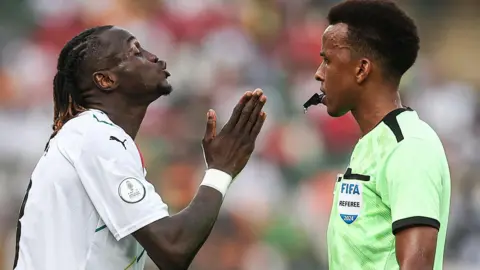
Artan became a Fifa-listed referee in 2018 and steadily moved through the African game, overseeing high-profile continental fixtures.
In January 2024, he became the first Somali to referee at an Afcon game, taking charge of the Group E match between Tunisia and Namibia.
He was recognised by Confederation of African Football (Caf) as its top male official in November, before being appointed by the continent's governing body to oversee the second leg of the African Champions League final between Moroccan club AS FAR and South Africa's Mamelodi Sundowns last month.
In April, praise came from President Mohamud after Artan was named among the 52 referees for the World Cup.
"I commend the effort, professionalism, and integrity shown by referee Omar," Mohamud said.
It was certainly a proud moment for Artan - and one he knew was a milestone achievement.
"It was not just my joy," he said.
"My family, Somali people, the federation and young referees all shared that feeling. It became hope for them that a Somali referee can reach that level."
In the months leading up to the tournament, Artan described an intensive preparation routine.
"Every morning I was on the pitch," he explained.
"Preparation for the World Cup is not small work... physically, mentally, and in knowledge.
"In World Cup football you are dealing with world-class referees at the highest level. You have to reach that standard and stay there."
Refused entry
 Getty Images
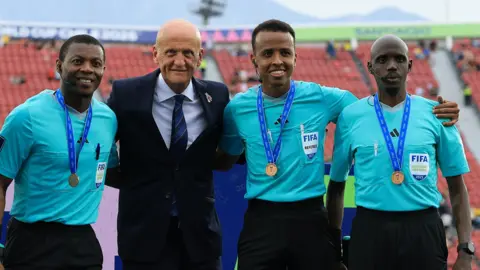
Artan set off for the World Cup via Turkey on Saturday, intending to attend a pre-tournament seminar in Miami where Fifa referees' chief Pierluigi Collina has created a training base for the referees and 88 assistant referees selected for the finals.
But Somalia is one of several countries on a travel ban list introduced by US President Donald Trump's administration, and Artan ran into difficulties on arrival in Florida.
He told the New York Times he was questioned by immigration officials for 11 hours, with the Al-Qaeda-aligned militant group al-Shabab one of the main topics raised by border and customs officers.
Artan was placed on a return flight after US immigration officials cited "vetting concerns".
All on-pitch officials at the World Cup must be based at Fifa's Miami hub for training, preparation and security, and that requirement means it would not be possible for Artan to only be assigned to games which are being played in Canada or Mexico.
Fifa appears powerless to intervene in the Somali's case.
"Fifa is not involved in host country immigration processes, including visa adjudications, and has been informed by authorities that Mr Artan's status will not be changed at present," the game's world governing body said in a statement on Monday.
"A host government ultimately determines who receives a visa and who is admitted into their country."
Somalia's government says it is "deeply saddened" by the circumstances while Artan expressed gratitude to the "football family" for their messages of support.
"I would like to thank Fifa and Caf for all their support and I promise to keep my refereeing levels up as I concentrate on the future," he said in his own statement issued to Reuters.
"I wish my colleagues all the best success during the World Cup and I look forward to joining them again in future competitions."
Africa will now be represented by six referees at the tournament, which kicks off on Thursday and runs until 19 July, with those officials coming from Algeria, Egypt, Gabon, Mauritania, Morocco and South Africa.
But Omar Artan will not join them after a historic moment for him and Somalia was scuppered by US immigration officials.