'Bionic' hairdresser's career saved by arthritis study

 BBC
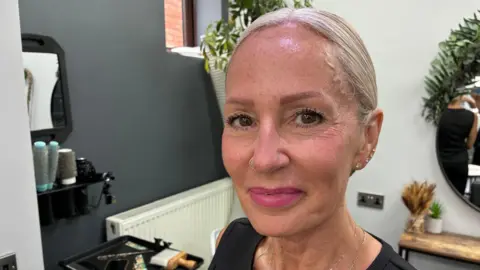
BBCAfter 43 years as a hairdresser, Beverley Wadsworth thought nothing could stop her from doing the job she loves.
But, when the 58-year-old first developed symptoms of osteoarthritis, commonly known as thumb arthritis, she was faced with a tough decision on whether to hang up the scissors altogether.
The condition meant she could no longer grip a hairdryer, twist a brush or use a comb without pain.
Wadsworth said she was only six months away from taking early retirement when she was accepted on to a trial pitting a new modern joint-replacement technique - described as a "mini-hip replacement for your thumb" - against more traditional methods.
The national trial, led by University Hospitals of Derby and Burton NHS Foundation Trust and South Tees Hospitals NHS Foundation Trust, has given her the chance to work for another 10 years, she said.
Speaking before her surgery, Wadsworth, from Burntwood, Staffordshire, said the pain in her hand became worse since she was first diagnosed two years ago.
"My hands are my tools and without them I can't do my job," she said.
"At first, it was just small, sharp pains, here and there - but then as the pain got worse over the last two years, my grip started getting worse.
"Working at the moment is quite uncomfortable - it's bone rubbing bone.
"I'm fed up with it.
"It impacted my life quite a lot - mentally too, because I'm in pain all the time.
"I absolutely love my job, but I was struggling to do it."
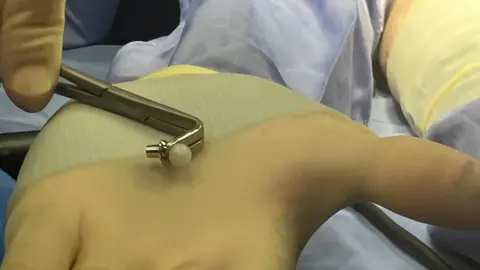
With her career under threat, the hairdresser joined a national study known as the SCOOTT trial (surgery versus conservative osteoarthritis of thumb).
In the trial, which is still ongoing, more than 600 patients are randomly assigned to receive one of three treatment types, before researchers review how successful each method is.
A third of the participants will have the carpometacarpal joint replacement surgery, while a second third are having trapeziectomies - surgery which removes a small amount of bone to ease pain.
The final third of patients are receiving non-surgical management packages which include exercises, splints, injections and other pain-coping strategies.
Nick Johnson, consultant hand surgeon, who is co-chief investigator for SCOOTT, said: "We see a lot of patients with the problem of thumb-based arthritis - but we don't know what the best treatment is.
"SCOOTT compares those three treatment options and will follow up with more than 600 patients for about 18 months, seeing how well every person does, what the situation is in terms of pain and function afterwards.
"It also helps assess everything in terms of cost effectiveness and efficiency - we know that all three approaches work, but we don't know how well they do compared to each other."
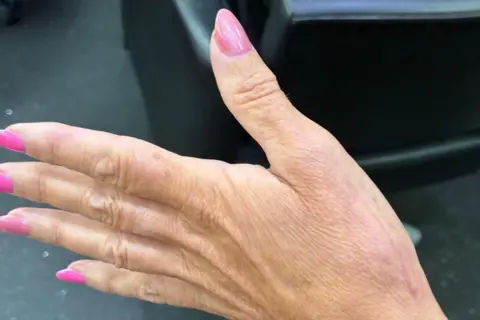
Nine weeks on from surgery, Wadsworth was again cutting hair at her salon cutting with no pain, describing herself as a "bionic woman".
"It's gone really well," she said.
"I can grip and pinch a lot better and my movement is great.
"I can use my hair brush without any pain, I've got my grip back for my hairdryer.
"If I hadn't had a good result, it would have been the end of my career, which is something I'm not ready for.
"Now, after the recovery, I can go on with my career, maybe for another 10 years."
The SCOOTT team said they were still actively recruiting to the trial and asked any patients with thumb arthritis who are interested in taking part to get in touch.
Listen to BBC Radio Derby on Sounds and follow BBC Derby on Facebook, on X, or on Instagram. Send your story ideas to eastmidsnews@bbc.co.uk or via WhatsApp on 0808 100 2210.