How can Jersey adapt to a changing climate?

 BBC
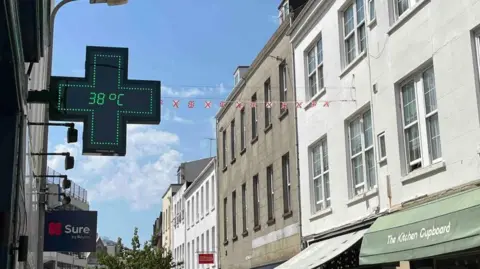
BBCBefore July and August, traditionally Jersey's two hottest months, had started, the island had already experienced a pair of heatwaves and record temperatures.
Climate change caused by humans has made heatwaves more frequent, intense, and last longer.
While some people enjoyed spending time on the beach during the hot weather, for many others temperatures over 30C (86F) in May and June were more of an endurance.
With Jersey now in the middle of its third heatwave in less than two months, and more hot weather increasingly likely, how can the island prepare its public buildings and homes?
'Unprecedented heat'
Jersey had its hottest ever May and June this year, when it hit by what Jersey Met described as "unprecedented heat".
Temperatures peaked at a record 39.3C (102.7F) in June and May brought the island's first ever five-day period of temperatures above 30C (86F).
More than half of the hottest 20 days ever recorded have been during this century, and seven since 2020.
Head of meteorology at Jersey Met Paul Aked said May had been the earliest there had been a heatwave, and the earliest in a year temperatures had been above 30C (86F).
He said: "Temperatures are indeed getting warmer or hotter in line with what we know about how our climate is changing.
"We're seeing these events happen more often in recent years... into the future we should expect to see and experience more hot weather."
The world has already warmed by about 1.1C (34F) since the industrial era began and temperatures will keep rising unless governments around the world make steep cuts to emissions.
Nearby France recorded more than 2,000 excess deaths during June's heatwave.
Jersey's new infrastructure minister deputy Jonathan Renouf said he will need to consider how to future-proof the island.
He said many buildings, such as schools and hospitals, had been built for a climate that "no longer exists" and is "only going to get more extreme".
"You can't plan infrastructure without the climate as a key variable.
"I think any infrastructure project has to have climate resilience built into it," he added.
He said that included the design of buildings, the implications of rising sea levels on sea defences and the water supply.
Jersey Water said June's heatwave led to the highest weekly demand for water since a drought in 2022.
The company said 35 million gallons (59 million litres) had been used, which had been nearly 5% of the island's stored water.
It said reservoir levels at Queen's Valley and Val de la Mare were in a "good position" but "could drop fast".
Is air conditioning the answer?
As people scrambled to keep cool in record temperatures, portable air conditioning quickly sold out in many shops.
Air conditioning has been in hot demand, with retailers seeing their stock fly off the shelves and units online sell out across the UK.
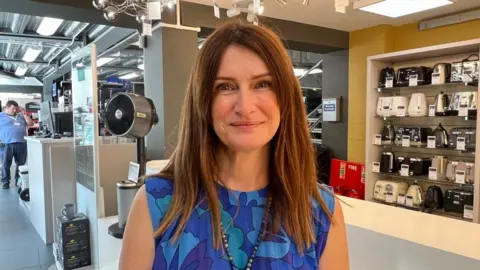
In two days in May, Romerils department store sold the same number of air conditioning units as it had the whole of 2025.
It reported sales in the last two months had been 70% higher than during the same period last year.
Carla Martini, who works at the company, said suppliers would not have more until next year.
She said there had not been more desire for built-in air conditioning in domestic homes but there had been extra demand for commercial premises.
Meanwhile, The Powerhouse shop said it had sold a year's worth of portable air conditioning units in the last few weeks.
Panther Office Products secured more stock of the units but said suppliers had set higher prices.
Managing director Anna Davies said demand had significantly increased.
She said: "Most summers people would buy fans and they could cope... we have been having people call non-stop looking for aircon units."
A new University of Reading study found 4.3% of homes in England used air conditioning, but that "groups most at risk from heat use it least", including over-75s and single-parent families.
During the heatwaves, deputy Louise Doublet raised concerns about the impact on patients in hospital and asked people to donate fans to help the wards cope.
She said the new government needed to take the issue of extreme heat "very seriously".
Doublet said some specific measures could be taken to help people access fans and air conditioning, adding that costs "shouldn't be a barrier" to health and safety, especially when involving the welfare of very young children.
She said there were other solutions which could help reduce the heat.
"Planting trees is really important because the shade that trees provide will lower the temperature by a few degrees and that can make all the difference in a heatwave," she explained.

Architect Anna Robertson agreed and said designs with more shade, shutters and greenery could keep temperatures down.
She is from Bermuda and said islanders there "survive on air-conditioning" but she was concerned Jersey and the UK lacked the infrastructure to deal with the amount of energy air conditioning would consume if everyone used it.
Meanwhile, researchers at the University of Birmingham have warned air conditioning "significantly worsens global warming".
An author of the paper, Hongzhi Zhang, said: "In regions with cleaner electricity systems, the same amount of cooling demand would have a much lower climate impact."
Jersey imports almost all of its electricity from France, which is generated through low-carbon nuclear or hydroelectric power systems.
As temperatures soared in June, vulnerable islanders in care homes were kept cool with ice lollies and fans.
Home manager at Stuart Court Residential Home, Elaine Jackson, said: "They are sweating so much, like us all, and the staff, we're all sweating.
"We do need to replace those fluids and replace those electrolytes and make sure people are kept cool."
Resident Beryl Butel said: "We're very lucky because we've got the fans going and I've got one in my room, but it's the staff, really, because they're very hot."
People in the hospital and outpatients centre said they had struggled to keep cool and the health minister has promised those problems would not continue when new health facilities had been built.
Renouf said the island need to start planning "now" for the fact the island will not return to previous, cooler climates.
He said he wanted to consider how developers could design methods of capturing rainwater to reuse and if older buildings could be retrofitted with cooling systems.
"I don't think we can wave a magic wand, we can't immediately address every single one of those problems in one go, but I think we need to start having the conversation now about what changes we make to building regulations, so that new buildings are future-proofed," he added.
Follow BBC Jersey on X and Facebook. Send your story ideas to channel.islands@bbc.co.uk.