Man wakes after cardiac arrest to see 'unbelievable' new baby

 Handout
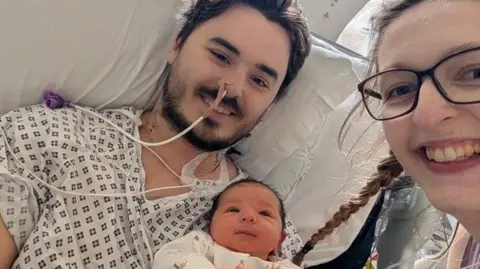
A dad has described the "unbelievable" moment he opened his eyes after suffering a cardiac arrest - and being placed in an induced coma - to see his newborn daughter's face for the first time.
When 27-year-old Sam King's heart stopped at home in Hedge End, near Southampton, he went two hours without a sustained heartbeat.
His survival is thanks to the actions of his wife, Emma, who was then 39 weeks pregnant, and a team of NHS staff, who continued treating Sam.
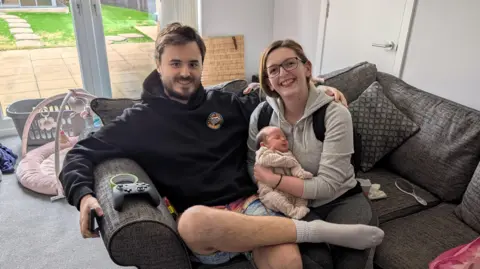
Since then, Sam has experienced a remarkable recovery, and said he first began to show signs he might pull through when he was shown his daughter, Sophie, for the first time, who was born four days after he almost died.
 Handout
"I don't remember anything that happened that day," said Sam. "It feels like it's not me. It's just unbelievable, because right now I am just completely normal."
Sam had no reason to suspect there was anything wrong with his heart when he went to bed in the early hours of 3 April after a night of gaming. Emma, lying next to him, was struggling to sleep.
At about 04:00 GMT, Sam says he stirred briefly before drifting off again but, just 10 minutes later, everything changed.
Sam began agonal breathing - gasping, involuntary breaths that can occur during cardiac arrest - and was unresponsive.
"I was probably shouting at him and wasn't getting anything back," Emma said.
She called 999 and was talked through chest compressions by South Central Ambulance Service (SCAS) call handler Sarah Smith, continuing CPR for about 20 minutes until help arrived.
"It was only by her quick actions in immediately starting CPR that ultimately gave Sam the chance of surviving once all the additional help arrived," said Smith.
Doctors would later tell the couple Sam's heart had gone into an abnormal rhythm that it was unable to correct on its own, though the cause has not yet been identified.
When they arrived, first responders from SCAS found themselves facing a difficult set of circumstances.
Sam had collapsed on the top floor of the family's three-storey townhouse, and equipment had to be carried up two flights of narrow stairs before treatment could begin.
He was shocked 11 times with a defibrillator, while a device delivered automated chest compressions to keep blood moving.
But as Sam's "downtime" - the period without a self-sustaining heartbeat - approached two hours, the team had to consider whether to continue treatment.
But when SCAS's on-call volunteer emergency doctor Edward Langford performed an ultrasound scan of Sam's heart and discovered activity, it was clear he still had the potential to pull through.
 South Central Ambulance Service
"A downtime of almost two hours usually means the outcome is unlikely to be survivable, or only survivable with the patient suffering life-changing effects," Langford said. "So I think we all hoped for the best, but were fearing the worst."
During the journey to hospital, the chest-compression device ran out of battery, and Hampshire firefighter Malc Grendon took over chest compressions by hand.
At University Hospital Southampton, Sam was stabilised but in a critical condition, with multiple organ failure.
He was transferred to St Thomas' Hospital in London for 12 days in an intensive care unit (ICU) before returning to Southampton for a further five days in an ICU.
"We didn't know, and no one could really tell us what sort of condition Sam might be in if he were to come out of his induced coma and survive," Emma says. "We just had to wait and hope."
Three days after Sam's cardiac arrest, Emma went into labour. She visited Sam's bedside twice during contractions so she could hold his hand. The couple's daughter, Sophie, was born safely the following day.
'Tears' when newborn at bedside
Shortly after the birth, when Sam was conscious but unresponsive, Emma and a midwife brought Sophie to his bedside.
It was the first moment of visible response since his collapse, Emma said.
"When the midwife held Sophie in front of his eyes, he actually had tears coming out of them," Emma said. "We just knew that he knew that Sophie was born - so we knew that there was some cognitive function there."
Sam and Emma had chosen Sophie's name months earlier.
"It was perfect," Emma said. "He knew exactly who Sophie was, and I think that really helped."
After 33 days in hospital, Sam was discharged and has suffered no lasting neurological or physical disability, though he now has an implantable cardioverter defibrillator (ICD) fitted.
"Amazingly, I feel completely normal," Sam said. "No cause has been identified for my cardiac arrest in all the tests and scans I've had, and I feel like I'm back to living as normal a life as I did before."
He and Emma are unequivocal about what made the difference.
"If she couldn't do CPR, I would, without a doubt, have been gone," he said. "For those 20 minutes, no one else can help. You have to do it."
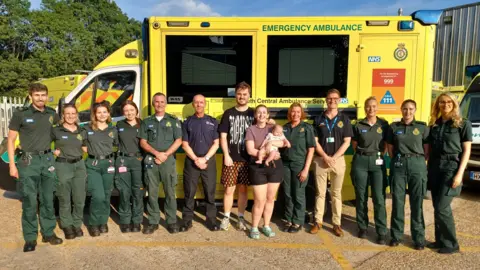
Both he and Emma are keen to see the South Central Ambulance Charity recognised - the charity that enabled Langford, an on-call volunteer doctor, to attend that night.
"I literally would be dead if it wasn't for them," Sam said. "Without all of them doing what they did that night, I wouldn't be here today."