Bride ran to find her groom after 1996 Manchester IRA bomb

 Chris Gleave
Warning: This article contains images that some may find distressing
All brides are nervous on their wedding day, aren't they?
Months of preparation come down to one day.
Many plan for every eventuality, but there are some things you just can't anticipate.
The unimaginable and unspeakable horror of being caught up in a huge bomb blast.
That's what happened to Mandy Hudson, who was heading into Manchester city centre on Saturday 15 June 1996 to get married.
On a sunny Mancunian day, England were due to play Scotland at Wembley in Euro 96, while Father's Day was just around the corner.
Every single one of the estimated 80,000 people in town that morning were about to be caught up in a day that changed Manchester forever.
The IRA bomb that exploded outside the Arndale Centre was the biggest device to be detonated in Great Britain since World War Two.
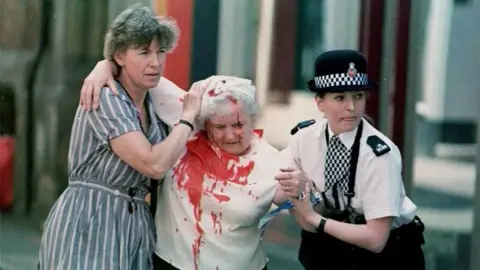
Miraculously, nobody died in the blast but more than 200 were hurt, with many suffering life-changing injuries.
 PA Media
I moved to Manchester just over six years ago, and I've been presenting on BBC Radio Manchester since the end of 2023.
Much to the annoyance of my family back home in South Yorkshire, I call myself an "adopted" Mancunian.
I've fallen in love with this city: the people, the gigs, the skyline, the intense football rivalries, the coffee spots, even the marathon eventually pulled me in to have a go earlier this year...
But there was a huge part of the city's history that had somehow escaped me.
At least once a day, I walk past a red postbox on Corporation Street which sits by a striking skyway linking the Arndale to both Marks & Spencer and Selfridges.
On that postbox is a small plaque, which explains how it had survived the bomb three decades ago.
One day, as I stopped to post a letter, I read that plaque and froze.
It was hard to grasp that before I was born, this place had been left in ruin.
I instantly wanted to know what happened on that day, and to hear the stories of those who were caught up in the middle of the nightmare.
My apartment looks out across the River Irwell, and you can't miss the Arndale.
I was having beers on the balcony one Friday night with a friend and he was visibly shocked when I shared with him what had happened on that day in June 1996.
The more I spoke to other friends in their late 20s, I realised there was a generation of "adopted Mancunians" who'd moved here and were unaware of the history of our city.
And that's why for my series on BBC Sounds, "Coded Warning", I wanted to search through the BBC archive and bring the story of that day to a new audience.
At 09:20 BST, two men in hooded jackets drove a Ford cargo van into Manchester city centre.
They parked on double yellow lines on Corporation Street, next to Marks & Spencer, and then walked away.
Their van was packed with 3,300lb (about 1,500kg) of fertiliser-based explosives.
Exactly 23 minutes later, a man with an Irish accent phoned the switchboard at Granada TV studios in Manchester.
Gary Hall, a security guard, answered the phone and was told that a bomb would explode in one hour's time. The caller gave a recognised codeword.
It's worth pointing out that in 1996 people were well used to bomb hoaxes and threats from the IRA.
- You can listen to more episodes of Coded Warning on BBC Sounds here
For the the best part of 30 years, The Troubles had impacted daily life in many ways.
Once the Ford cargo van had been identified, a specialist bomb disposal unit deployed from Liverpool worked to defuse the device.
Meanwhile, a dozen police officers joined firefighters and security staff to evacuate an estimated 80,000 people who were in the city centre that day.
At 11:17 the bomb detonated.
More than 200 people were injured and I can't begin to imagine the emotional and physical scars carried by them.
 Manchester Evening News
In 2016, BBC Radio Manchester brought together many of the victims to mark the 20th anniversary of the bombing.
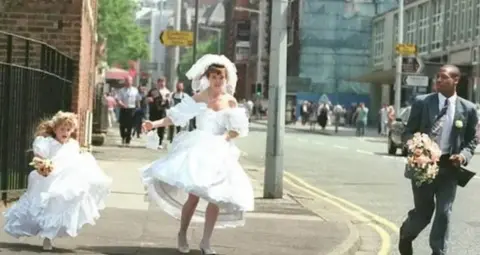
Bride-to-be Mandy recalled hearing a "massive bang" and her car "lifting off the ground" before she ran past the police cordons in search of her groom.
The image of her running through the streets of the city in a wedding dress is one of the defining images of that day.
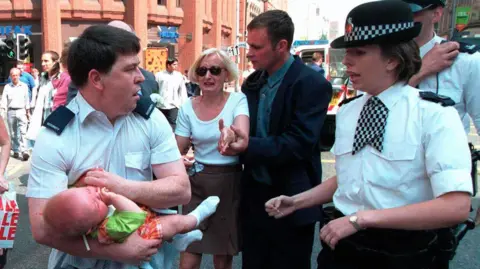
So too is the image of a visibly upset Lisa Hughes, whose seven-month-old son Sam is pictured being taken away by a security guard in the aftermath of the explosion.
Lisa told the BBC that her family was in "complete panic mode" and described the "double trauma" of her crying son then being taken away to safety by a police officer.
Listening to their accounts, the reality of what it must have been like to have been in Manchester that sunny morning really hit home.
Were I ever to be caught up in something like this, my instinct would be to FaceTime my parents or tell friends I was OK in a Whatsapp chat.
Back in 1996 though, technology was very different and people queued next to phone-boxes, inserting 10p and 20p coins to make brief calls to loved ones.
To this day, nobody from the IRA has been convicted of plotting, assisting or carrying out the bombing, which caused an estimated £700m of damage.
Plans to regenerate Manchester had already been in place - a tram network had been reintroduced, cultural venues were shaping up nicely and the city had already won the right to host the 2002 Commonwealth Games.
The bomb inevitably widened the scale and pace of that rebuilding.
Bev Craig, leader of Manchester City Council, said: "It is fair to say that it was a big driver for regeneration, and the city from the late 80s and early 90s was... struggling [and in] decline."
When you look at the part of Manchester targeted by the IRA that day, it's changed almost beyond recognition.
Craig said: "People from across the country and the world really look at Manchester city centre as a bit of a success story. You think about what it was and what it has become."
Only the red postbox on Corporation Street - standing tall in the rubble - survived the huge explosion.
It remains a symbol of Manchester's enduring resolve and strength in the face of terror.
Listen to the best of BBC Radio Manchester on Sounds and follow BBC Manchester on Facebook, X, and Instagram. You can also send story ideas via Whatsapp to 0808 100 2230.