Israel launches fresh strikes on Lebanon despite Trump criticism
Israeli forces have carried out new strikes in southern Lebanon, state media say, despite renewed criticism from US President Donald Trump of Israel's actions in the country.
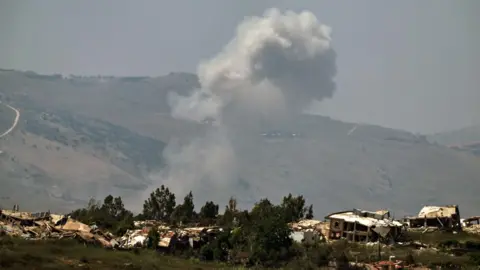
Israeli drone strikes injured several people in Mansouri and Aaziyyeh on Wednesday, while jets attacked Nabatieh al-Fawqa and Kfar Tebnit, Lebanon's National News Agency reported. Israel's military has not commented, but it did say five soldiers were injured in a drone attack in Lebanon by the Iran-backed armed group Hezbollah.
Mediator Pakistan has said the deal between the US and Iran to end the war includes Lebanon.
On Tuesday, Trump said Israel's prime minister needed "to be more responsible with respect to Lebanon".
Speaking at the G7 summit in France, he also said that Israel had been fighting Hezbollah for "too long and too many people are being killed".
Both Israel and Hezbollah have carried out attacks against each other since the US-Iran agreement was announced on Sunday night.
Earlier that day, an Israeli air strike on Beirut in response to a cross-border rocket attack by Hezbollah had put pressure on attempts to finalise the deal.
Trump told the G7 that he had a "great relationship" with Israeli Prime Minister Benjamin Netanyahu, but said he "didn't like that he did an attack... that was too much".
He added: "Without the United States, there would be no Israel. Without me, there would be no Israel because no other president was willing to do what I did."
Netanyahu said on Monday that Israeli forces would remain in Lebanon "for as long as necessary".
On Tuesday, after Lebanese media reported that four people had been killed in Israeli strikes, Iran's top military command warned Israel of a "harsh response" if it did not end its "malice" in southern Lebanon.
 EPA
EPALebanon was drawn into the war between Israel, the US and Iran on 2 March, when Hezbollah launched rockets into Israel in retaliation for a strike that killed Iran's supreme leader.
Israel responded by launching a bombing campaign across Lebanon and invading a significant part of the country's south.
More than 3,800 people have been killed in Lebanon during the conflict, according to the country's health ministry, whose figures do not differentiate between combatants and civilians.
Israeli authorities say 30 soldiers and four civilians have been killed on both sides of the border.
Hezbollah's leader, Naim Qassem, declared in a televised address on Wednesday that the US-Iran agreement was a "great victory" and urged Lebanon to "benefit from this pivotal point".
He also said Lebanon's negotiations with Israel should be limited to issues of "mutual security", and that its main demand should be the restoration of its sovereignty through the withdrawal of Israeli troops from occupied Lebanese territory.
Lebanese President Joseph Aoun, meanwhile, said his country was pursuing an "independent path" at its negotiations with Israel in Washington, but added that he was "in favour of a ceasefire and welcome the support of any country that helps us, including Iran".
The text of the US-Iran deal - referred to as a memorandum of understanding - has not been officially released.
Both sides were expected to sign the deal on Friday in the Swiss resort of Bürgenstock, Switzerland's Foreign Ministry told the Schweiz Heute newspaper.
Trump said he would likely hold a news conference to publicly read the agreement between the US and Iran "word by word".
He also said the deal meant Iran would "never have a nuclear weapon" and that the crucial Strait of Hormuz waterway in the Gulf would reopen and be "toll-free".
Trump has argued this deal would be better than the one Barack Obama negotiated when he was president.
"We didn't pay for it like Obama did. He paid billions of dollars," Trump said on Tuesday.
Under the 2015 Joint Comprehensive Plan of Action (JCPOA) with the US and five other world powers, Iran agreed to limit its nuclear activities and allow international inspections in return for sanctions relief and the release of frozen funds.