Midlands wildfire 999 calls were diverted to London

 EPA/Shutterstock
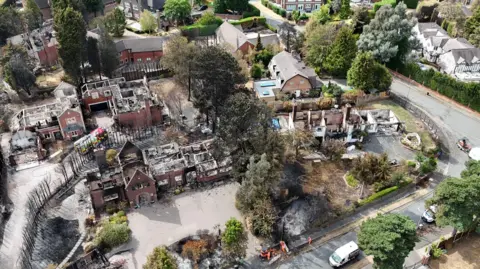
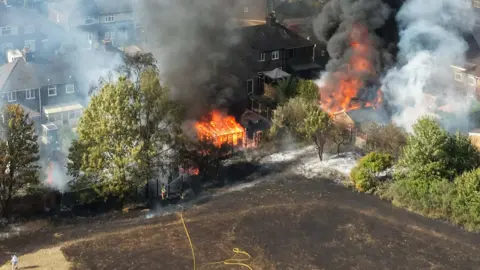
When Michael Morgan spotted flames tearing along a road in Stourbridge on the hottest day of the year, he stopped his car to ring 999.
He was shocked to find the call answered by people working for London Fire Brigade, some 100 miles away.
As thousands of people rang the West Midlands service to report lots of fires breaking out on 13 August - including the devastating Stourbridge wildfire - calls had to be diverted elsewhere.
In total, London Fire Brigade said it answered 754 calls in support of West Midlands Fire Service and Staffordshire Fire Service, as part of national arrangements.
The unprecedented demand on call handlers and firefighters, as well as the loss of dozens of homes, has led to calls for the government to make rapid improvements.
Martin Starkey, the regional chair for the Fire Brigades Union (FBU) for the West Midlands, said: "The fire and rescue service for many years now, since 2008, has faced a decline in firefighters [and] appliance availability.
"I would like to see more firefighters so that fire crews aren't stuck on incidents as long as they are at the minute, and investment in the equipment both that we wear and what we use to fight these fires.
"There should be more pre-planning involved on a national scale to assist fire and rescue services when they are stretched."
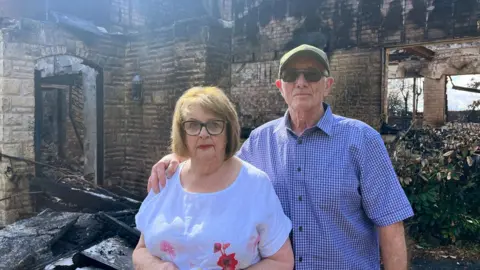
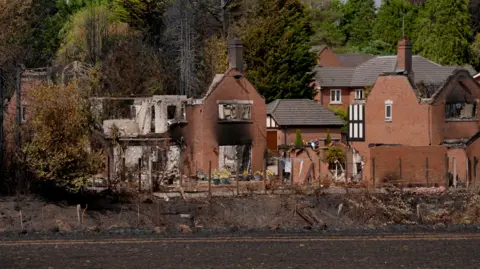
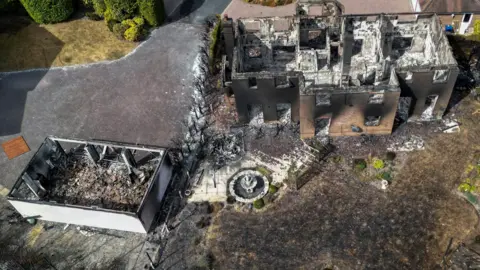
As well as the 19 homes that were lost in Stourbridge that day, about a dozen homes were lost in Birmingham, four in Stoke-on-Trent, three in Pershore, Worcestershire and three in Willenhall, near Wolverhampton.
The causes of most are still under investigation, although it was confirmed a barbecue started the one in Stoke on Trent, due to the tinder dry conditions across the drought-hit West Midlands.
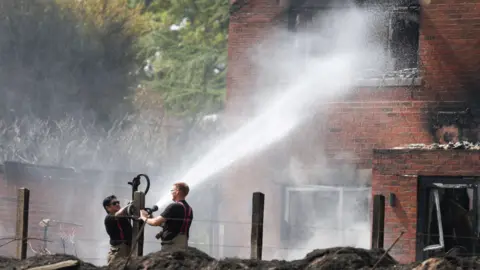
One firefighter in Stourbridge told the BBC he had never seen anything like it in his 23 years on the job, saying it was a miracle nobody had died.
"We have not stopped - no food, no rest, it's onto the next [fire]," he said.
Speaking in an open letter, West Midlands Fire Service's chief fire officer, Simon Tuhill, said the service had faced unprecedented demand and the events of the day would stay with him for a long time.
"For hours on end, our people responded to multiple major fires simultaneously," he said.
"I have heard countless accounts of the physical and emotional toll on our crews, control staff and many of our partners."
 PA Media
 Jordan Andrew Card
Starkey said he had been "gobsmacked" seeing the reports of numerous blazes across the region.
However he believed the government should have been better prepared because such fires have happened before.
"People have used the word unprecedented. I think it's unprecedented in the sense of it happened to many fire and rescue services at the same time," he told the BBC.
"But if we go back to 2022 and 2018, again we saw hot weather where fire and rescue services struggled."
On 19 July 2022, the London Fire Brigade fielded more than 2,400 calls, with 740 relating to wildfires, including a fire in Wennington which destroyed 16 homes.
A report later revealed that firefighter shortages meant 39 fire engines were not available to help tackle the wildfires that burnt across London that month.
For the blazes in the West Midlands this month, Starkey said such huge wildfires needing masses of resources led to a lack of fire engines being available for elsewhere and firefighters "being stuck" on incidents for long periods of time, affecting their service's abilities to respond to day-to-day incidents.
In Willenhall, resident Bob Musson said it took crews more than an hour and a half to arrive at the scene from him dialling 999, in which time the fire had spread rapidly and was approaching houses.
"We've seen that strain on resources many times before," Starkey said.
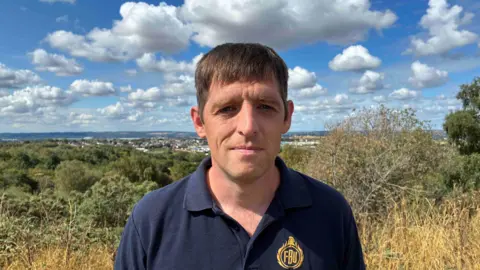
What Starkey wanted to see now was "investment from the government first and foremost".
The country's fire and rescue service was "stretched to breaking point", the FBU claimed, with climate change creating more extreme wildfires and severe weather, while "for over a decade, deep cuts have hollowed out the service".
Across the UK, there were 20% fewer firefighters employed in 2025 compared to 2010, according to figures provided by the union.
The drop is even higher in the West Midlands:
- West Midlands had a quarter fewer firefighters in 2025 than it did 15 years earlier
- Staffordshire Fire Service saw a drop of 27.2%
Saying firefighters in the region were exhausted, Starkey concluded: "I think firefighters just want a fighting chance when it comes to this and that means more firefighters, better equipment, better PPE (personal protective equipment)."
The BBC contacted the Ministry for Housing, Communities and Local Government for comment. The Staffordshire Police and Fire Commissioner did not wish to respond.
 Reuters/Temilade Adelaja
The prime minister visited Stourbridge the day after the fire which ravaged people's homes and gardens.
Speaking to reporters in the town, he brought up the fact that other countries have aerial resources for fires, adding that the government would commission firefighting planes in order to tackle future wildfires.
"That obviously wasn't available [in Stourbridge], but it will be available elsewhere, and it would have made a difference," Andy Burnham added.
However, Phil Garrigan, chair of the National Fire Chiefs Council, said UK fire services relied on the support of landowners to access local water sources.
That could change though as they look at "investment in firefighting capabilities", he said, and using aerial support "is something we are in extensive dialogue about".
On the same day, Burnham also appointed Baroness Blake as fire minister and the government temporarily banned disposable barbecues from being sold.
 Reuters
Follow BBC Birmingham on BBC Sounds, Facebook, X and Instagram.