McAllan stands by description of council failings in child abuse case as 'catastrophic'

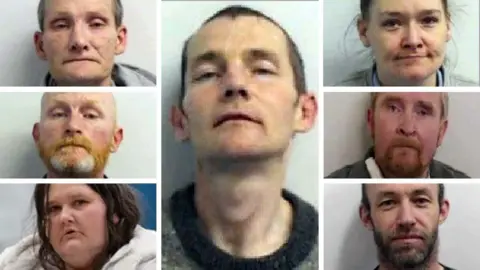 Police Scotland/Spindrift
The education secretary has stood by her description of failings in a major child abuse case as "catastrophic" after a local authority boss took issue with her choice of language.
The comment was made by Mairi McAllan in a letter she sent to Glasgow City Council chief executive Susanne Millar.
It came six days after a review found that social services failed to step in and protect three victims of a paedophile gang.
Missed red flags about their welfare included one child having 12 rotten teeth removed before the age of five.
A council spokesperson said the review did not conclude there were "catastrophic failures" but there was no intention to minimise the impact of the harrowing case.
Details of the letter exchange were first reported by the Scottish Sun newspaper following a Freedom of Information request.
 Getty Images
The review, commissioned by Glasgow's child protection committee, found the children also repeatedly missed medical appointments, were frequently in homeless accommodation and begged neighbours for food during their decade-long ordeal.
It followed the conviction in 2023 of seven people involved in the abuse at a property that became known as the "beastie house".
Between 2012 and 2019 Police Scotland said the children had suffered "unimaginable abuse", with the offences including rape, attempted murder and assault.
McAllan was appointed education, culture and Gaelic minister by First Minister John Swinney on 20 May - the same day the learning review was published.
On 26 May the Clydesdale MSP wrote to Millar to arrange a meeting to discuss the case.
McAllan said: "To say that I am deeply concerned about the neglect and abuse the children suffered and the catastrophic failure of the system which was supposed to protect them, is an understatement.
"I am sure you share my profound concern. I am keen to meet with you to discuss how we collectively ensure that such catastrophic failures can never be repeated."
The following day Millar responded and noted that the review was "of a very high quality, thoughtful, insightful and clear in its recommendations".
But she added: "At no point does the report conclude there were catastrophic failures in the systems designed to protect children and in my 38 years experience in public services, with 36 years in social work services, it is very important that leaders are consistent and accurate in their use of language in describing the outcome of learning reviews.
"I don't think it's it [sic] helpful or accurate to describe the conclusion of the review as identifying catastrophic failures in the system."
McAllan was asked about the fallout on Monday, as she launched a new initiative to provide every child with a bag of essential items for starting school
She told BBC Scotland News: "I stand by my categorisation of the family C case as a catastrophic failure.
"I don't think anybody could read that case review - as I did when I became education secretary - and conclude that it was anything other than a catastrophic failure.
"So the imperative now is that action is taken to learn every lesson and that no stone is left unturned in that case."
MacAllan said it was up to Millar to "account for" her comments and repeated that she stood by her categorisation of the case as a "catastrophic failure".
Asked if the council chief executive should clarify her language the minister replied: "I'll leave that to her."
A Glasgow City Council spokesperson said: "It is factually accurate to say that the learning review did not conclude there were catastrophic failures but this language was not in any way intended to minimise the distressing nature of this case.
"No-one with any awareness of this thinks it's anything other than one of the most shocking and difficult cases they've ever come across.
"If specific catastrophic failures had been found then those would be the obvious focus of our next steps.
"This case has been much more complex than that and the council, along with partners, is continuing to put in place an improvement plan which will be the subject of democratic scrutiny."
'The worst examples of human behaviour'
Three victims under the age of 13 were subjected to horrific sexual abuse and violence in the Glasgow drug den.
Iain Owens, 46; Elaine Lannery, 40; Lesley Williams, 43; Paul Brannan, 42; Scott Forbes, 51; Barry Watson, 48, and John Clark, 49, were found guilty.
In January last year they were jailed for between eight and 20 years and handed orders for lifelong restriction (OLRs), with a warning that they may never be released from prison.
Judge Lord Beckett told the gang, whose jail sentences totalled more than 93 years, that they may never be released from prison.
He said: "This court is used to hearing the worst examples of human behaviour but such depravity towards young children is beyond my experience."
The learning review was carried out by a panel of experts and supported by Prof Alexis Jay, known for her work on a grooming gangs report in England.
Experts reviewed written records and files regarding the children - who went on to be abused by the group - and their interactions with social work and other agencies.
The findings highlighted a series of failings across more than a decade, including a four-month-old child being removed from the child protection register despite a health visitor warning of "significant" ongoing risks.
If you are affected by any of the issues raised in this story, support and advice is available via the BBC Action Line.