Andy Burnham would oppose second Scottish independence referendum

 PA Media
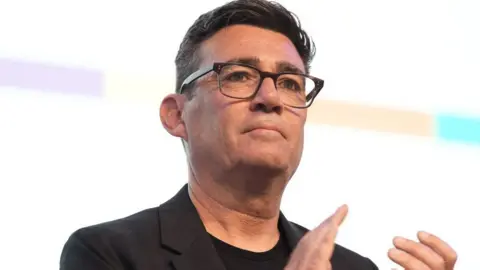
Andy Burnham has said he would not consider agreeing to a second referendum on Scottish independence.
The Labour MP, who is expected to succeed Sir Keir Starmer by the end of the month, confirmed his constitutional views in a meeting with Scottish Labour MPs, the BBC understands.
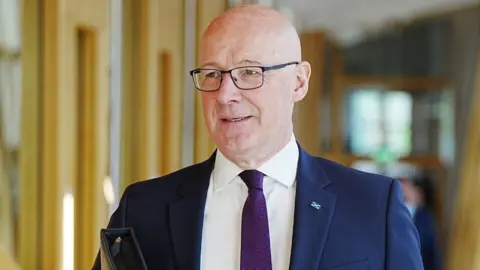
First Minister John Swinney is aiming to hold a referendum by 2028 after the SNP won a comfortable victory in May's Holyrood election.
However, any vote would need to be signed off by the UK government.
As first reported by The Mail On Sunday, Burnham told a meeting of Scottish Labour MPs last week that he would not consider granting Holyrood the powers it would need to hold a referendum.
It is understood that Burnham made his opposition to a vote clear after being asked for his views by a parliamentary colleague.
In the lead up to May's Holyrood election, Swinney urged Scots to elect an SNP majority - describing it as the best route to an independence referendum.
His party fell short of that target, but there is a pro-independence majority when Green MSPs are taken into account.
In one of its first acts of the new parliament, the Scottish government passed a motion calling on Labour ministers to grant a Section 30 order.
That mechanism would give Holyrood the power to hold a referendum, as happened ahead of the 2014 vote.
In response, a Downing Street spokesperson said that the UK government did not support Scottish independence or a referendum.
 PA Media
SNP MSP Alyn Smyth said he was waiting to hear Burnham speak publicly about his constitutional views, noting that the former mayor of Greater Manchester had promised to devolve power away from Westminster, as well as decentralising power in Scotland.
Smyth told BBC Radio Scotland Breakfast: "We're ready to work with them [the UK government] in terms of getting more powers to the Scottish Parliament."
He added: "But if we all believe in democracy then the best way to let the people choose about Scotland's future is a democratic agreed referendum."
On Sunday, Public Service Reform Secretary Ivan McKee claimed that Burnham's promises of devolution were "unravelling very quickly".
He told BBC Scotland's Sunday Show: "When he can't even devolve the power to the people of Scotland to decide on their constitutional future, and he's not even in office yet.
"So I think it's more of the same-old, same-old from the UK government."
'Let the people choose'
Green MSP Patrick Harvie noted that the Scottish Parliament currently had the largest pro-independence majority in its history.
He said: "If that's not a mandate, what is? It's a simple question and one that no Labour leader has been able to answer.
"Andy Burnham is perfectly entitled to argue against Scottish independence. What he shouldn't do is block the people of Scotland from having the choice."
Scottish Labour MSP Paul Sweeney, a supporter of Burnham, noted that support for the SNP dropped in May's election, when compared to 2021.
Support for independence has remained steady at about 50% in recent months.
However, Sweeney described independence as a "minority pursuit", arguing that Scots wanted "fundamental, tangible improvements to their daily lives".
He added: "And the indulgent debate about breaking up the UK isn't really featuring high on the agenda right now."
The MSP called for a "mature debate" about the UK constitution instead of "being reduced to this absurd binary where we're constantly replaying this forever war of 2014".