More domestic abuse help for 999 control rooms

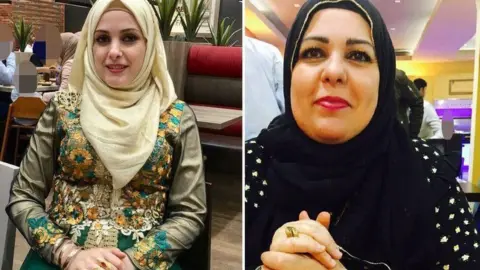 Family
The aunt of a woman murdered by an ex-partner has said she is "incredibly proud" that domestic abuse specialists will be embedded in 12 more 999 control rooms.
Nour Norris, whose niece Raneem Oudeh, 22, and sister Khaola Saleem, 49, were murdered by Oudeh's ex-partner in 2018, said the scheme "gives me hope that other families may be spared the heartbreak that ours live with every day".
The Home Office has pledged that, under Raneem's Law, domestic abuse specialists will be deployed across every police force in England and Wales by 2029.
An inquest found mistakes made by West Midlands Police had "materially contributed" to the women's deaths at the hands of Janbaz Tarin.
Tarin, who was 21 at the time of the attack on Northdown Road, Solihull, was jailed for life in December 2018 with a minimum term of 32 years.
On the night of the murders, Oudeh had called West Midlands Police four times to register concerns for her safety, and the force had previously responded to 10 domestic abuse incidents linked to the case.
Five officers were disciplined over the failures, which Oudeh's family described as "beyond imagination".
 Graham Hodson
The latest expansion of the scheme brings the total number of control rooms with specialists to 17, including Thames Valley, West Yorkshire, Essex, Merseyside and North Wales.
The experts' duties include giving advice to officers responding to incidents on the ground, reviewing incoming domestic abuse cases and their risk assessments, and listening in to live calls before giving feedback to call handlers.
They also train force control room staff on domestic abuse and support the use of technology, including responding to victims with a video call.
'A legacy built on love'
Norris said her sister and niece should have been heard, understood and protected when they called police for help.
"Instead, our family lost two beautiful lives in circumstances that should never have happened," she said.
"Every step forward for Raneem's Law is deeply emotional for me because it comes from unimaginable pain and loss.
"Knowing that 12 more police forces will have domestic abuse specialists in their 999 control rooms gives me hope that other families may be spared the heartbreak that ours live with every day."
Norris said that Raneem's Law was more than a policy, adding: "It is a legacy built on love for my sister and niece and on the determination that their voices, and the voices of all victims of domestic abuse, are never ignored again.
"I am incredibly proud to see this expansion and remain committed to ensuring that every victim who reaches out for help is met with understanding, expertise and, most importantly, protection."
Natalie Fleet, minister for safeguarding and violence against women and girls, said: "Last year, one in eight women experienced domestic abuse, sexual assault, or stalking. No society that tolerates this level of violence can claim to be safe for women.
"That's why we are rolling out the pioneering Raneem's Law to another 12 police forces in England and Wales, because every victim – no matter where they live – should be able to rely on a system that truly supports them.
"But we will not stop there. We will deploy the full power of the state to make this country safe for women and girls."
Follow BBC Birmingham on BBC Sounds, Facebook, X and Instagram.