Heatwave reducing milk production, says farmer

 BBC
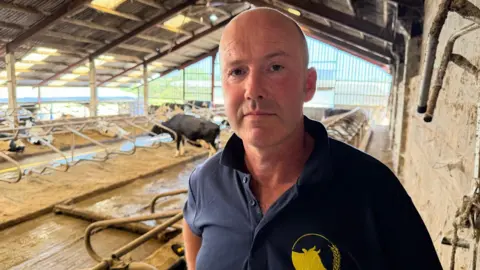
BBCA Warwickshire farmer says this summer's hot weather has reduced milk production, creating further challenges for the farming industry.
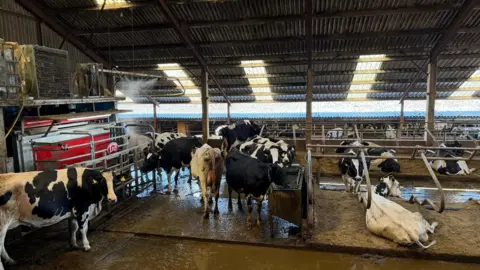
Charles Goadby, who runs Manor Farm near Nuneaton, told the BBC Politics Midlands programme the recent heatwave had affected both his dairy herd and arable crops.
He said yields from cows that would normally produce about 40 litres of milk a day had fallen to 32 litres during the hottest weather.
Calling for government support, he said farmers were losing money while production faltered as they were unable to change milk's market price. The government said it was backing dairy farmers and had worked to improve fairness across the supply chain.
Production had since recovered, Goadby said, to about 35 litres a day, but remained below normal levels.
"Farmers [are] paid on a set price," he stated, "and we have no say in that. We're price takers, not price makers, so we're just we're losing money.
"When we're having drops in production, this heat is hitting us in the pocket hard."
The hot, dry conditions have also affected arable farming, with crops drying out more quickly than usual.
Goadby said some harvesting had taken place overnight to help retain moisture and avoid the hottest part of the day.
He added that while farmers were used to dealing with changing conditions and would continue to adapt, the industry needed long-term support.
"Farmers are very good at adapting to change, it's what we've done for generations. But without the support and without the fairness and the returns to enable us to do that, it's going to be hard.
"We're up for the challenge. We just need the backing from government.
"We need some more support, not necessarily in terms of handouts, but in terms of fairness within the supply chain.
"Allow farming to be long-term sustainable, allow farmers to make a profit to reinvest, and ensure that we've got a good food supply here in the UK."
A DEFRA spokesperson said: "This government is backing our hard-working dairy farmers with new regulations put in place last year to improve fairness and transparency across the supply chain so that businesses can flourish.
"Most supermarkets have direct supply contracts with farmers to ensure more stable farm incomes and the price paid to them has not fallen in the past year.
"If farmers feel that their contracts are not compliant, they should contact the Agricultural Supply Chain Adjudicator."
Follow BBC Coventry & Warwickshire on BBC Sounds, Facebook, X and Instagram.