'I lost so much blood giving birth I can't work as a nurse any more'

 Martin Giles/BBC
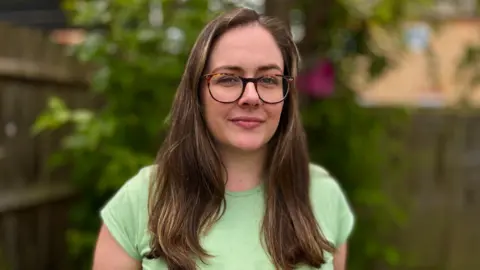
Two years ago, Erin Cooper was 26 weeks pregnant and packing to go on holiday when she started bleeding.
"I was terrified. In the back of my mind, I thought my baby was dead," she says.
The intensive care nurse, from Bedfordshire, held an ambulance technician's hand the entire way to hospital and begged him to save her life.
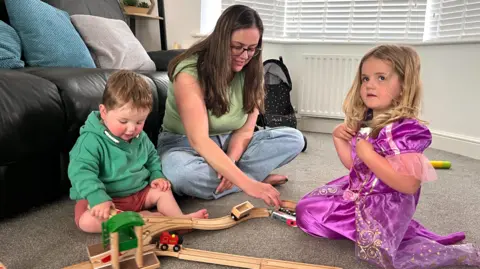
"I said 'Please don't let me die, I've got two older children that I need to be home for.'"
 Martin Giles/BBC
Doctors managed to stem the bleeding but failed to investigate its cause and she suffered multiple bleeds until she gave birth.
Her son Milo was born by an emergency C-section while Erin was under general anaesthetic, after a huge bleed broke her waters at 34 weeks.
Erin had a "catastrophic" haemorrhage and needed 13 blood transfusions.
Doctors later realised the 35-year-old had Placenta Accreta Spectrum (PAS), which occurs when the placenta attaches too deeply to the wall of the womb.
"When I woke up, I had a piece of paper in my hands. I couldn't talk. And I wrote the word 'hysterectomy'. And they said, 'Yes, we had to do hysterectomy'. I knew at that point, things had gone really wrong."
PAS was previously thought to be a rare pregnancy condition, but the NHS says numbers are rising, potentially linked to the increasing number of C-sections.
There is no single national dataset tracking PAS specifically, however, although NHS estimates range from one instance per 300 to one per 2,000 pregnancies.
'Women are losing their lives'
Erin is one of more than 100 mothers who have joined forces to raise awareness of the condition and what they call "a dangerous gap in maternity care", with little specialist training and no national database or mandatory reporting of cases.
Some mothers have been left with permanent damage to their bladder and bowels, while one said her daughter suffered a neonatal stroke due to the condition, leaving her with cerebral palsy.
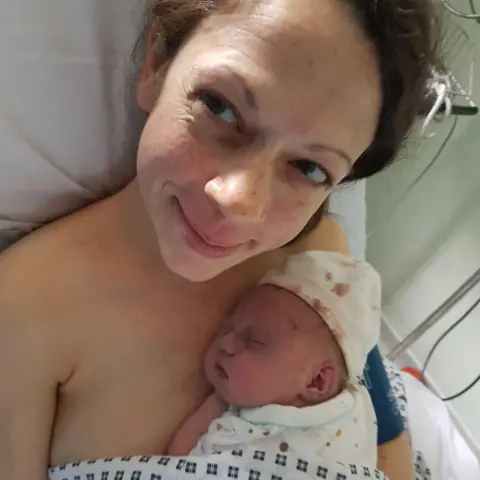
When Charlotte Dron gave birth to her second child Luca in 2018, there was so much blood that a nurse fainted and "midwives were shouting at each other".
The 42-year-old teacher, from Southend, was left traumatised following the emergency C-section, in which she lost three litres (five pints) of blood.
 Charlotte Dron
"I was frightened because no one was explaining what was going on," she says. "I wish I had been seen and heard before my emergency became life-changing."
Charlotte was diagnosed with PAS and needed counselling after replaying the haemorrhage "over and over" in her mind.
She desperately wanted a third child but had two miscarriages before a consultant told her that having another child would "more than likely end in death".
"It was hard-hitting, but I needed someone to say that," she says.
 BBC/Martin Giles
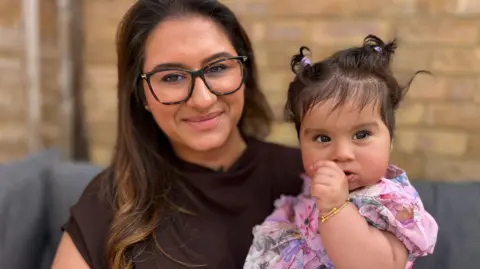
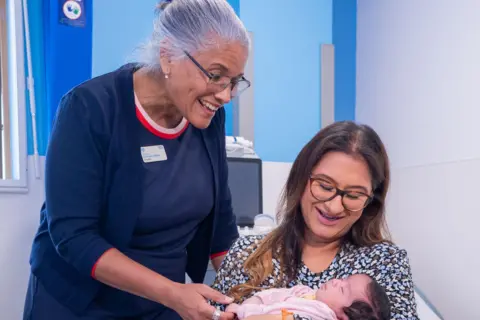
Amisha Adhia started the campaign group Action for Accreta earlier this year after suffering from PAS during her pregnancy.
The 37-year-old suspected she had the condition and pushed for answers from five specialist hospitals before consultant obstetrician Dr Chineze Otigbah diagnosed her, meaning her baby girl Ishaani was delivered safely.
The Royal College of Obstetricians and Gynaecologists has committed to changing the guidelines around the condition as a result of her campaign, but Amisha believes more needs to be done.
"I thought I was the only one who was going through this, but actually there are hundreds of women still out there that need help and support," she says.
"If it was any other condition, the world would be in uproar about it. Women and babies are losing their lives."
 Amisha Adhia
What is Placenta Accreta Spectrum (PAS)?
- PAS occurs when the placenta attaches too deeply into the wall of the womb
- When doctors try to remove it after birth, a woman can haemorrhage within minutes
- Pregnant women are at much greater risk of developing it if they have already given birth by C-section or had IVF treatment
- Action for Accreta says 61% of mothers who develop PAS were undiagnosed before delivery and 64% go on to require major emergency surgery, with 30% resulting in emergency hysterectomies
Every maternity unit should be able to screen for PAS and refer to one of several specialist centres, according to Dr Otigbah.
She has been studying the condition for 20 years and has seen it increase in line with C-sections.
"We have the perfect storm of a condition that was previously thought to be very rare all of a sudden becoming extremely common," she says.
"Because of that, it is almost like we've been caught on the hop; we're unprepared."
Several women have died from blood loss and many have been left with severe trauma, she adds.
- Details of help and support with infertility are available at BBC Action Line
Erin is learning to live with the trauma of what happened to her but says she thinks about the fact she can no longer have children every day.
She loved being a nurse who worked in intensive care and in operating theatres, but has had to change career, saying she trusted the NHS "with everything" but now feels her employer has let her down.
Though she is grateful that she and her son survived, she feels angry that her condition was not diagnosed while she was pregnant, which would have put her at far less risk of a haemorrhage.
"I live with PTSD around blood. I can no longer work in a patient-facing role. I panic when I hear sirens," she says.
"I can't drive past the hospital without feeling like I'm about to have a panic attack. I feel a deep loss of my womanhood."
The campaign group has referred the care of the condition to the NHS safety organisation, the Health Services Safety Investigations Body (HSSIB), which confirmed it was assessing the evidence as to whether a national investigation was needed.
A spokesperson for NHS England in the East said: "We agree it is likely that the prevalence of Placenta Accreta Spectrum (PAS) is increasing with the increase in national caesarean section rate.
"NHS England is therefore in the process of reviewing the specification for this specialised commissioned service to improve national data collection and access."
Do you have a story suggestion for Beds, Herts or Bucks? Contact us below.
Follow Beds, Herts and Bucks news on BBC Sounds, Facebook, Instagram and X.