'I've never been this good' – revolutionary immune reset puts lupus in remission

 BBC
BBCAn experimental treatment that resets a malfunctioning immune system has put the disease lupus into remission in early UK trials.
Experts say the approach could potentially treat similar disorders including multiple sclerosis and rheumatoid arthritis.
One of the first patients, Katie Tinkler, said she had "never been this good" since being diagnosed 30 years ago.
She once struggled to walk with her children, but can now ski and is off all lupus medication. The disease, which affects around 50,000 in the UK, sees the immune system attack the body.
Women make up 90% of people with lupus in the UK and tend to be diagnosed as young adults.
When the immune system attacks the body, it causes joint pain, skin conditions and damage to organs including the kidneys.
Katie was diagnosed in 1993 when she was 20. She refused to let the condition take over her life and even worked as a fitness instructor, but always had a packet of steroids tucked away in case of a flare up.

When I met her in her kitchen in Surrey, glitterball dangling from the ceiling, she told me flare ups in her hands left her struggling to lift a cup of tea and she would need to take drugs 45 minutes before getting out of bed in the morning, otherwise it would be too painful.
The disease became much more aggressive in the past decade, which has been "pretty horrendous" and Katie needed long spells in hospital. Her lupus was damaging her heart, lungs and kidneys, leaving her on the cusp of needing dialysis.
"Lupus at its worst was in bed, unable to move, going downhill rapidly, possibly dying…now I'm living," she told me.
But speaking to Katie, a year-and-a-half after her experimental treatment, she has the energy and zest for life of a woman reborn.
"It's amazing. I'm living like a normal person, I'm literally saying yes to anything. I sort of forgot that you could feel this good," she said.
The difference is an experimental treatment Katie had to reset her immune system at University College London Hospitals.
It works by engineering a civil war within the immune system – to get one part to destroy the part causing disease.
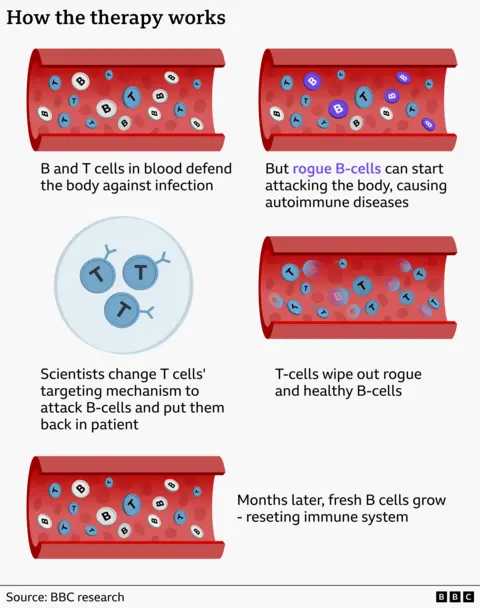
Two types of white blood cells are involved - the B cells and T cells which normally protect the body from infection.
But in lupus, and other autoimmune diseases, the B cells go rogue and produce antibodies that can attack the body.
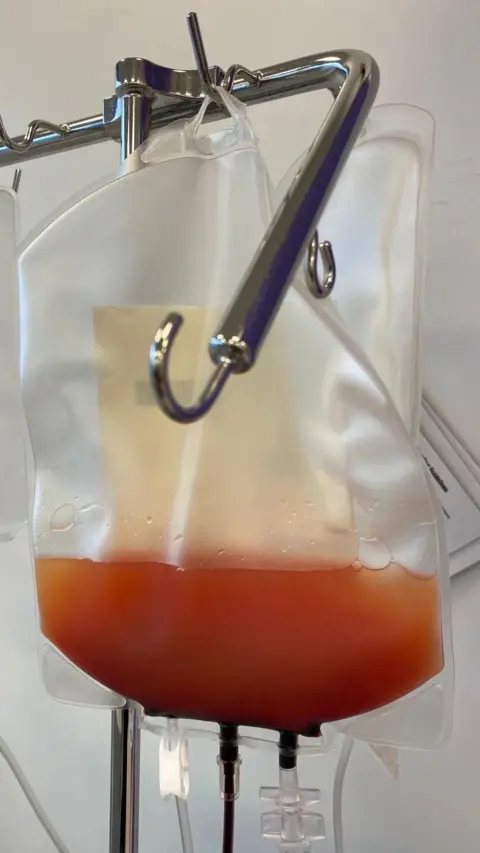
So scientists took millions of Katie's own T cells and genetically modified them in the laboratory. Their targeting mechanism was changed so now they attack B cells and these are put back in the body.
Once inside, the T-cells destroy both the rogue and healthy B cells. But months later new healthy B cells grow – effectively resetting the immune system.
 Katie Tinkler
There were no guarantees it would work and Katie remembers a letter to her GP explaining "she knows she might die" because of the risks involved.
And it was a gruelling processes that also involved chemotherapy to prevent the modified T-cells being rejected.
But Katie had the treatment in November 2024 and is still well, no longer needs medication for her lupus and her organs have recovered.
"I can live to an old lady with these kidneys and that is phenomenal. My heart's much better, my lungs much better. My blood disorder is no longer there," she said.
 Katie Tinkler
Out of the first six patients treated, five are still in remission. One has improved symptoms, but had a lupus flare after 11 months.
The team, presenting data at the EULAR European Congress of Rheumatology, said their patients were still well after more than 18 months.
However, it is still uncertain how long the treatment will last before the lupus returns and how successful it will be when trialled in more patients.
Dr Maria Leandro, a consultant rheumatologist at UCLH, told BBC News: "If we were to have patients in remission for three-to-five years consistently, that would be a major gain in lupus, it may be longer than that, but we'll have to wait and see.
"This is clearly a significant step forward towards a possible cure, so it is very exciting."
This approach – known as CAR-T or chimeric antigen receptor T-cells – is already an approved treatment in blood cancers including some leukaemias and lymphomas.
This is some of the earliest data suggesting the approach can also be used in autoimmune disease.
Many of these diseases work in a similar way to lupus. It means there is the potential for CAR-T therapy to be used more widely to target errant B cells.
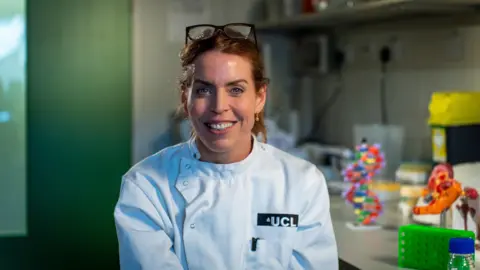
Dr Claire Roddie, from UCL, told BBC News: "We're really excited about the potential of CAR-T cell therapy for autoimmune diseases.
"Multiple sclerosis would be one condition, we've got a clinical study running right now, and rheumatoid arthritis, for instance, huge number of patients affected by this disorder... huge potential."
Katie does not know how long the treatment will last, but she is taking every opportunity she can.
"I want to climb mountains, I'd love to do Kilimanjaro, I'd love to do a triathlon again, I just want to participate, and I want to say yes to as many things as I possibly can."
Additional reporting by Vicki Loader