Meta vs the nipple - the 'never-ending' censorship battle

 Vicky Martin Method
Social media bans are not anything new. Many of us will have seen examples of this in our timelines - friends announcing their return from "Facebook jail" or complaints about posts being removed for what appear to be strange reasons.
But there is another group of people who say they are frustrated by a "never-ending" battle with Facebook owner Meta - tattooists who provide restorative nipple tattoos for people who have undergone breast cancer treatment.
They say their work is often mistakenly flagged as nudity or pornography, which can result in their content or social media accounts being permanently removed.
The wider censoring of clinical images and medical terminology relating to women's bodies on social media was raised in Parliament on 21 May, in a debate secured by Emily Darlington, MP for Milton Keynes Central.
The Labour member told the debate: "Shadow banning is the term for when users can still technically post but their visibility is secretly throttled.
"Their posts stop appearing in feeds, their reach collapses, their engagement disappears and their followers cannot find them. In the examples I have seen, the user is never clearly informed about it.
"That is censorship without accountability, which is harming education, charities and businesses, reinforcing stigma and, in some cases, putting women's lives at risk. We need to call that what it is: algorithmic sexism."
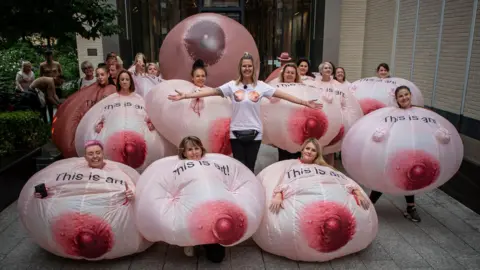
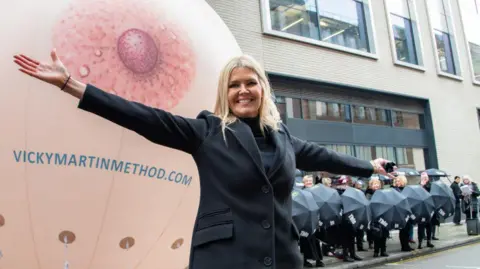
The problem facing medical tattooists has been widely reported in news outlets for more than a decade at least, and has seen protests - including one featuring a 20ft (6m) inflatable breast - take place outside the London headquarters of Meta, which also owns Instagram.
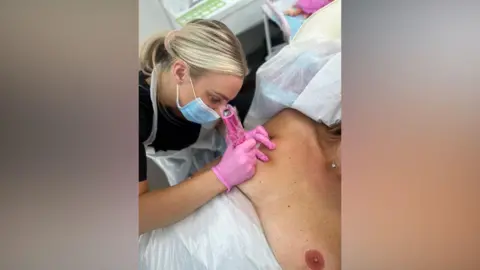
"We're trying to give something back to someone who's lost something, to help them feel whole again," said Emma Roberts, a former nurse who now offers free nipple tattoos to breast cancer survivors.
"It's like that's being stripped away from them, just from not being able to post about the service I provide. It's not nudity, it's a tattoo."
 Emma Roberts
But Emma, from Littleover in Derby, said Meta had "repeatedly" mistaken her work for nudity.
The 32-year-old qualified as a nurse in 2011 but, inspired by a woman who had lost eyelashes, eyebrows, hair and her breasts after cancer treatment, became a full-time tattooist in March 2025.
She began sharing her work on social media, but said she had to create multiple Facebook and Instagram pages due to her content being flagged and, in some cases, her accounts being permanently removed.
"Words like 'boob', 'areola', 'mastectomy' or 'breast' are instantly flagged, and images can be taken down," Emma said.
"This stops people benefiting from a free service."
Emma, who now relies on word of mouth rather than social media, said she had also been shadow banned by Meta.
 Vicky Martin Method
Vicky Martin, a medical tattooist from Reading, has faced restrictions and shadow bans on Facebook since 2016.
"I would get told that my pictures were taken down because they were classed as pornographic," she said.
Vicky, who has been a medical tattooist for 25 years, told the BBC she had lodged appeals but did "not hear anything" back, leaving her with restricted Facebook use.
"The worst part was that no-one was told I was blocked, so when women reached out to me, I couldn't reply," the 52-year-old said.
"I feel it's my duty to share on social media what's possible, because every woman deserves to look complete and feel stronger for the journey they are on."
She decided to start posting on Instagram instead, but she found herself facing the same problems and said it was "just like banging your head against the brick wall".
Frustration pushed Vicky to organise a protest outside Meta's London headquarters on 15 November 2019, where she was joined by other tattooists, surgeons, mastectomy groups and breast cancer survivors.
"I needed to do something to get a response," she said. "I wasn't just going to sit there and not allow the world to see how complete someone can look again after something terrible like breast cancer."
Vicky, who spent £3,500 on a large inflatable breast to take to the protest, said she did not get to speak to anyone but it had "put pressure" on Meta.
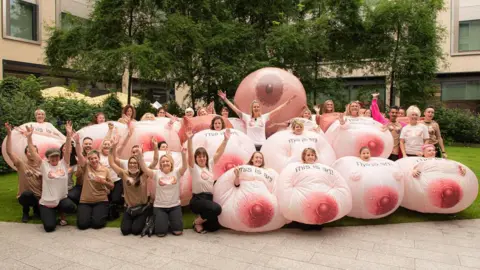
Vicky continued to experience the same issues and returned for a second protest outside Meta's headquarters on 1 September 2021.
This time, she was joined by protesters wearing inflatable breasts.
"We actually linked arms and stood in front of the door," Vicky said.
The second protest resulted in a meeting between Vicky and Meta, which she said had taken place online.
During that meeting, she created a list of accounts that had experienced bans and restrictions over content relating to nipple tattoos or breast cancer.
Vicky said Meta had told her the list would help prevent future bans and provided guidance on how to format posts to avoid them being flagged.
That advice, she told the BBC, was to clearly label posts with "post mastectomy", for users to state their medical role on their profiles and to clearly state in captions that the content relates to either "breast cancer or post mastectomy" work.
Vicky said accounts started to be unblocked, but she "wanted permanent change" and for those not on the list she gave to Meta, like new accounts, to make efforts to avoid being banned in the first place.
She feels progress has "stalled" and said she continued to hear from tattooists and breast cancer survivors who needed support.
"I'm banging my head against the brick wall again," she added. "It feels like we're on the back burner.
"It's just heartbreaking that people can't show off how good they look.
"If you say you're going to help us, then I think it's important to stick to your word."
Vicky recently sent the company another list of more than 70 flagged accounts belonging to surgeons, tattooists, and breast cancer survivors.
Meta told the BBC it had met members of the medical tattoo community, including Vicky, to "better understand these challenges and improve enforcement outcomes".
 Vicky Martin
Dr Carolina Are, a digital criminologist at the London School of Economics and Political Science, specialises in the shadow banning and deplatforming of nudity, sex work and sex‑positive users on social media.
She said nipples were a "hill that platforms decide to die on in terms of online safety".
"A nipple is not a marker for sexuality. It's not a marker for harm. It's a completely arbitrary decision," she added.
Carolina described the issue of shadow banning as "never-ending" and said: "It doesn't seem like platforms are making any strides or progress about their obsession with nipples."
She said Meta asking for lists of banned accounts to reinstate them was "a band-aid approach over a systemic issue".
Caroline added: "I think it's going to be unlikely to see any change, because nipple tattoos are a very good example of the nuance that is missing from content moderation."
'Women deserve equal access'
When approached by the BBC after the debate, the MP Emily Darlington said she was "shocked but unfortunately not surprised" by the struggles faced by medical tattooists.
She added: "We need platforms to work directly with groups like these medical tattoo artists who are doing such great work for breast cancer survivors, alongside clinicians, educators and trusts charities to make sure their content isn't censored.
"Women deserve equal access to medical information and support groups".
A spokesperson for Meta told the BBC the company "continues to work on improving" how it identifies and protects medical and health-related content.
They said: "Images showing post-mastectomy scarring and areola tattoos are allowed on Facebook and Instagram.
"We recognise the important role medical tattooists play in supporting breast cancer survivors, and we want this content on our platforms.
"Because these tattoos are often highly realistic, our systems may occasionally make mistakes enforcing our nudity policies.
"We understand how frustrating that can be, which is why we allow users to appeal these decisions and we continue to work on improving how we identify and protect medical and health-related content."
Listen to BBC Radio Derby on Sounds and follow BBC Derby on Facebook, on X, or on Instagram. Send your story ideas to eastmidsnews@bbc.co.uk or via WhatsApp on 0808 100 2210.