Stained glass rule change may impact women's jobs

 BBC/Cathy Killick
The oldest and largest stained glass studio in the UK says it will have to close or no longer employ women if the Health and Safety Executive (HSE) presses ahead with proposed new regulations.
The HSE is consulting on new limits to lead exposure in all employees who work with the metal.
For York Glaziers' Trust, which looks after the medieval glass in York Minster and countless other heritage buildings, the changes would be unworkable.
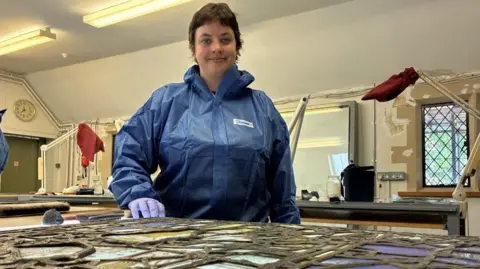
"The immediate impact for me would be that I'm out of a job," says Hannah Page who's worked as a conservator at the trust for two years.
Under current health and safety legislation, a level of 60 micrograms of lead per decilitre of blood triggers an immediate suspension of the employee working with lead.
The new level, after a two-year transition period, would be 15 micrograms per decilitre.
For pre-menopausal women, the current level of 30 micrograms per decilitre would reduce to 7.5. The levels differ because of the effect of lead on women's reproductive health.
 BBC/Cathy Killick
Hannah's lead blood level is currently 8 micrograms per decilitre – well within the legal range now – but not if the proposals become law.
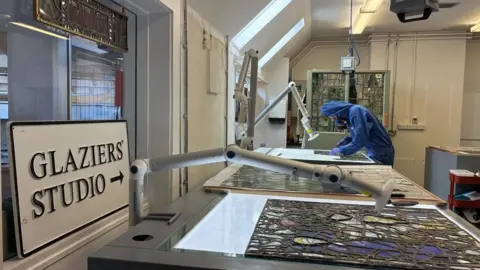
Conserving stained glass is impossible to do without contact with the lead that holds the fragile fragments of glass together.
The trust's conservators use all known precautions to limit their exposure.
They wear PPE and masks and use close up extractor fans to suck away any dust.
"Long term, I'm worried that these works of art will be potentially unprotected because the skilled workforce is no longer there to look after them," says Hannah.
Prof Alastair Hay is Emeritus Professor of Environmental Toxicology at the University of Leeds. He sits on the committee that advises the HSE about toxic substances.
He says new evidence has emerged over the last few years that points to a higher risk of heart attacks in both men and women exposed to lead.
But for women, there's another risk.
"For women in particular there's a risk that if they subsequently become pregnant it will end up in the bloodstream and some of that will affect the baby.
"And we know from unequivocal evidence that any lead in children affects their development, their IQ and their behaviour. So I think the HSE has to reduce the levels."
Hannah Page says she has never wanted children and feels her ability to make an informed choice about her work may be removed from her.
 BBC/Cathy Killick
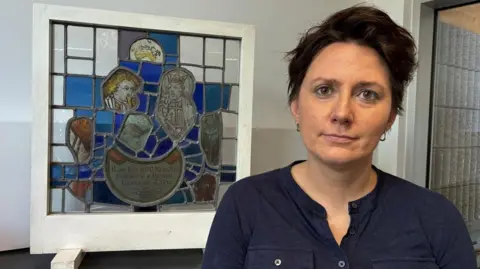
Her boss, Marie Groll agrees.
She's the director of York Glazier's Trust and has fed her concerns into the consultation process. "If you were a firefighter or in the armed forces, you would be able to understand your risks fully and still embark on that career," she says.
"If the new proposals came in, we don't believe that it would be viable anymore to employ women within our team."
It's a stark choice and an unintended consequence of proposals that conservators understand are well-intentioned.
A spokesperson for the HSE said: "The Control of Lead at Work Regulations have not been reviewed in over 20 years, and it is now known that health can be improved through lower levels of lead exposure.
"We recognise the strength of feeling among those working in our heritage and craft sectors about the proposed changes, which is why we have consulted with affected industries to make sure we fully understand their impact.
"We are continuing to engage with affected sectors and will carefully consider all responses before final recommendations are made."
Listen to highlights from North Yorkshire on BBC Sounds, catch up with the latest episode of Look North.